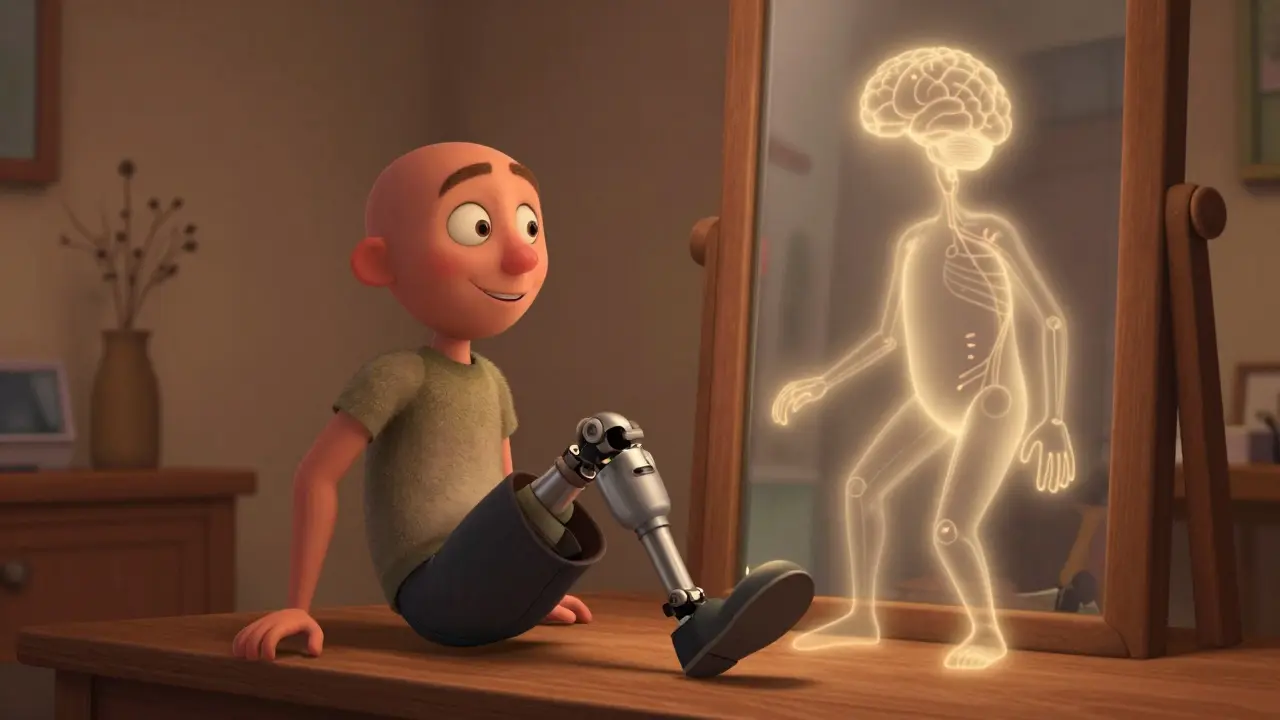
When someone loses a limb, their body doesn’t just lose a part-it keeps feeling it. That’s the reality of phantom limb pain (PLP), a condition where people feel pain in a limb that’s no longer there. It’s not in their head. It’s in their brain. And for 60% to 85% of amputees, it’s a daily struggle. This pain isn’t just a memory-it’s a neurological glitch. The nerves and brain regions that once controlled the missing limb keep firing signals, tricking the person into thinking the limb is still there-and hurting.
What Phantom Limb Pain Really Feels Like
People describe phantom limb pain in different ways: burning, electric shocks, cramping, or even the feeling of a clenched fist that won’t open. The pain usually starts within days or weeks after amputation, but it can show up months later. It’s often worst in the toes or fingers of the missing limb, even if the amputation was at the hip or shoulder. This isn’t stump pain-the pain at the cut site. This is deeper, stranger, and harder to treat. Research shows PLP isn’t psychological. Brain scans prove it. When someone feels phantom pain, areas of the brain that used to process signals from the missing limb light up. That’s not imagination. That’s real brain activity. And the longer the pain lasts, the more the brain rewires itself. After six months, the chance of it going away on its own is almost zero. That’s why early action matters.Why Medications Are the First Line of Defense
Most doctors start with medication because it’s fast, accessible, and backed by decades of use. The most common drugs fall into three categories: antidepressants, anticonvulsants, and NMDA blockers. Tricyclic antidepressants like amitriptyline and nortriptyline are the go-to. They’re not used for depression here-they work on nerve pain. A typical dose starts at 10 mg at night and slowly increases over weeks. About 45% of users report moderate relief, but side effects like drowsiness, dry mouth, and weight gain make some quit. Still, for many, it’s the only thing that helps. Anticonvulsants like gabapentin and pregabalin were originally made for seizures but turned out to calm overactive nerves. Gabapentin starts at 300 mg daily and can go up to 3,600 mg. Pregabalin works faster, at 75-600 mg daily. Reddit users report 72% found gabapentin helpful, but 58% stopped because of dizziness or brain fog. These drugs don’t cure PLP-they just turn down the volume on the pain signals. NMDA receptor blockers like ketamine are reserved for tough cases. Given as an IV infusion, ketamine can cut pain by 50% or more. But it’s not a daily pill. It’s a clinic visit, often with side effects like dizziness or hallucinations. Still, for people who’ve tried everything else, it’s a lifeline. Over-the-counter NSAIDs like ibuprofen or naproxen help some people, especially if there’s inflammation around the stump. But for true phantom pain? They rarely do more than take the edge off. Opioids like oxycodone or morphine are still used, but experts warn against them. The American Pain Society says to keep daily doses under 50 morphine milligram equivalents (MME) to avoid addiction. One in three long-term opioid users ends up dependent. That’s why they’re a last resort.Mirror Therapy: Seeing Is Believing
Mirror therapy is one of the most fascinating non-drug treatments. It was pioneered by neuroscientist V.S. Ramachandran in the 1990s. The idea? Trick the brain into thinking the missing limb is moving again. Here’s how it works: You sit in front of a mirror, with your intact limb on one side and the stump hidden behind the mirror. You move the good limb while watching its reflection. To your brain, it looks like the missing limb is moving too. Over time, this visual feedback helps the brain unlearn the pain signal. It sounds simple, but it takes discipline. You need to do it for 15-30 minutes every day. Studies show about 60% of people who stick with it see improvement. But 40% give up within eight weeks because it’s boring, awkward, or hard to set up. That’s why newer versions use virtual reality headsets now-making the illusion more immersive and engaging. A 2024 study in the Journal of Neurosurgery found that combining mirror therapy with virtual reality improved adherence by 30%. By 2027, experts predict over 85% of patients will use some form of VR-assisted mirror therapy. That’s a big jump from today’s 35% adoption rate.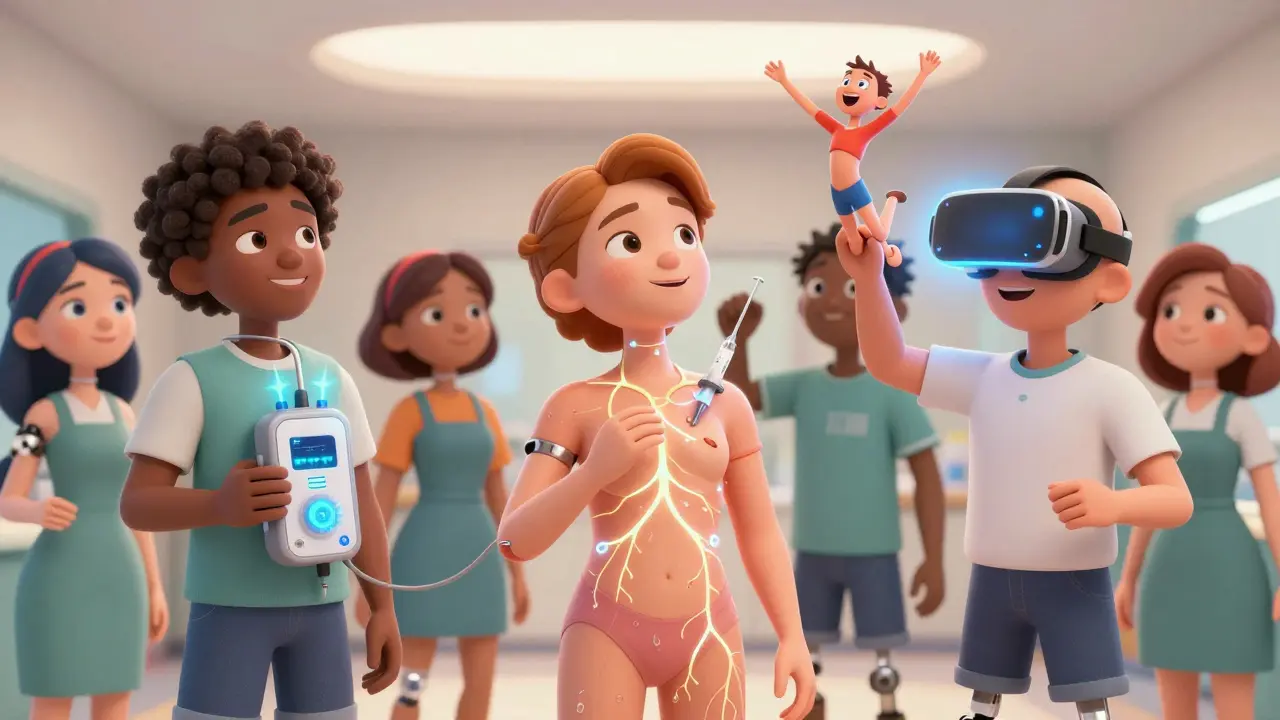
Other Non-Medication Options
Not everyone responds to pills or mirrors. That’s where other tools come in:- TENS (Transcutaneous Electrical Nerve Stimulation): Electrodes on the stump deliver tiny electrical pulses. About 30-50% of users get relief. It’s FDA-approved, non-invasive, and cheap. But you need to learn how to place the pads right-wrong placement, no help.
- Botulinum toxin (Botox) injections: Used for patients with painful neuromas (tangled nerves). One study showed pain dropping from 8/10 to 3/10 for 12 weeks after a few shots. It’s not permanent, but it buys time.
- Spinal cord stimulation: A device implanted near the spine sends pulses to block pain signals. FDA-approved in 2024, Saluda Medical’s Evoke system showed 65% average pain reduction in trials. It’s expensive and requires surgery, but for severe cases, it’s life-changing.
- Biofeedback: Teaches you to control your body’s responses-heart rate, muscle tension-using sensors. It’s not a magic fix, but 25-40% of patients report better control over flare-ups.
What Doesn’t Work-and What’s New
Some old ideas have been disproven. For example, giving epidural anesthesia during amputation was thought to prevent PLP. But recent studies show it doesn’t. Pain on the day of surgery? That’s a bigger red flag. People who had severe pain before or during surgery are far more likely to develop long-term phantom pain. New developments are promising. Targeted muscle reinnervation (TMR)-a surgery that reroutes nerves to muscles near the stump-is now being paired with osseointegration (a metal implant in the bone). In a 2024 trial, 70% of patients had major pain reduction. And new NMDA blockers are in Phase II trials, aiming for ketamine’s pain relief without the hallucinations.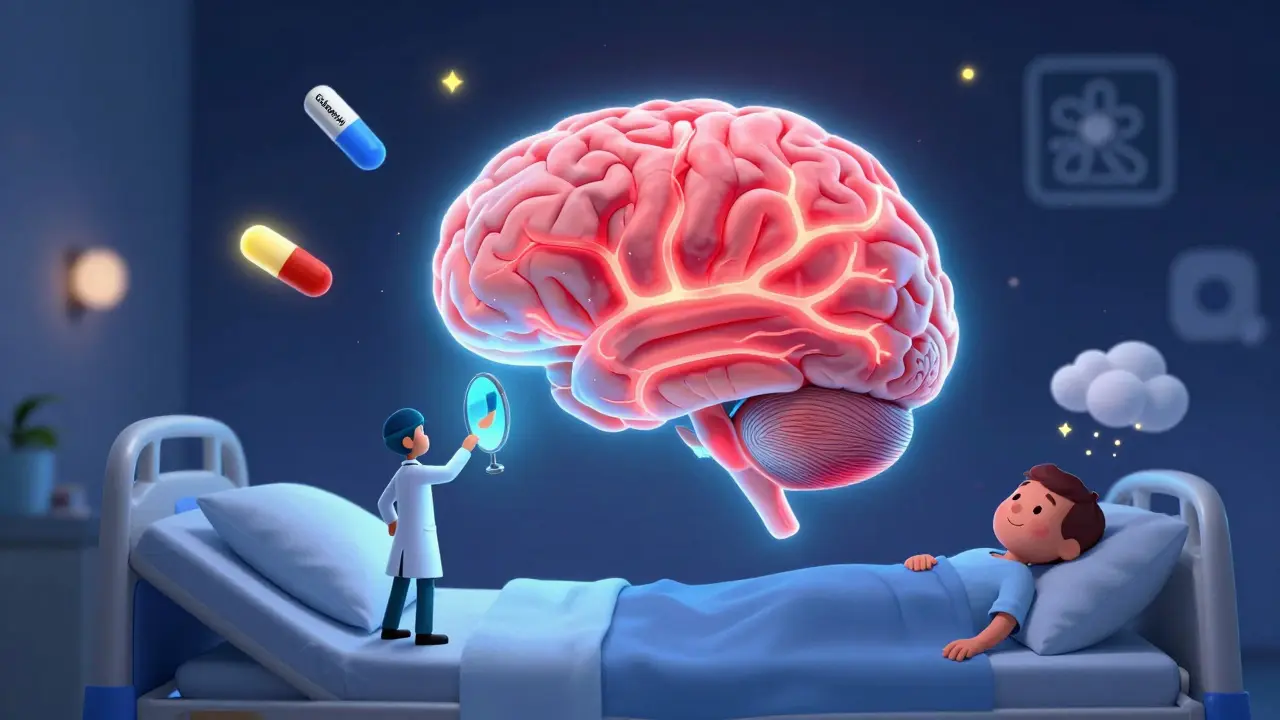
Choosing the Right Path
There’s no one-size-fits-all solution. Some people find relief with gabapentin alone. Others need Botox, mirror therapy, and TENS together. The key is starting early and trying combinations. Here’s a simple rule: If pain lasts more than six months, don’t wait. Talk to a pain specialist. Most major hospitals now have dedicated PLP clinics. The Amputee Coalition offers peer support for over 12,000 people annually. You’re not alone. And remember: Medications help manage symptoms. Mirror therapy and neuromodulation can change how your brain processes pain. The best outcomes come from mixing both.What to Do Next
If you or someone you know is dealing with phantom limb pain:- See a pain specialist within the first three months after amputation.
- Start with a low-dose tricyclic antidepressant or gabapentin.
- Try mirror therapy daily-even 10 minutes counts.
- Ask about TENS or Botox if pain is localized to the stump.
- Avoid opioids unless all else fails and you’re under close supervision.
- Join a support group. Sharing experiences helps more than you think.
Phantom limb pain isn’t going away. But with the right tools, it doesn’t have to control your life.
Is phantom limb pain real, or is it all in my head?
It’s real. Brain scans show clear activity in areas that once controlled the missing limb. This isn’t psychological-it’s neurological. The pain comes from rewiring in the spinal cord and brain after amputation.
How long does phantom limb pain last?
For most people, pain eases within six months. But if it lasts longer than that, it’s unlikely to disappear without treatment. Studies show the chance of spontaneous relief after six months is slim to none.
Can mirror therapy really help with phantom pain?
Yes. Mirror therapy helps retrain the brain by tricking it into seeing movement in the missing limb. About 60% of people who stick with daily sessions report reduced pain. New virtual reality versions are making it easier and more effective.
Are opioids safe for treating phantom limb pain?
Opioids like oxycodone or morphine can help in severe cases, but they carry high risks of dependence. Experts recommend limiting daily doses to under 50 morphine milligram equivalents (MME). They’re a last resort, not a first-line treatment.
What’s the most effective combination of treatments?
The best results come from combining medication with neuromodulation. For example, using gabapentin along with mirror therapy or TENS often works better than either alone. For severe cases, spinal cord stimulation plus physical therapy gives the highest long-term success rates.
Can I do mirror therapy at home?
Yes. All you need is a mirror and a quiet space. Place the mirror so the reflection of your intact limb looks like the missing one. Move it slowly for 15-30 minutes daily. Many people start with online guides or apps. Consistency matters more than perfection.
Why do weather changes make phantom pain worse?
Changes in barometric pressure can affect fluid pressure around nerves, especially in the stump. This can trigger signals that the brain misinterprets as pain in the missing limb. It’s not just a myth-many patients report this pattern.
Is there a cure for phantom limb pain?
There’s no cure yet, but there are effective ways to manage it. With early intervention, up to 40% of chronic cases could be reduced by 2030, according to the American Academy of Pain Medicine. The goal isn’t to erase the pain completely-it’s to make it manageable.



15 Comments
Hariom Sharma
This is such a needed post. I’ve been through this and mirror therapy changed my life. Started with just 10 minutes a day-felt silly at first, but now I can’t imagine not doing it. My phantom foot stopped feeling like it was in a vice grip. You don’t need fancy gear. Just a mirror and consistency. Seriously, try it for two weeks. You’ve got nothing to lose.
Nina Catherine
omg i just found this and i’m sobbing bc i didn’t know i was alone 😭 my dr said it was 'just in my head' but brain scans prove otherwise. gabapentin helped a little but mirror therapy? i tried it once and felt like a weirdo… but now i get it. gonna start again tomorrow. thank you for writing this ❤️
Jayanta Boruah
The assertion that phantom limb pain is purely neurological is an oversimplification. While fMRI data demonstrates cortical reorganization, it does not account for the somatosensory feedback loops involving the dorsal horn and thalamus. Furthermore, the efficacy of tricyclic antidepressants suggests a noradrenergic and serotonergic modulation component that cannot be reduced to mere 'brain activity.' The clinical literature is replete with evidence that pharmacological intervention must be paired with neuroplasticity-based rehabilitation, not merely observational mirroring. Mirror therapy, while intriguing, lacks longitudinal validation in randomized controlled trials beyond 12 weeks.
Taylor Mead
I’ve been on gabapentin for 8 months. It helps, but man… the brain fog is real. I forget my kid’s birthday once. Mirror therapy? I tried it. Felt like I was doing a weird dance in front of a mirror. But I stuck with it. Now I do it while watching Netflix. No more electric shocks. Just… quiet. Not cured. But manageable. That’s enough.
Amrit N
i just got my prosthetic last month and i’ve been doing mirror therapy every night. it’s kinda meditative? like… i move my good leg and watch the reflection like it’s magic. i don’t even feel the pain as much anymore. also, weather changes? yeah. rain = bad. i swear it. my stump gets all tingly. weird but true.
Robert Shiu
I’m a physical therapist who works with amputees. Let me tell you: the combo of gabapentin + mirror therapy + TENS is the holy trinity. I’ve seen people go from 8/10 pain to 2/10 in 6 weeks. But the biggest thing? Consistency. One guy did 5 minutes a day for 3 months and gave up. Then he came back after 6 months and did 30 minutes. Boom. Pain halved. It’s not about perfection. It’s about showing up.
Scott Dunne
This is why Ireland’s healthcare system is superior. We don’t waste time on mirror therapy. We give the patient a strong analgesic and move on. The British NHS has been doing this for decades. Why are we playing psychological games with mirrors? If the pain is real, treat it with real medicine. Not parlor tricks.
Ashley Paashuis
I appreciate the depth of this post. The mention of spinal cord stimulation in 2024 is particularly timely. I’ve been following the Evoke system trials-65% reduction is remarkable. However, I’m curious about long-term durability. Are there data beyond 24 months? Also, has there been any research on biomarkers that predict response to mirror therapy? I’d love to see a predictive model based on cortical mapping.
Marie Crick
OPIOIDS ARE A MISTAKE. I LOST MY LEG AND MY LIFE BECAUSE I TOOK OXYCODONE. DON’T DO IT. YOU THINK YOU’RE IN CONTROL. YOU’RE NOT. I’M 43 AND I’M ON METHADONE NOW. DON’T BE ME.
Liam Crean
I’ve tried everything. Gabapentin, TENS, Botox. Nothing stuck. Then I got a VR mirror setup. It was expensive, but worth it. The illusion is so real now-I can ‘see’ my foot move. It’s not magic, but it’s the closest thing. My pain dropped from constant to occasional. I still do it daily. It’s part of my routine now. Like brushing teeth.
John Cena
I’m not a doctor, but I’ve been living with PLP for 12 years. The key? Don’t wait. Start mirror therapy on day 30. Don’t wait for it to get worse. And find a community. I joined a Facebook group. 12,000 people? That’s a lifeline. We share tips, vent, and sometimes just say, 'I see you.' That matters more than you think.
Irish Council
they told you it was neurological but they never told you the real truth-pharmaceutical companies paid for the brain scans. mirror therapy works because it’s free. no profit. no patent. they don’t want you to know. ketamine? it’s a party drug. they’re just repackaging it. the truth? your nerves are screaming. and no pill will ever shut them up. only your mind can. and they don’t teach you that in med school
Freddy King
Let’s deconstruct this. The claim that '60% of mirror therapy users see improvement' is statistically misleading. Selection bias is rampant-those who persist are self-selected. The dropout rate of 40% in 8 weeks is the real metric. Also, 'neurological glitch' is a pop-sci euphemism. It’s maladaptive cortical reorganization. And gabapentin? It’s a calcium channel modulator, not a 'nerve calmer.' The language here is dangerously reductive. This isn’t education-it’s wellness content dressed as science.
Laura B
I’m from a rural area with no pain specialist. I made my own mirror box out of a cardboard box and a cheap mirror. Did it for 10 minutes every night while my kid napped. Took 3 months. But one day, I reached for my missing hand… and didn’t feel the burn. I cried. It’s not perfect. But I got my life back. You don’t need a clinic. You just need to start.
Robin bremer
i tried mirror therapy and it felt like i was watching myself in a horror movie 😅 but then i started doing it with my phone screen as a mirror (using the camera) and it was SO MUCH COOLER. now i do it with my headphones on and my favorite playlist. pain? gone. for now. 🤞❤️