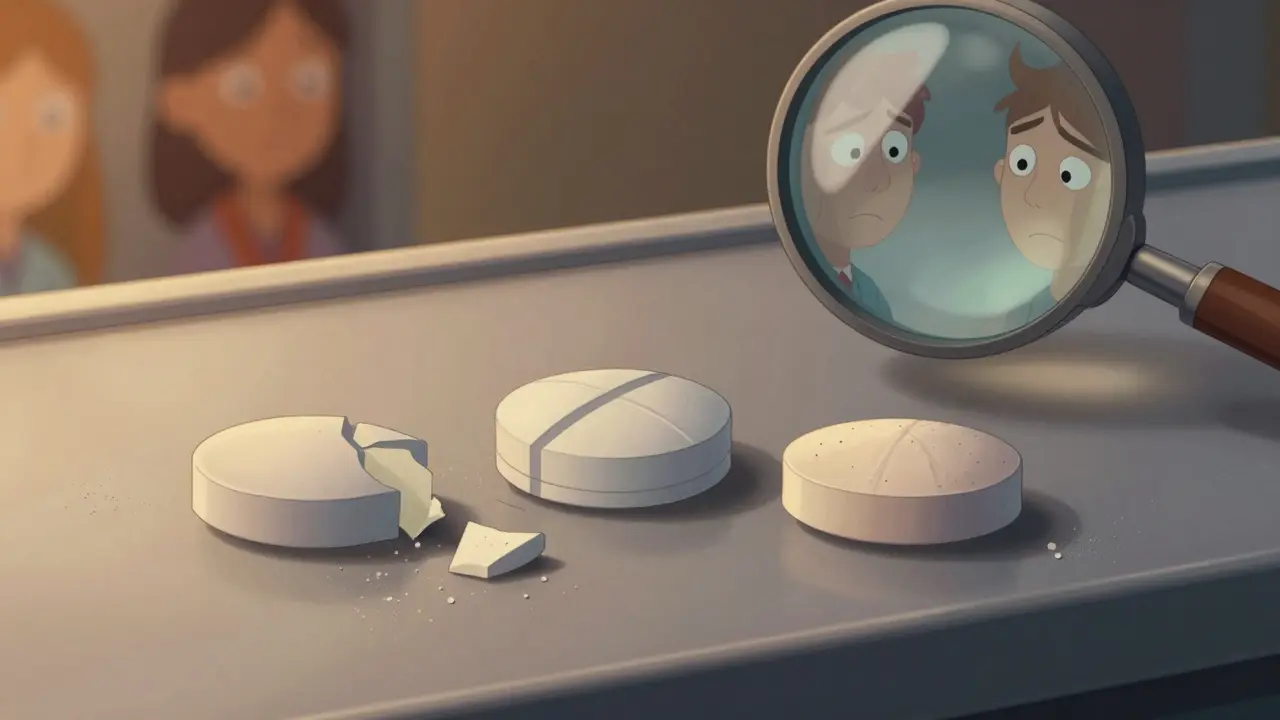
When you pick up a generic pill from the pharmacy, you expect it to work just like the brand-name version. But what if that pill is cracked, discolored, or contains the wrong amount of active ingredient? These aren’t rare mistakes-they’re common manufacturing defects that happen far more often in generic drugs than most people realize. And they’re not just cosmetic. They can directly affect your health.
What Are the Most Common Defects in Generic Pills?
Generic drugs are copies of brand-name medications, but they’re not always made the same way. The most frequent problems show up in tablet form: capping, lamination, sticking, and weight variation.
Capping happens when the top or bottom of a tablet splits off during handling or swallowing. It’s not just a visual issue-it means the dose inside might be uneven. This occurs when compression force exceeds 15 kN and moisture levels in the powder are below 2%, especially with hydrophobic ingredients. A single batch of metformin ER tablets was pulled in early 2024 after pharmacists reported patients receiving pills that crumbled in their hands.
Lamination is when layers inside the tablet separate. It often happens at high turret speeds-above 40 rotations per minute-with poor pre-compression. These split layers can cause the drug to release too fast or too slow, throwing off blood levels. Patients on thyroid medication like levothyroxine have reported inconsistent effects after switching between generic batches, with some noticing symptoms returning despite taking the same dose.
Sticking occurs when the drug material clings to the machine’s punch heads during compression. This is common with active ingredients that melt easily-those with melting points below 120°C-especially when moisture levels rise above 4% during long production runs. The result? Tablets come out with uneven surfaces, missing chunks, or inconsistent dosing.
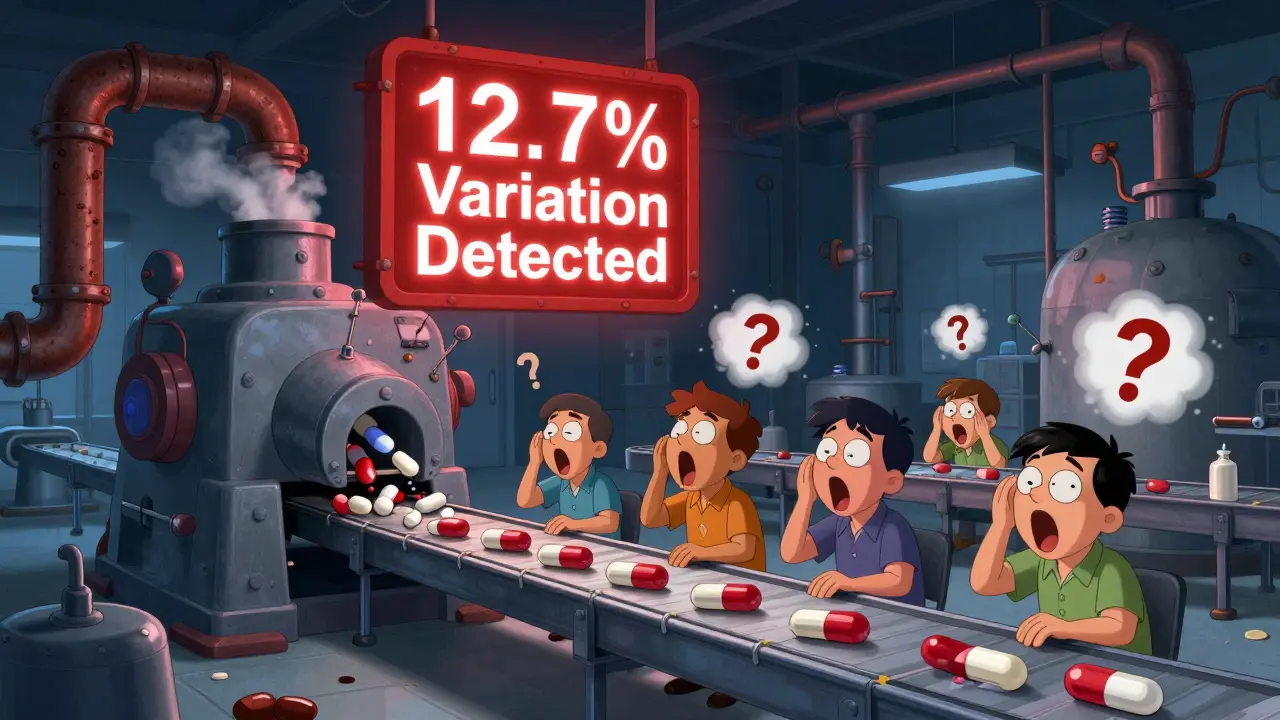
Weight variation is one of the most dangerous defects. The USP <905> standard allows no more than 5% deviation from target weight. But when granule flow rates drop below 0.5 g/s, batches can have up to 12.7% variation. That means one pill might have 10% too much drug, and another 10% too little. For drugs with narrow therapeutic windows-like warfarin or digoxin-this can be life-threatening.
Why Are Generic Drugs More Prone to These Problems?
Branded drug makers spend 15-18% of their production budget on quality control. Generic manufacturers average just 8-10%. Why? Because they’re under constant pressure to cut costs. The market for generics is huge-90% of U.S. prescriptions are filled with them-but they make up only 23% of total drug spending. That means every penny counts.
Many generic factories still use equipment from the 1980s or 90s. Modern tablet presses have real-time force monitoring and automated visual inspection systems that catch defects as small as 0.1 mm. But older machines don’t. Human inspectors, who used to catch 70% of flaws, now miss nearly a third because of speed demands and fatigue.
Another issue: shared production lines. One facility might make blood pressure pills in the morning and antibiotics in the afternoon. Cross-contamination risks rise, and cleaning protocols often get rushed. In 2023, the FDA issued 42% of its Warning Letters to generic manufacturers for quality defects-more than double the rate for branded companies.
Even the raw materials can be problematic. Some manufacturers source active pharmaceutical ingredients (APIs) from overseas suppliers with less rigorous oversight. A single batch of contaminated API can taint thousands of pills before anyone notices.
Who’s Affected-and How?
It’s not just patients who notice. Pharmacists are on the front lines.
A 2023 survey of 1,247 U.S. pharmacists found 68% had encountered quality issues with generics in the past year. Forty-two percent reported patients complaining about tablets that were discolored, cracked, or oddly shaped. Twenty-nine percent said patients experienced unexpected side effects or loss of symptom control after switching generics.
One pharmacist on Reddit described receiving a shipment of generic omeprazole where every tablet had a dark spot. Patients reported nausea and heartburn returning-despite taking the same dose. Another recounted a batch of generic amoxicillin that dissolved too quickly in water, leaving a gritty residue. The pharmacist had to throw out 200 bottles.
Patients report these issues to the FDA’s MedWatch system. In 2023 alone, 1,842 adverse event reports mentioned visible tablet defects-chipping, cracking, discoloration. Of those, 327 involved pills that looked visibly damaged. These aren’t isolated complaints. They’re signals of systemic problems.
Why Sterile Injectables Are Even Riskier
Oral tablets get most of the attention, but injectable generics are where things get truly dangerous.
Sterile injectables-like IV antibiotics, painkillers, or chemotherapy drugs-must be free of particles, microbes, and endotoxins. Even a tiny speck of glass or metal can cause a stroke or anaphylaxis. Yet, 8.7% of generic injectable batches fail quality checks, mostly due to particulate contamination.
Why? Because cleaning and sterilization processes are complex and expensive. Many generic makers cut corners by reducing autoclave cycles or skipping endotoxin testing. In 2022, a batch of generic vancomycin was recalled after patients developed fever and chills. Testing revealed bacterial endotoxins in the solution. The manufacturer had skipped a required test to save $12,000.
Unlike pills, you can’t see contamination in an IV bag. That’s why these defects are more likely to cause serious harm-and why they’re responsible for 78% of all drug shortages linked to quality failures between 2013 and 2017.
What’s Being Done to Fix This?
Change is happening-but slowly.
The FDA’s Emerging Technology Program has helped 47 generic manufacturers switch to continuous manufacturing. This process runs 24/7 with sensors monitoring every step. Defect rates drop by 65% compared to old batch methods. Sandoz and Dr. Reddy’s are using AI-powered cameras to scan pills at 600 per minute. These systems detect flaws with 92% accuracy-far better than human eyes.
Regulators are tightening rules. The 2024 Drug Supply Chain Security Act now requires track-and-trace for high-risk generics. Early results show a 22% drop in counterfeit-related quality issues.
But the biggest hurdle remains money. The Generic Pharmaceutical Association estimates it would take $28.7 billion to bring all U.S. generic facilities up to modern standards. Right now, the industry invests only $1.2 billion annually. That’s a gap of $27.5 billion.
Some manufacturers are succeeding. Teva’s batch rejection rate in 2023 was just 0.8%. Smaller companies averaged 3.2%. The difference? Investment in automation, training, and real-time monitoring.

What Can Patients and Providers Do?
You can’t control the factory-but you can take steps to protect yourself.
- Inspect your pills. If a generic looks different-cracked, discolored, oddly shaped-don’t take it. Ask the pharmacist to check the batch or swap it.
- Track your response. If you notice new side effects or reduced effectiveness after switching generics, tell your doctor. Keep a log of symptoms and pill appearance.
- Ask about the manufacturer. Not all generics are equal. Some brands consistently have lower defect rates. Your pharmacist can tell you which ones.
- Report issues. Use the FDA’s MedWatch system to report bad pills. One report won’t stop a batch-but thousands can force action.
Doctors and pharmacists should also push for formulary reviews that prioritize manufacturers with proven quality records. If a generic has a history of recalls or inspection failures, consider sticking with the brand-or choosing a different generic.
The Bottom Line
Generic drugs save billions every year. But savings shouldn’t come at the cost of safety. Manufacturing defects aren’t accidents-they’re the result of economic pressure, outdated equipment, and insufficient oversight.
The system is improving. New technology, better regulations, and smarter manufacturers are making progress. But until investment catches up with demand, patients will keep getting pills that don’t just look wrong-they might not work right.
If you’re on a generic medication and feel something’s off-trust your instincts. Your health is worth more than the cost of a pill.
Are generic drugs less effective than brand-name drugs?
Generally, yes-generic drugs are bioequivalent to brand-name versions and should work the same. But manufacturing defects like inconsistent dosing, contamination, or poor dissolution can make them less effective. Between 2015 and 2020, 7.3% of generic drug applications failed bioequivalence tests due to manufacturing inconsistencies, not formulation differences.
Can I tell if a generic pill has a manufacturing defect?
Yes, sometimes. Look for cracks, chips, unusual colors, uneven surfaces, or pills that crumble easily. Tablets that stick together or have a powdery coating may indicate moisture exposure or poor compression. If the pill looks different from previous batches, especially if you’ve noticed changes in how you feel, ask your pharmacist about the batch.
Why do some generic pills look different from others?
Different manufacturers use different inactive ingredients-fillers, dyes, binders-which can change color, shape, or size. That’s normal. But if the same generic from the same manufacturer suddenly looks different, it could signal a change in the manufacturing process or a quality issue. Always check with your pharmacist if the appearance changes unexpectedly.
Are generic injectables more dangerous than oral generics?
Yes, because you can’t see or feel contamination in an IV bag. Particulates, bacteria, or endotoxins can cause severe reactions like sepsis or stroke. Injectable generics have higher defect rates than oral ones-8.7% compared to 12.4% for oral solids-and are responsible for the majority of drug shortages linked to quality failures.
What should I do if I suspect a defective generic drug?
Stop taking the medication. Contact your pharmacist or doctor immediately. Take a photo of the pills and keep the packaging. Report the issue to the FDA through MedWatch. Your report helps regulators identify patterns and trigger recalls. Don’t wait-your report could prevent harm to others.



13 Comments
Susie Deer
This is why we need to stop outsourcing everything to China and India. These pills are junk because we let foreign labs cut corners. American workers could make this right if we just funded them.
Allison Deming
It is deeply concerning that the pharmaceutical industry has been allowed to prioritize profit over patient safety for so long. The systemic neglect of quality control in generic drug manufacturing represents not merely an economic failure but a moral one, wherein the most vulnerable populations-those who rely on affordable medication-are subjected to unacceptable risk under the guise of cost-efficiency. This is not capitalism; this is negligence dressed up as commerce.
TooAfraid ToSay
Wait wait wait-so you're telling me the FDA is just sitting there while people get sick from pills that look like they were made in a garage? Bro, this is a government conspiracy. They want us all on meds so we don't revolt. You think they really care if your levothyroxine crumbles? Nah. They just want you docile.
says haze
The real tragedy isn't the defective tablets-it's the epistemological collapse of trust in institutions. We've been conditioned to equate 'generic' with 'equivalent,' when in reality, bioequivalence is a statistical abstraction that dissolves under the weight of manufacturing variance. The pill you swallow is not the same pill your neighbor swallows, even if the label says otherwise. This isn't medicine anymore. It's a lottery with your life as the prize.
Sarah -Jane Vincent
I’ve been saying this for YEARS. My cousin took a generic blood thinner and almost had a stroke. The pill was half the size and had a weird green tint. She didn’t report it because she thought it was ‘just her imagination.’ Spoiler: it wasn’t. The FDA is corrupt. They take money from big pharma to look the other way. And guess what? The same companies that make generics also own the brand names. It’s all one big scam.
Anna Hunger
Thank you for bringing attention to this critical public health issue. It is imperative that healthcare providers and patients alike remain vigilant. I strongly encourage all clinicians to document and report any observed anomalies in generic medication appearance or patient-reported outcomes. Your diligence may prevent a preventable tragedy.
Sarah Triphahn
You think this is bad? Wait till you find out how many people are getting fake insulin from online pharmacies that look legit. People don’t even check the bottle. They just pop the pill and pray. This isn’t a manufacturing problem-it’s a human problem. We’re lazy and we trust too much.
Dylan Livingston
Oh sweet Jesus. So the only reason I’m not dead yet is because my pharmacist happened to notice the tablet had a crack? I’m just supposed to be grateful that I didn’t overdose on my own blood pressure med? And now I’m supposed to pay more for the brand-name version because the system is broken? I’m not mad. I’m just... profoundly disappointed in humanity.
Andrew Freeman
generic pills look diffrent all the time its not a big deal i took one that was pink one day and white the next and i was fine
Alvin Bregman
I’ve worked in a pharmacy for 15 years. I’ve seen batches where the pills were so brittle they’d turn to dust in the bottle. We threw out over 400 units once. No one complained. No one knew. That’s the scary part-not that it happens, but that no one ever connects the dots between a bad pill and a bad day. We’re all just hoping we get lucky.
Henry Sy
I had a generic version of my antidepressant that made me feel like I was underwater. Like my brain was wrapped in saran wrap. I switched back to brand and boom-clarity. No one believed me until I showed them the pill. The generic looked like a crumbled cookie. I still have the picture. Don’t ignore your body. It’s screaming.
Jason Yan
It’s interesting how we treat medication like a commodity, but forget it’s literally shaping our biology. We accept flaws in our phones, our cars, even our coffee makers-but when it comes to what’s inside our bodies, we shrug and say, 'It’s just a pill.' Maybe we need to start treating medicine like the sacred, life-altering intervention it is. Not a bargain bin afterthought.
shiv singh
You think this is bad? In India, they make generics in villages with no clean water. The workers wash the tablets with river water. Then they dry them on rooftops. And you wonder why people die? This isn’t a US problem. It’s a global problem. And the rich countries are the ones buying it. You’re all complicit.