When a worker gets hurt on the job, the goal is simple: get them better, faster, and at the lowest possible cost. That’s where generic substitution comes in. It’s not a fancy term, but it’s one of the most powerful tools in workers’ compensation pharmacy management. Instead of automatically reaching for a brand-name painkiller or anti-inflammatory, doctors and pharmacists are increasingly swapping it out for a generic version that works the same way - but costs a fraction of the price.
Why Generic Substitution Matters in Workers’ Comp
Workers’ compensation systems spend about 20% of their total medical budget on drugs. And for years, those drug costs were rising fast. Between 2015 and 2020, pharmacy expenses grew at 4.2% per year. Meanwhile, brand-name drug prices were skyrocketing. According to data from myMatrixx, the most common brand-name medications used in workplace injuries saw list prices jump by 65.5% over five years. In the same period, generic versions dropped in price by 35%. That’s not a typo. While milk and bread went up 7.4%, the drugs workers needed to heal got cheaper - if they were generic. The reason? FDA rules. Generic drugs must have the same active ingredients, strength, dosage form, and how the body absorbs them as the brand-name version. That’s called bioequivalence. The FDA doesn’t allow a generic to be sold unless it performs the same way in the body. So when a doctor prescribes ibuprofen, the generic version isn’t a lesser product - it’s the exact same medicine, just without the marketing budget.How It Works: Formularies, PBMs, and State Laws
Generic substitution doesn’t happen by accident. It’s built into the system. Pharmacy Benefit Managers (PBMs) like OptumRx, Express Scripts, and Prime Therapeutics - who control about 65% of the workers’ comp pharmacy market - set up formularies. These are lists of approved drugs. If a generic exists, it’s usually the first option. If a doctor wants to prescribe a brand-name drug instead, they have to justify it. In states like Tennessee, the rules are clear: "An injured employee should receive only generic drugs... unless the authorized treating physician documents medical necessity for the brand-name product." That means just saying "the patient prefers it" isn’t enough. The doctor must explain why the generic won’t work. As of 2023, 38 states have formal drug formularies for workers’ compensation. And 44 states, plus D.C., have laws that either require or permit generic substitution when appropriate. California leads the pack with 92.7% generic utilization in 2022. Colorado just raised the bar - as of January 1, 2024, 95% of all drugs on the state formulary must be dispensed as generics. That’s not a suggestion. It’s a rule.The Real Savings: Numbers That Speak
The cost difference isn’t small. A brand-name drug might cost $100. The generic? Around $20. That’s 80% less. Multiply that across thousands of prescriptions, and you’re talking millions saved every year. Coventry’s 2016 report showed that 85.7% of all managed prescriptions in workers’ comp were generics. That’s over 8 out of every 10 pills. And those generics made up 77.7% of total pharmacy costs - meaning the system paid less for more prescriptions. One of the biggest contributors? Diclofenac, the generic version of Voltaren Gel. Before generics became standard, that topical pain reliever cost over $100 a tube. Now, it’s under $15. That’s not just a win for insurers. It’s a win for injured workers, because lower drug costs mean lower overall claims, which can help keep premiums stable.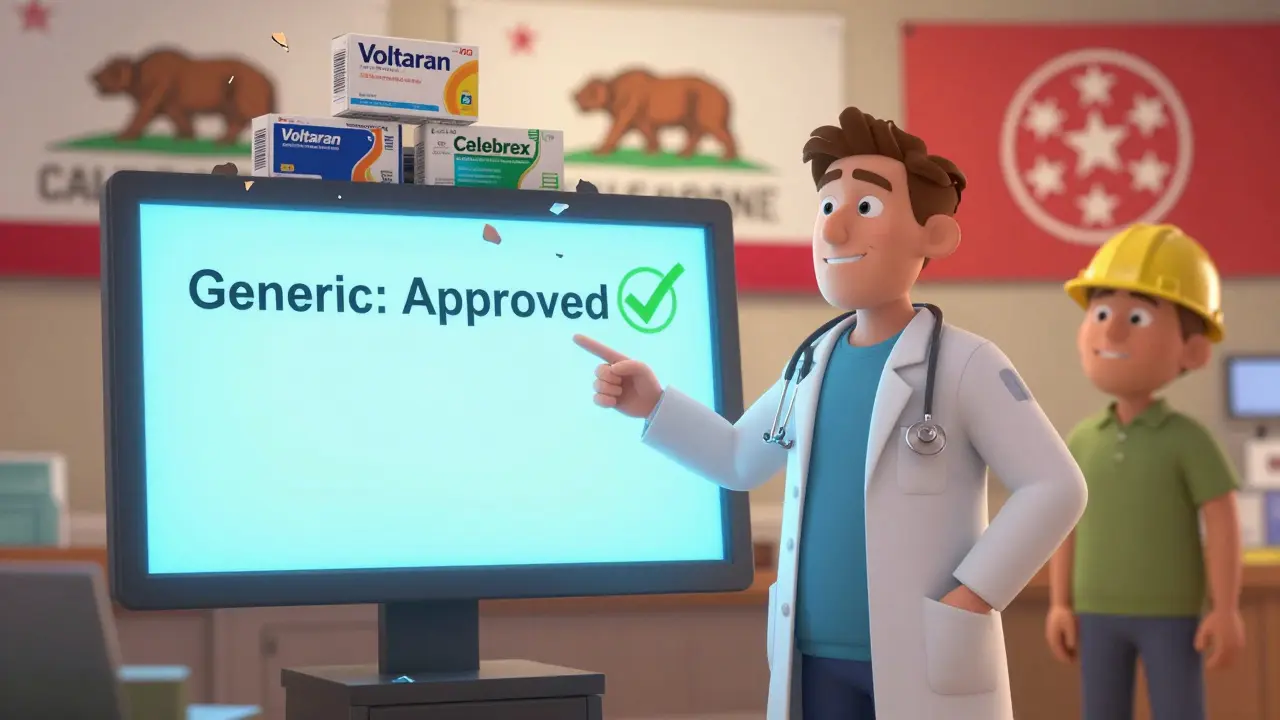
But It’s Not Perfect - Here’s Where It Gets Tricky
Not every drug can be swapped. Drugs with a narrow therapeutic index - where even a tiny difference in blood levels can cause harm or reduce effectiveness - need extra care. Think warfarin, lithium, or some seizure medications. These make up less than 2% of workers’ comp prescriptions, but they’re the ones that cause the most concern. Providers still hesitate to substitute them, even when generics are available. Then there’s the perception problem. A 2019 survey found that 68% of injured workers believed brand-name drugs were better. Even though they’re chemically identical, many people think the name on the bottle means something. Nurses and occupational health providers spend hours explaining: "It’s the same medicine. The FDA makes sure of it. The only difference is the price." And here’s the twist: even generic prices aren’t always low. A 2022 analysis by Enlyte found that some generic manufacturers have engaged in anti-competitive behavior - reducing supply, delaying new entries, or colluding on pricing. That’s led to unexpected spikes in the cost of certain generics, especially older drugs with few competitors. So while the goal is to cut costs, the system isn’t immune to market manipulation.What Providers and Patients Need to Know
For doctors, the learning curve is real. It takes 3 to 6 months to get comfortable with state-specific rules, the FDA’s Orange Book (which lists therapeutic equivalence ratings), and PBM requirements. But once they do, it becomes routine. The key is documentation. If you’re prescribing a brand-name drug, you need to say why - not just "patient wants it," but "patient had an allergic reaction to the filler in the generic," or "the generic caused nausea at this dose, and we need to try the brand to stabilize." For workers, education is critical. Many don’t know that generics are held to the same standards. A simple handout or a 30-second conversation can ease fears. And the results? Once they try it, 82% of workers report the generic worked just as well.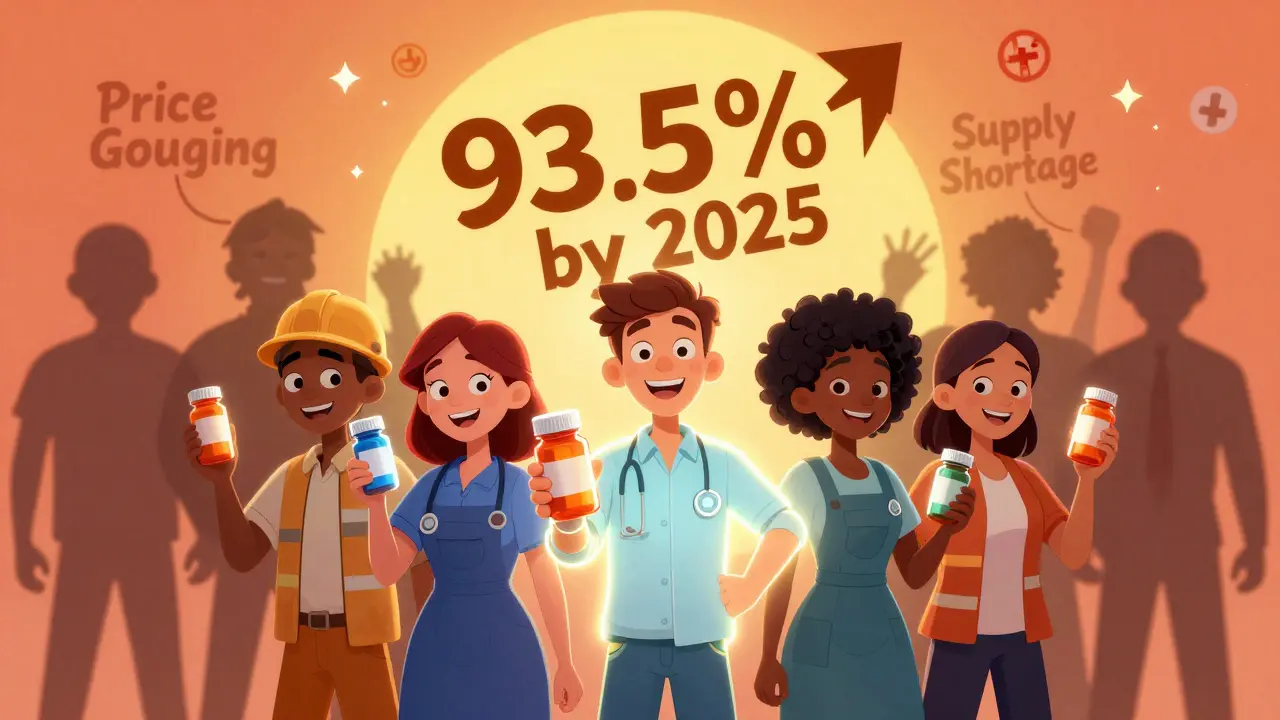
What’s Next? Biosimilars, Personalized Medicine, and the Road Ahead
The future of generic substitution is expanding. Biologic drugs - complex medications made from living cells, like those used for severe inflammation or autoimmune conditions - are starting to lose patent protection. That’s opening the door for biosimilars, which are the generic version of biologics. Texas started allowing biosimilar substitution in workers’ comp in 2022. More states will follow. Long-term, we’re moving toward pharmacogenomics - testing a worker’s genes to see how they’ll respond to certain drugs. That could mean fewer trial-and-error prescriptions. But for now, the best tool we have is still the generic pill. By 2025, experts predict generic use in workers’ comp will hit 93.5%. That’s up from 89.2% in 2023. The challenges remain - pricing volatility, provider resistance, patient myths. But the data doesn’t lie. Generic substitution saves money without sacrificing safety. It’s not a loophole. It’s a science-backed, system-wide upgrade. And for injured workers, it means getting the care they need without the financial burden that comes with inflated brand-name prices.Common Misconceptions About Generic Drugs
- "Generics are weaker." False. They contain the same active ingredient at the same strength. The FDA requires them to work the same way.
- "Brand names are made in better factories." False. Many brand-name drugs are made in the same facilities as generics. The FDA inspects all of them equally.
- "My doctor knows best - if they prescribed the brand, it’s better." Not always. Doctors are often influenced by marketing, not evidence. Generic substitution helps cut through that noise.
- "If it’s cheap, it must be low quality." The price reflects marketing, not medicine. A $20 generic isn’t inferior - it’s efficient.
What You Can Do as a Worker or Provider
- As a worker: Ask if a generic is available. Don’t assume the brand is better. If you’re skeptical, ask for the FDA’s bioequivalence explanation.
- As a provider: Use your state’s formulary. Document medical necessity clearly. Educate your patients. It’s not just about cost - it’s about trust.
- As an employer or claims adjuster: Support formulary compliance. Push back on unnecessary brand-name requests. Savings fund better care for everyone.
Generic substitution isn’t about cutting corners. It’s about cutting waste. It’s about using proven science to deliver the same outcome at a fairer price. In workers’ compensation, where every dollar saved can mean faster recovery and fewer lost workdays, that’s not just smart - it’s essential.
Are generic drugs really as safe as brand-name drugs in workers’ compensation?
Yes. The FDA requires generic drugs to have the same active ingredients, strength, dosage form, and bioequivalence as their brand-name counterparts. This means they work the same way in the body and meet the same safety and quality standards. Over 90% of prescriptions filled in workers’ compensation are generics, and clinical outcomes are equivalent. The only difference is cost.
Can a doctor refuse to prescribe a generic drug?
Yes - but only if they document medical necessity. In states with strict formularies like Tennessee and California, a doctor must provide a specific clinical reason - such as an allergy to a filler in the generic, or a documented failure of the generic version - to prescribe a brand-name drug. Patient preference alone is not sufficient justification.
Why do some generic drugs cost more than others?
Generic prices vary based on competition. If only one manufacturer makes a generic, prices stay higher. If multiple companies produce it, prices drop. But some generics have seen price spikes due to supply shortages or anti-competitive behavior among manufacturers. This is rare, but it happens - especially with older drugs that have few producers.
Do all states require generic substitution in workers’ compensation?
No. As of 2023, 44 states and D.C. have laws allowing or requiring generic substitution where medically appropriate. Some states, like Virginia, have looser rules that allow more brand-name prescribing. But even in those states, PBMs and formularies often push for generics anyway because of cost pressures.
What are biosimilars, and how do they relate to generic substitution?
Biosimilars are generic versions of complex biologic drugs - like those used for chronic pain or autoimmune conditions. Unlike traditional generics, they’re not exact copies but are highly similar and proven to work the same way. Texas began allowing biosimilar substitution in workers’ comp in 2022. As more biologics lose patent protection, biosimilars will become a major part of cost-saving strategies in occupational health.


10 Comments
Jessie Ann Lambrecht
Let me tell you, I’ve seen this play out in real time in occupational rehab clinics. Generics aren’t just cheaper-they’re *better* for the system. I had a guy with a back injury on brand-name celecoxib for months. Cost: $140/month. Switched him to generic celecoxib? $18. Same pain relief, same mobility gains, zero side effects. The only difference? His employer stopped complaining about the premium hike. This isn’t cutting corners-it’s cutting the BS.
Ayodeji Williams
Broooo… why are we even debating this? 😅 I got my cousin on generic naproxen after a warehouse fall-same relief, $5 vs $90. He thought the brand was ‘stronger’ till I showed him the FDA page. Now he’s like ‘why did we pay so long?’ 🤦♂️ #GenericWins #NoMoreCorporateTax
Elen Pihlap
I just don’t trust generics. What if they don’t work right? My uncle took one and it made him sick. I don’t want that to happen to me.
Jessie Ann Lambrecht
That’s exactly why education matters. Your uncle probably reacted to a filler-like dye or lactose-not the active ingredient. Generics use different inactive ingredients, sure. But if there’s a known allergy, the doctor documents it. That’s why the system requires medical necessity. It’s not random. It’s clinical. And 82% of workers who try generics report no difference. That’s not luck. That’s science.
Aparna karwande
How dare you reduce medicine to a spreadsheet? This is not about cost-it’s about dignity. The pharmaceutical industry is not some back-alley vendor. Brand-name drugs carry decades of research, human trials, and innovation. To call generics ‘just as good’ is to insult the very science that built modern medicine. You think your body is a vending machine? Pop in a dollar, get the same result? Wake up. The FDA doesn’t regulate quality-it regulates paperwork. And now we’re letting corporations dictate healing? Shame.
Paul Mason
Look, I get the savings. But if you’re gonna push generics, at least make sure the packaging doesn’t look like it was printed on a dot matrix in 1997. My cousin got a pill that looked like a candy. He thought it was a vitamin. Took it wrong. Bad vibes. Also-why do all generic bottles smell like burnt plastic? Just saying.
Sai Ganesh
In India, generics are the backbone of public health. We don’t have luxury of brand names. But the quality? Strictly regulated by CDSCO, equivalent to FDA. I’ve seen farmers heal from fractures with generic diclofenac-same as in California. The difference isn’t in the pill. It’s in the narrative. We need to stop equating price with worth. Medicine is medicine.
Poppy Newman
Wait so if generics are identical… why do some cost 10x more than others? 🤔 Like, I saw diclofenac gel for $12 and another for $85. Same box, same name. Is that the manufacturer? Or… are we being played again? 😳
Vince Nairn
Oh wow so now we’re gonna make workers take pills from a factory in China because it’s cheaper? 🙄 Meanwhile the brand-name ones are made right here in the USA with FDA inspections and union labor. You think a $20 pill from a 3rd-world plant is gonna heal a construction worker’s spine the same way? Yeah right. Let’s just save money by skipping the doctor too. Save even more. 💀
LALITA KUDIYA
My cousin’s a nurse in Texas. She says 95% of the meds she dispenses are generic. Workers are way less stressed now because their bills are lower. No drama. No arguments. Just healing. Simple. 🌿