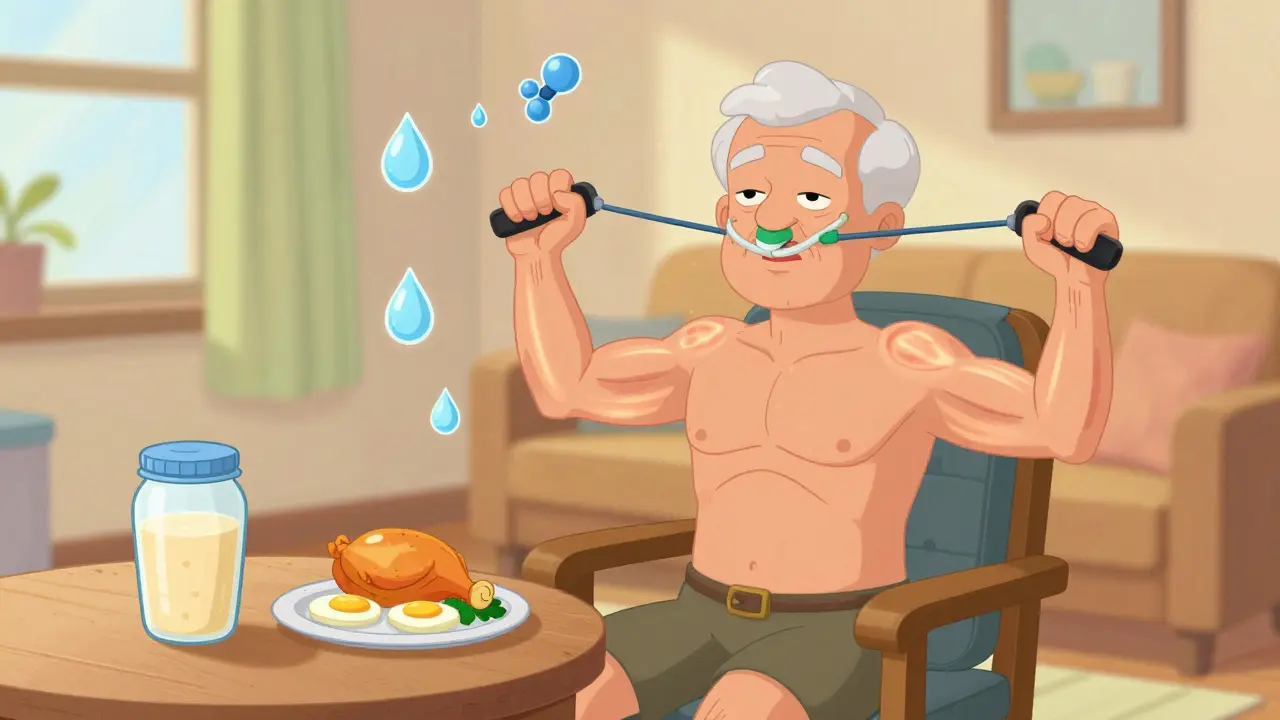
Why Sarcopenia Matters in COPD
If you have COPD, your lungs aren’t the only thing suffering. Up to sarcopenia in COPD affects nearly 1 in 5 patients, and it’s one of the biggest reasons people lose the ability to walk, climb stairs, or even get out of bed. This isn’t just about getting older-it’s about your body losing muscle faster than it should. People with COPD and sarcopenia are 20-40% more likely to die within five years than those with COPD alone. The good news? You can fight it. Nutrition and resistance training don’t just help you feel stronger-they can actually extend your life.
Sarcopenia means losing muscle mass, strength, and movement ability. In COPD, it hits differently than in healthy aging. While older adults without lung disease lose muscle mostly in their legs, people with COPD often lose it in their chest, arms, and even the muscles that help you breathe. One study found that 68% of COPD patients have visibly shrunken pectoral muscles-compared to just 22% of healthy people their age. This isn’t random. It’s caused by a mix of chronic inflammation, low oxygen levels at night, not moving enough, and not eating enough protein.
How Doctors Diagnose Sarcopenia in COPD
Most doctors don’t check for sarcopenia unless you ask. But it’s easy to screen. The first step? Handgrip strength. If you’re a man and your grip is under 27 kg (about 60 pounds), or a woman under 16 kg (35 pounds), that’s a red flag. The next step is measuring how fast you walk four meters. If it’s slower than 0.8 meters per second, that’s another sign. These tests take less than five minutes and cost nothing.
For more detail, doctors use scans. A CT scan at the L3 spine level can show exactly how much muscle you have. For men, less than 55 cm² per square meter of body surface area means sarcopenia. For women, it’s under 39 cm²/m². But here’s the catch: standard BMI numbers don’t work well for COPD patients. Many are thin but still have low muscle mass. That’s why specialists now use the pectoralis muscle index (PMI)-a measurement of chest muscle size adjusted for body weight. A PMI below 1.06 cm²/BMI is a strong indicator of sarcopenia in COPD.
The severity is broken into three stages: mild (just muscle loss), moderate (muscle loss plus weakness), and severe (muscle loss, weakness, and trouble moving). The worse your COPD, the more likely you are to have severe sarcopenia. Studies show a clear link: as your FEV1 drops, your muscle mass drops too.
The Perfect Storm: Why Muscle Disappears Faster in COPD
It’s not just one thing. It’s a chain reaction. First, you’re short of breath. So you move less. Less movement means muscle breaks down. At the same time, your body is flooded with inflammatory chemicals like TNF-alpha and IL-6. These don’t just make your lungs inflamed-they also tell your muscles to waste away. Research shows these inflammation markers directly correlate with weaker grip strength and less muscle mass.
Then there’s oxygen. Many COPD patients drop below 88% oxygen saturation during sleep. If this happens for more than 30% of the night, your risk of severe sarcopenia jumps by 47%. Your muscles need oxygen to rebuild. When they’re starved at night, recovery stops. And because you’re tired from poor sleep and breathing all day, you don’t have the energy to eat well or exercise-even if you know you should.
Finally, protein intake. Most COPD patients eat only 0.8-1.0 grams of protein per kilogram of body weight. Experts say you need 1.2-1.5 grams. That’s a 50% gap. Without enough protein, your body can’t repair muscle, no matter how much you train.
Nutrition That Builds Muscle, Not Just Calories
Calories alone won’t fix sarcopenia. You need the right kind of fuel. Start with protein. Aim for 1.2-1.5 grams per kilogram of body weight every day. If you weigh 70 kg (154 lbs), that’s 84-105 grams of protein daily. Spread it out-eat 20-30 grams at each meal. Why? Your muscles can only use so much protein at once. Eating it all at dinner won’t help your morning recovery.
Leucine is the key amino acid that triggers muscle growth. You need 2.5-3.0 grams per meal. That’s hard to get from food alone. A scoop of whey protein powder typically has 2.5 grams of leucine. Add it to a smoothie with a banana and peanut butter. Or choose fortified nutritional shakes designed for COPD patients. Some brands like FortiFit include extra leucine, vitamin D, and omega-3s-all shown to help muscle retention.
Don’t skip meals because you’re too tired. Eat small, frequent meals. If solid food feels heavy, try liquid nutrition. A study from the Cleveland Clinic found that patients who drank a protein shake after their rehab session gained more muscle than those who didn’t. And if you’re losing weight unintentionally, talk to a dietitian. Malnutrition worsens sarcopenia-and vice versa.
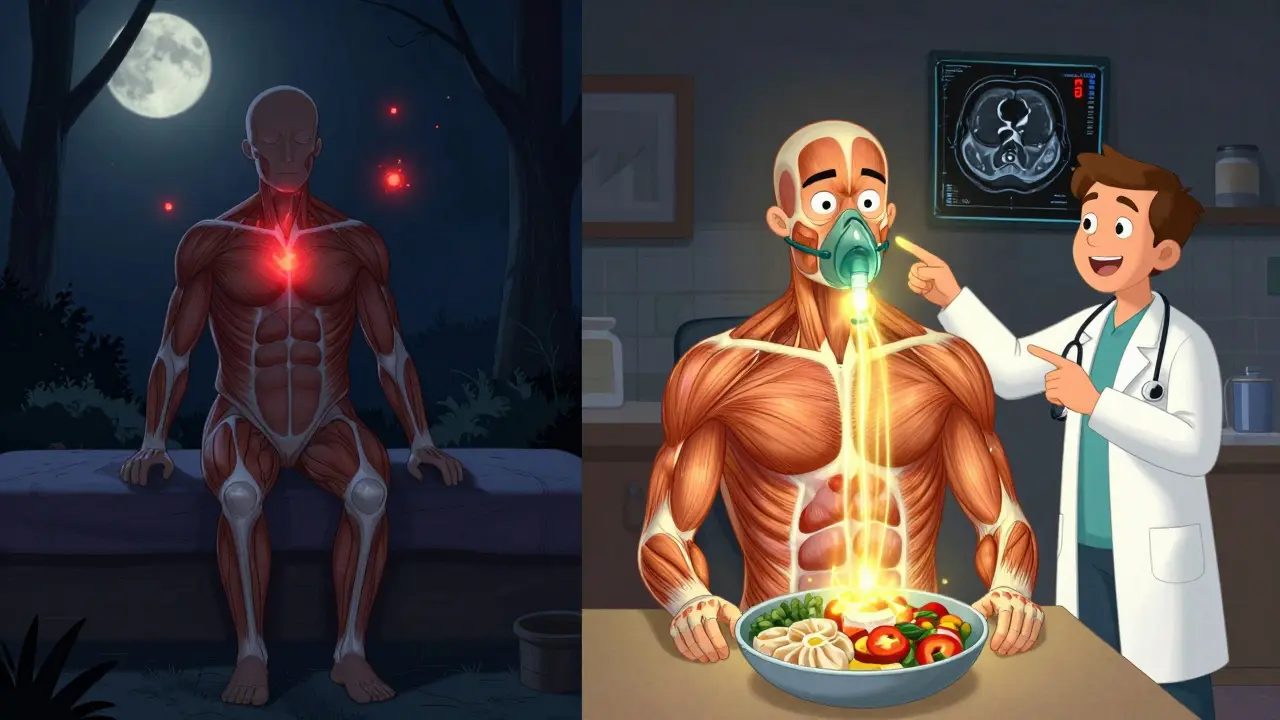
Resistance Training That Doesn’t Break Your Breath
You don’t need heavy weights. You don’t need to lift to failure. You just need to move your muscles regularly-with control.
Start at 30-40% of your one-rep max. That means using light bands, 1-5 pound dumbbells, or even your own body weight. Do two sets of 10-15 reps for each major muscle group: shoulders, chest, back, arms, legs. Do this two to three times a week. Rest 2-3 minutes between sets. That’s not laziness-it’s survival. You need time to catch your breath.
Here’s what works in real life: sit in a chair and do seated shoulder presses with resistance bands. Stand behind a chair and do slow heel raises. Lie on your back and squeeze a pillow between your knees. These movements build strength without needing to stand for long. As you get stronger, slowly increase resistance. Most people see gains in 8-12 weeks.
Important: If you use oxygen at home, use it during exercise. Forty-two percent of COPD patients need supplemental oxygen just to do light resistance training. Don’t wait until you’re gasping. Start with oxygen on. It’s not a sign of weakness-it’s part of the treatment.
A 2023 review found that COPD patients who did resistance training improved their 6-minute walk distance by 28% more than non-COPD sarcopenic patients. That’s the difference between needing help to walk to the bathroom and walking to the mailbox alone.
Real People, Real Results
Mary Thompson, 68, had GOLD Stage 3 COPD. She couldn’t carry groceries without stopping. After 12 weeks of pulmonary rehab with light resistance bands and a daily protein shake, she could carry two bags without stopping. "It wasn’t magic," she said. "It was just doing the same thing every day."
John Peterson, 72, tried resistance training without oxygen and had to quit after three sessions. "I thought I was being strong by pushing through," he said. "Turns out, I was just making my lungs work harder."
At the Cleveland Clinic, 78 patients with sarcopenia and COPD did 16 weeks of supervised training and protein supplements. Their 6-minute walk distance jumped 23%. Hospital visits dropped. Quality of life improved. This isn’t theory-it’s happening every day in rehab centers.
Common Mistakes and How to Avoid Them
Many people give up because they’re told to "exercise more" but never shown how to do it safely. Here are the biggest mistakes:
- Starting too heavy. Use bands, not dumbbells, at first.
- Skipping rest between sets. You need 2-3 minutes to recover your breath.
- Not using oxygen during exercise. If you use it at rest, use it during movement.
- Not eating enough protein. Track your intake for a week-you’ll likely be under.
- Stopping during flare-ups. Instead, reduce intensity. Do seated exercises. Stay consistent.
One study found that 57% of COPD patients quit exercise during exacerbations. But those who kept going-even at 50% effort-had better long-term outcomes. Adapt, don’t quit.
What’s Next for Sarcopenia Treatment in COPD
The GOLD guidelines now include sarcopenia screening as part of standard COPD care. A new algorithm, released in 2024, links nighttime oxygen levels to exercise prescriptions. If your sleep oxygen drops too low, your rehab plan changes.
Researchers are testing new supplements like HMB (beta-hydroxy-beta-methylbutyrate), which helps prevent muscle breakdown. Early results show it preserves muscle mass better than protein alone. A drug called PTI-501, which blocks myostatin (a protein that limits muscle growth), is in phase 2 trials and could be available by 2026.
But the most powerful tool right now is simple: move your muscles and eat enough protein. It’s not glamorous. It’s not a pill. But it works.
Getting Started: Your Action Plan
- Ask your doctor for a handgrip strength test and 4-meter walk test.
- If you’re on oxygen, use it during all physical activity.
- Calculate your protein needs: weight in kg × 1.2-1.5 = daily grams.
- Divide protein into 4 meals: aim for 20-30 grams per meal.
- Start resistance training with bands or light weights, 2-3 times a week.
- Rest 2-3 minutes between sets.
- Track your progress: can you carry more groceries? Walk farther? Climb stairs without stopping?
You don’t need to be perfect. You just need to start. And keep going.
Is sarcopenia the same as muscle loss in aging?
No. While both involve muscle loss, sarcopenia in COPD happens faster and affects different muscles. In healthy aging, leg muscles decline first. In COPD, chest and arm muscles are hit harder due to breathing strain and low oxygen. Inflammation and inactivity also accelerate the process.
Can I do resistance training if I’m on oxygen?
Yes-and you should. Forty-two percent of COPD patients need supplemental oxygen during resistance training. Using oxygen while exercising helps you work longer, recover faster, and build more muscle. Don’t wait until you’re out of breath. Start with oxygen on.
How much protein do I really need?
Most COPD patients eat only 0.8-1.0 grams of protein per kilogram of body weight. You need 1.2-1.5 grams. For a 70 kg person, that’s 84-105 grams daily. Spread it across 4 meals: 20-30 grams per meal. Add a whey protein shake if you struggle to eat enough.
What if I can’t go to a rehab center?
You don’t need a gym. Use resistance bands, water bottles, or your body weight. Sit in a chair and do shoulder presses, leg lifts, or heel raises. Do two sets of 10-15 reps, 2-3 times a week. Focus on control, not speed. Even 15 minutes a day helps.
Will this help me live longer?
Yes. Studies show that treating sarcopenia in COPD can increase 5-year survival from 45% to 68% in severe cases. It also cuts hospital visits by 32%. Building muscle isn’t just about strength-it’s about staying alive.
Final Thought: Small Steps, Big Impact
You don’t have to run a marathon. You don’t have to lift heavy weights. You just have to move your body and feed it enough protein. That’s it. And if you do that consistently, you’ll find yourself doing things you thought were gone for good-carrying your own bags, walking to the store, climbing stairs without stopping. That’s not just improvement. That’s freedom.





10 Comments
Caitlin Foster
So let me get this straight: if I eat protein and wiggle my arms a little, I won't die? Holy heck, I've been wasting my life on kale smoothies and yoga. 🙃 Time to buy resistance bands and a whey protein tub bigger than my cat.
Nikki Thames
One must question the ontological underpinnings of muscular preservation in the context of chronic respiratory insufficiency. The body, as a vessel of suffering, is not merely a mechanical system to be optimized through caloric input and resistance. Rather, it is a metaphysical arena wherein the soul's resilience is tested by the tyranny of breathlessness. Protein, while chemically necessary, cannot address the existential void that accompanies the loss of bodily autonomy.
Chris Garcia
In my village in Nigeria, we don't have protein shakes or CT scans. We have beans, yams, and elders who walk three miles to the market every day. Muscle isn't built in gyms-it's built by living. If your lungs are weak, move slower. Eat more beans. Stand up when you can. No machine can replace the wisdom of a body that refuses to quit. This isn't medicine-it's survival, and we've been doing it for centuries.
James Bowers
The assertion that 1.2–1.5 g/kg of protein is optimal lacks sufficient longitudinal validation. Moreover, the reliance on whey protein introduces an uncontrolled variable: dairy-induced inflammation, which may exacerbate COPD symptoms in a subset of the population. Furthermore, the cited studies demonstrate correlation, not causation. Until randomized controlled trials with double-blind placebo controls are published, this remains speculative.
Will Neitzer
It is imperative to acknowledge the profound significance of this clinical insight. The integration of nutritional optimization with structured resistance training represents a paradigm shift in the management of COPD-related sarcopenia. The evidence, as presented, is methodologically sound and clinically actionable. For patients who have been told to 'just breathe better,' this offers a tangible, empowering pathway-not merely to mitigate decline, but to reclaim agency over one’s physical existence. This is not just treatment. It is dignity restored.
Janice Holmes
Okay, but have you considered that Big Pharma is pushing protein shakes because they know if you build muscle, you won’t need their $12,000 inhalers? And resistance training? That’s just a distraction so you don’t notice they’re hiding the real cure: ozone therapy and hyperbaric chambers. They don’t want you strong. They want you dependent. Look at the funding behind these ‘studies’-it’s all tied to supplement companies. I’ve been tracking this for years. They’re lying to you.
Miriam Piro
I've been doing this for 7 years now. I lost 40% of my muscle mass by 58. I didn't know it was sarcopenia. I thought I was just getting old. Then I started doing seated band rows with my oxygen on, ate 110g of protein a day, and now I carry my grandkids up the stairs. Not because I'm strong. Because I refused to let my lungs decide my fate. If you're reading this and you're tired-get up. Just one rep. Then another. Then another. Your body remembers how to fight. You just have to remind it.
dean du plessis
I live in Cape Town and my dad has COPD. He does 10 minutes of leg lifts every morning while watching the sunrise. No bands. No shakes. Just him, the sky, and his breath. He says it’s not about the numbers. It’s about showing up. I think that’s the real secret. You don’t need a study to know your body needs movement. You just need to listen.
Olivia Goolsby
This is all a lie. Sarcopenia doesn't exist. It's a construct created by the medical-industrial complex to sell protein powders and rehab packages. Your muscles don't 'waste away'-they're being actively suppressed by glyphosate in your food, 5G radiation, and fluoride in the water. The fact that you're being told to 'eat more protein' is a trap. Your body is trying to detox. You should be fasting, drinking lemon water, and meditating under moonlight. Resistance training? That's just stress on top of stress. Let your body rest. Nature knows best.
Alex Lopez
I'm a pulmonologist. I've seen this work. The data is solid. But I also know that most patients give up because they're overwhelmed. So here’s the truth: you don’t need to do it all at once. One protein shake. One set of seated presses. One day. Then another. That’s how change happens. And if you’re on oxygen-use it. Don’t be proud. It’s not weakness. It’s strategy. You’re not failing. You’re adapting. And that’s the most courageous thing you can do.