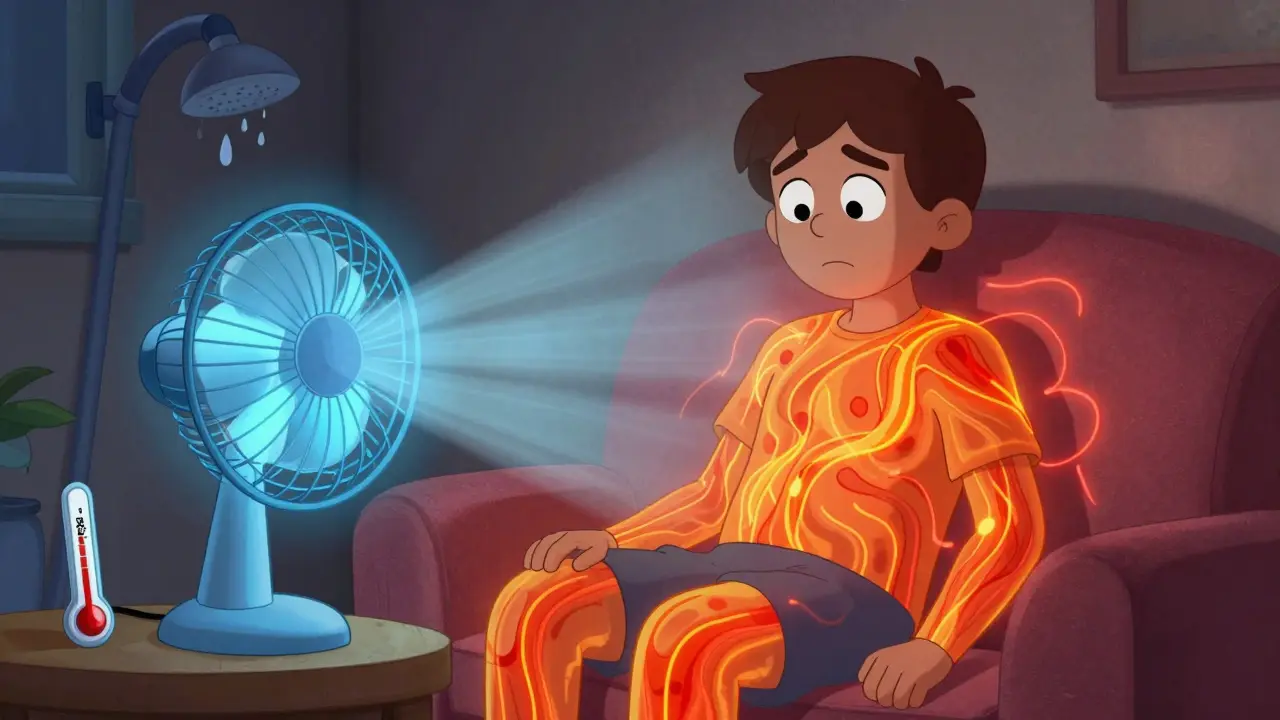
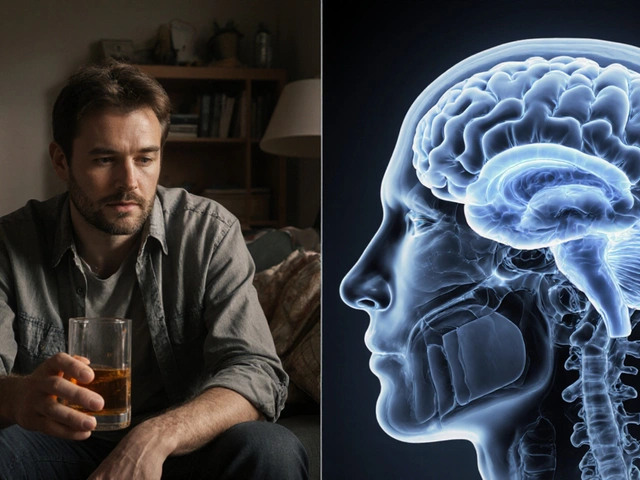
When your legs suddenly feel heavy, your vision blurs, or you can’t hold a cup steady, it’s natural to panic. You’ve been here before - this is multiple sclerosis, after all. But is this a relapse - a sign your disease is actively attacking your nervous system - or just a pseudorelapse, a temporary flare-up caused by something simple like a hot shower or a urinary infection? Getting this wrong doesn’t just cause stress. It can lead to unnecessary steroids, hospital visits, and even serious side effects like high blood sugar, insomnia, or mood swings - all for a problem that doesn’t need them.
What’s Really Happening? Relapse vs. Pseudorelapse
A true MS relapse is caused by new inflammation in your brain or spinal cord. It’s not just your symptoms getting worse - it’s your immune system launching a fresh attack, damaging the protective coating around your nerves (myelin). This damage shows up on MRI as new or growing lesions. Symptoms last at least 24 to 48 hours, often longer, and don’t improve just because you rest or cool down. A pseudorelapse, on the other hand, is not new damage. It’s your old, scarred nerves acting up because something else is throwing them off balance. Think of it like an old wire with frayed insulation. It works fine under normal conditions, but when it gets hot, wet, or tired, it shorts out. No new inflammation. No new lesions. Just temporary chaos in signals that were already compromised. The key difference? One is disease activity. The other is a system overload.Common Triggers for Pseudorelapses
Pseudorelapses aren’t random. They’re tied to very specific, often avoidable triggers. The most common ones:- Heat - Hot showers, saunas, summer heat, even a fever. About 60-80% of people with MS who’ve had optic neuritis get Uhthoff’s phenomenon - vision gets blurry or double when their body warms up. It clears in minutes once you cool down.
- Urinary tract infections (UTIs) - This is the #1 trigger. In fact, nearly two out of three pseudorelapses in MS patients are linked to UTIs. You might not even feel sick - just notice your legs are weaker or your bladder is acting up again.
- Fever - Even a mild cold or flu can spike your temperature enough to trigger symptoms. Your body’s internal thermostat gets confused, and old nerve damage starts acting up.
- Stress and exhaustion - Physical or emotional stress can throw your nervous system into overload. Lack of sleep, a big work deadline, or family drama can all do it.
- Physical overexertion - Pushing too hard in the gym, walking too far, or even doing too many chores can trigger a flare.
Here’s the thing: if your symptoms started yesterday after you got a fever, or after you spent the afternoon in the sun, or after you didn’t sleep for two nights - it’s probably not a true relapse. It’s your body saying, “I’m overwhelmed.”
Why Steroids Don’t Fix Pseudorelapses
High-dose IV steroids - like methylprednisolone - are the standard treatment for true MS relapses. They work by calming down the immune system’s attack. But they do nothing for pseudorelapses because there’s no immune attack to calm. Yet, studies show that 30-40% of people with MS get steroids when they don’t need them. Why? Because the symptoms feel identical. Fatigue, numbness, weakness - they all look the same. And many doctors, especially outside MS centers, aren’t trained to spot the difference. The cost? Not just money. Steroids can cause:- High blood sugar - especially dangerous if you’re prediabetic
- Insomnia - you’ll be wired for days
- Mood swings or even psychosis - rare, but real
- Weakened immunity - making you more vulnerable to infections
One nurse with MS on Reddit shared a story about five patients she saw get IV steroids for UTI-triggered pseudorelapses. One developed steroid-induced psychosis and had to be hospitalized. That’s not an outlier. It’s a system failure.

How to Tell Them Apart - A Simple Checklist
You don’t need an MRI to start ruling things out. Here’s what to do when symptoms return:- Check the clock - Did symptoms last less than 24 hours? If yes, it’s likely a pseudorelapse. True relapses don’t vanish overnight.
- Look for triggers - Did you have a fever? A UTI? Were you out in the heat? Were you exhausted? Write it down.
- Test your temperature - If you’re over 37.8°C (100°F), that’s a red flag for pseudorelapse.
- Do a urine test - Even if you don’t feel like you have a UTI, get a dipstick test. Many MS patients have silent infections.
- Try cooling down - Put on a cooling vest, take a cool shower, sit in front of a fan. If your symptoms improve in under an hour, it’s probably Uhthoff’s or heat-related.
- Wait and watch - If symptoms don’t improve after 24 hours and no trigger is found, then it’s time to suspect a true relapse.
Keep a symptom diary. Note the date, what you were doing, your temperature, any infections, stress levels, and how long symptoms lasted. This isn’t just for you - it’s gold for your neurologist.
When Steroids Might Actually Help
Steroids are helpful - but only when they’re needed. If your symptoms:- Last more than 48 hours with no clear trigger
- Involve sudden weakness in your legs or arms
- Include trouble walking, bladder control, or coordination
- Are confirmed by new lesions on MRI
- then yes, steroids can speed up recovery. About 70-80% of true relapses improve with treatment. But even then, full recovery is rare. Only about half of people get back to exactly how they were before. That’s why early treatment matters - not because steroids cure MS, but because they reduce the damage from the inflammation.
Who’s Most at Risk for Confusion?
People with longer MS duration - especially over age 55 - are more likely to have pseudorelapses. Why? Because their nervous system is already full of scars. The more damage you have, the more fragile your signals become. A little heat, a little stress, and everything goes haywire. Also, people who’ve had multiple relapses in the past are more likely to misinterpret new symptoms as relapses. It’s fear talking. But fear leads to unnecessary treatment. Neurologists who specialize in MS get it right 85% of the time. General neurologists? Only 60%. Primary care doctors? Just 45%. That’s why it’s so important to see an MS specialist if you’re unsure.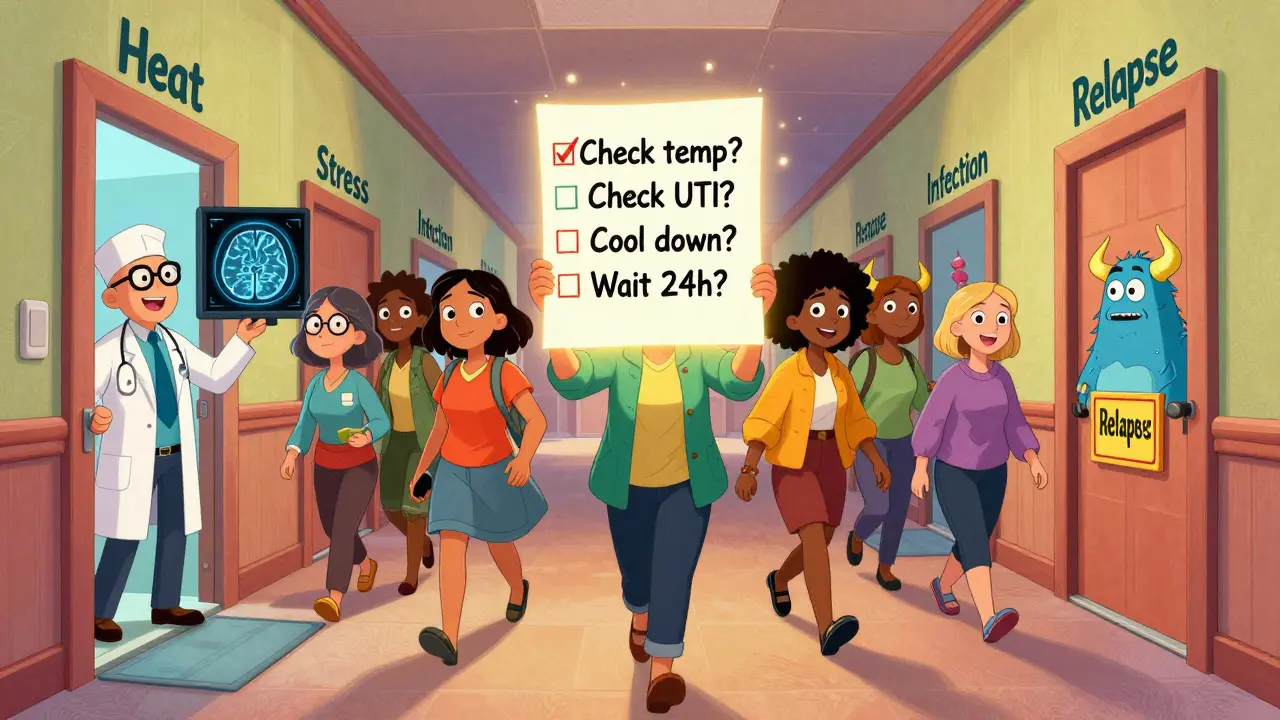
What’s New in Diagnosis?
In 2023, a new tool called the MS-Relapse Assessment Tool (MS-RAT) was validated. It uses three things to give you a score:- How long symptoms lasted
- Your body temperature at the time
- How much your daily function dropped
This tool correctly identifies true relapses 92% of the time. It’s not perfect, but it’s a game-changer for patients and doctors who don’t have MRI access right away.
Telemedicine apps like MS Selfie are also helping. Patients record videos of their movements, speech, and vision. AI compares them to baseline recordings. Early results show 78% accuracy in spotting true relapses from pseudorelapses.
Future research is looking at blood tests - like neurofilament light chain levels - to detect actual nerve damage. If this works, we might one day have a simple blood test to prove whether your body is having a new attack or just overheating.
Real Stories, Real Mistakes
One woman on MyMSTeam wrote: “I had leg weakness during a heatwave. My GP gave me steroids. I spent three days in bed, dizzy and anxious. My neurologist said, ‘You had Uhthoff’s. Just cool down.’ I felt like an idiot - but I was just lucky I had a good neurologist.” Another shared: “I had a UTI and didn’t know it. My legs gave out. ER thought it was a relapse. They gave me steroids. I got a yeast infection, couldn’t sleep, and felt like I was losing my mind. Turned out I just needed antibiotics.” These aren’t rare cases. They’re common.What You Can Do Today
- Know your triggers - Write them down. Heat? Stress? Infections? Avoid them when you can. - Carry a thermometer - If you feel off, check your temperature. Over 37.8°C? Rule out infection first. - Keep a symptom diary - Track everything. It’s your best tool. - Ask for a urine test - Before you agree to steroids, insist on ruling out a UTI. - Try cooling - A cold pack on your neck, a fan, a cool bath - if it helps fast, it’s not a relapse. - See an MS specialist - Not just any neurologist. Someone who sees MS patients every day.MS is unpredictable. But you don’t have to be confused about your symptoms. The difference between a relapse and a pseudorelapse isn’t just medical - it’s life-changing. One leads to treatment. The other leads to rest, recovery, and avoiding unnecessary risks.
You know your body better than anyone. Trust your instincts - but back them up with facts. Because sometimes, the thing that feels like a relapse is just your body asking for a break.


12 Comments
jeremy carroll
man i thought i was the only one who got wiped out after a hot shower 🤦♂️ turned out it was just uhthoff’s. no steroids needed, just a fan and some ice water. life changer.
Jocelyn Lachapelle
this is the kind of info every ms patient needs to hear before they walk into the ER and get pumped full of steroids. thank you for writing this. so many of us are just scared and guessing
Cassie Henriques
neurofilament light chain as a biomarker for true relapse? that’s huge. if we can get a blood test that distinguishes inflammatory activity from thermal conduction block, we’re talking about a paradigm shift in acute management. the ms-rat tool is already being piloted at my clinic and it’s reducing unnecessary steroid courses by 40%. game changer.
Edward Stevens
so let me get this straight... we’re telling people with a chronic neurological disease to ‘cool down’ instead of treating them like they’re having a relapse? brilliant. next they’ll tell me to ‘just breathe’ when my spine is on fire. 🤡
Jonny Moran
i’ve been living with ms for 14 years and this is the first time someone explained pseudorelapses in a way that actually stuck. i used to panic every time i felt a little off. now i check my temp, grab a cold towel, and wait. if it doesn’t lift in an hour? then i call my neuro. simple. smart. life-saving.
Mike Nordby
The distinction between relapse and pseudorelapse is not merely clinical-it is existential. The burden of misattribution-steroid-induced hyperglycemia, insomnia, emotional lability-imposes a secondary pathology upon an already compromised system. The data supporting the MS-RAT and telemedicine-based AI tools are not merely encouraging; they are necessary. Clinicians must be trained to interrogate triggers before initiating immunomodulation. Patient diaries are not anecdotal-they are longitudinal biomarkers of lived experience.
John Samuel
As an inclusive mentor to newly diagnosed individuals, I must say: this article is a beacon. 🌟 The way you articulate Uhthoff’s phenomenon as ‘frayed wiring in a heatwave’ is poetic and precise. I’ve shared this with my support group-three members had been misdiagnosed and overtreated. One had been on oral steroids for six weeks due to a silent UTI. They’re now on antibiotics, sleeping, and breathing again. Thank you for turning confusion into clarity.
RONALD Randolph
This is why America’s healthcare is broken. You have a man with MS getting IV steroids for a UTI? That’s not incompetence-that’s negligence. We need mandatory MS training for every primary care doc. And stop letting nurses run the show! I’ve seen this happen in three states. It’s a scandal. Someone needs to get fired. And someone needs to go to jail.
Sinéad Griffin
i had a pseudorelapse last summer after a 10-hour road trip. thought i was having a relapse. went to urgent care. got steroids. woke up with a yeast infection, a racing heart, and crying for no reason. then my neuro said ‘you had a fever, right?’ yeah. 100.1. she laughed. i cried. now i carry a thermometer like it’s my third eye 🔥🌡️
Christina Bischof
i just want to say thank you to everyone who’s shared their stories here. i’ve been silent for years because i thought i was just being dramatic. turns out i just needed to cool off and drink more water. this community? it’s everything.
Sai Nguyen
In India, we don't have access to MS specialists or MRI machines every time symptoms flare. We just suffer. This article is for rich Americans. You think a thermometer changes anything when you can't afford antibiotics?
Jake Sinatra
I’ve been an MS patient for 22 years. I’ve had six true relapses. I’ve had over 30 pseudorelapses. I’ve been given steroids seven times. Four of those times were wrong. The side effects were worse than the symptoms. I now have steroid-induced osteoporosis and insulin resistance. This article isn’t just helpful-it’s a lifeline. Please, if you’re reading this and you’re about to agree to steroids-ask for a urine test first. It takes two minutes. It could save your next decade.