When someone says they’re just trying to eat healthier, it’s easy to miss the warning signs. But for millions, eating isn’t about health-it’s about control, fear, or survival. Eating disorders aren’t choices. They’re life-threatening illnesses with complex biological, psychological, and social roots. Anorexia nervosa, bulimia nervosa, and binge eating disorder don’t look the way most people expect. You won’t always see extreme thinness. You might not even know someone is struggling. Yet, every 52 minutes, someone in the U.S. dies from an eating disorder. That’s not a statistic-it’s a neighbor, a student, a sibling.
What Anorexia Nervosa Really Looks Like
Anorexia nervosa isn’t about being picky or dieting too hard. It’s a brain disorder where the body’s hunger signals get hijacked. People with anorexia often have a body weight far below what’s medically safe, but they still see themselves as overweight. Their fear of gaining weight is so intense it overrides basic survival instincts. About 1% of the population will develop it in their lifetime, and while it’s more common in females, the number of males diagnosed has risen sharply in the last decade. The physical toll is brutal. Heart rate drops. Bones weaken. Organs begin to shut down. One in five people with anorexia will attempt suicide. The mortality rate is higher than almost any other mental illness-5.1 deaths per 1,000 person-years. That’s six times higher than people without the disorder. And here’s the part no one talks about: less than 6% of people with eating disorders are underweight by medical standards. Many people with anorexia appear normal-or even overweight-to outsiders. That’s why diagnosis is so often delayed.Bulimia Nervosa: The Hidden Cycle
Bulimia nervosa operates in secret. Binge eating-consuming large amounts of food in a short time-is followed by purging: vomiting, laxatives, fasting, or excessive exercise. Unlike anorexia, people with bulimia often maintain a normal weight, which makes the disorder invisible. About 1.5% of women and 0.5% of men will experience it in their lifetime. One in ten people with bulimia vomit so often their cheeks swell from damaged salivary glands. The physical damage runs deep: tooth enamel erodes, esophagus tears, potassium levels crash, and heart rhythms become erratic. What makes bulimia especially dangerous is how closely it’s tied to depression and anxiety. Nearly 76% of people with bulimia also suffer from major depression. Substance abuse is common too-up to half of all people with eating disorders misuse alcohol or drugs, often to numb emotional pain. And yet, fewer than half of those with bulimia ever seek help. Insurance denies care. Clinicians miss the signs. People feel too ashamed to speak up.Why Evidence-Based Care Isn’t Optional
Treating eating disorders isn’t about willpower. It’s not about telling someone to “just eat.” Recovery requires specific, proven methods backed by decades of research. The American Psychiatric Association’s 2023 guidelines are clear: for adolescents with anorexia, Family-Based Treatment (FBT) is the gold standard. In FBT, parents take charge of meals and weight restoration under clinical guidance. After 12 months, 40-50% of teens recover-double the rate of traditional individual therapy. For adults with bulimia or binge eating disorder, Enhanced Cognitive Behavioral Therapy (CBT-E) is the most effective option. Developed by Dr. Christopher Fairburn, CBT-E targets the core thoughts and behaviors driving the disorder. It doesn’t just stop bingeing or purging-it rewires the way people think about food, shape, and self-worth. Studies show 60-70% of patients achieve remission after 20 sessions. Even more powerful: CBT-E works across diagnoses. Someone with bulimia, anorexia, or binge eating disorder can all benefit from the same core treatment. And now, for the first time, there’s a medication approved specifically for an eating disorder. In 2023, the FDA approved lisdexamfetamine (Vyvanse) for binge eating disorder. In clinical trials, over half of patients saw their binge episodes cut in half. It’s not a cure, but it’s a tool-and a sign that medicine is finally catching up to the science.
The Broken System: Why So Few Get Help
Here’s the harsh truth: most people with eating disorders never get treatment. Only 27% of women who develop an eating disorder by their 40s ever see a specialist. Insurance companies routinely deny care. In 2022, 68% of people surveyed by the National Eating Disorders Association reported at least one insurance denial. One person on a recovery forum spent 27 months waiting for care-nine months for outpatient therapy, another 18 for an intensive program. Her BMI was 14.5. She was in critical condition. Her insurance said it wasn’t medically necessary. The cost of care is staggering. A 90-day residential program can run $78,000. Many families turn to GoFundMe. In 2023, over 1,200 insurance appeals were filed just for eating disorder treatment-57% required legal help to win. Meanwhile, there are only 35 specialized residential facilities in the entire U.S., with a total of 1,200 beds. That’s less than 0.004% of the estimated 30 million Americans living with an eating disorder. Rural areas are especially underserved. A 2023 Johns Hopkins study found only 22% of rural counties have even one eating disorder specialist. Telehealth has helped, but it’s not a full solution. Many patients need hands-on medical monitoring, especially during refeeding-when the body starts to heal after prolonged starvation. Refeeding syndrome, a dangerous shift in electrolytes, can kill if not managed carefully. It happens in 10-20% of severe anorexia cases.What Recovery Actually Looks Like
Recovery isn’t linear. It’s messy. It’s setbacks. It’s crying over a bowl of cereal. It’s sitting through a meal with your family and feeling like you’re failing. But it’s also possible. People do get better. One woman shared on HealthUnlocked that after seven years of bulimia, she started CBT-E through a university clinic. Her binge-purge episodes dropped from 14 a week to two. Another, in a Monte Nido residential program, gained 15 pounds under medical supervision and learned Dialectical Behavior Therapy (DBT) skills to manage emotional distress. These aren’t rare success stories-they’re the result of evidence-based care. The key is early intervention. Research shows that people who start treatment within three years of symptoms beginning have a 65% chance of full remission. After five years, that number drops sharply. That’s why delays are deadly. Every day without care increases the risk of permanent organ damage, chronic depression, or death.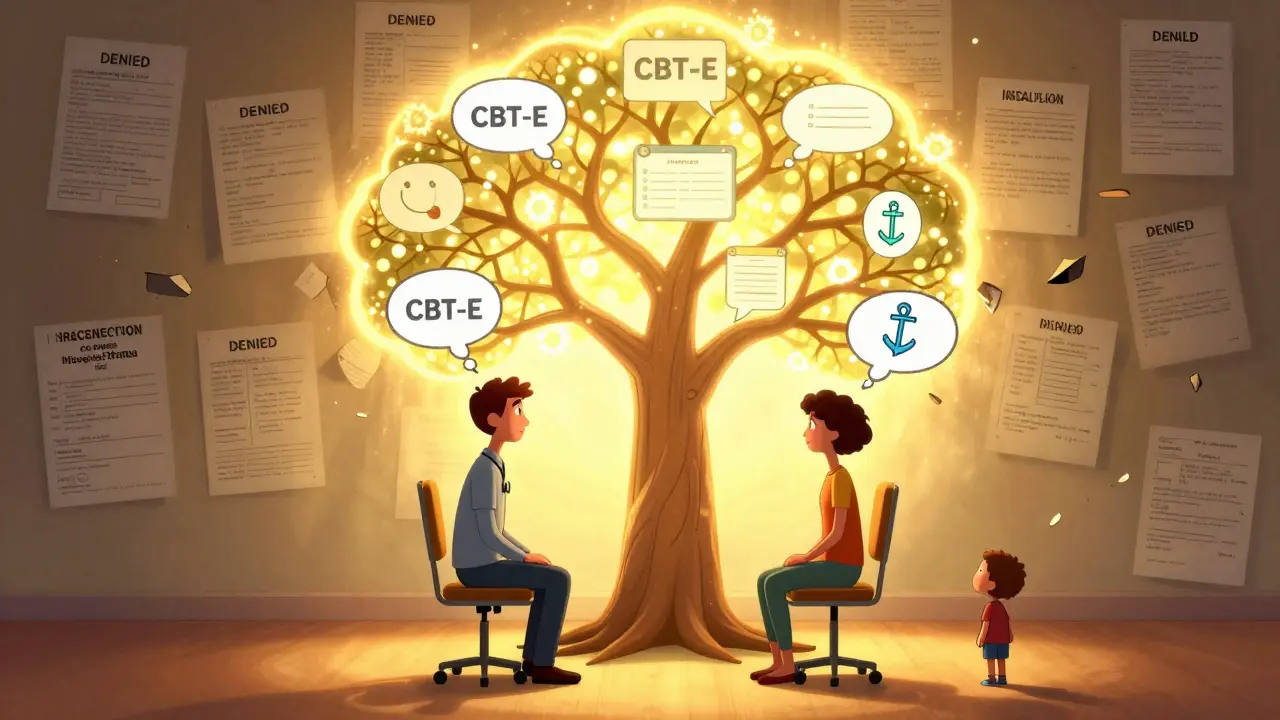
What You Can Do
If you suspect someone you love has an eating disorder, don’t wait. Don’t assume they’ll “grow out of it.” Don’t wait for them to look “sick enough.” Ask. Listen. Don’t judge. Offer to help them find a specialist. Help them navigate insurance. Share resources like the National Eating Disorders Association helpline. If you’re struggling yourself, know this: you are not broken. You are not weak. You are sick-and you deserve care. Reach out to a doctor, even if you’re scared. Start with your primary care provider. Ask for a referral to an eating disorder specialist. Look for providers trained in FBT or CBT-E. Demand insurance coverage. File appeals. You are worth the fight.Hope Is Real
The tide is turning. The FDA approved its first medication for binge eating disorder. The military now requires screening for service members. The NIH is funding a $25 million study to track 7,500 children from birth to find early warning signs. Telehealth is expanding. More clinicians are being trained in evidence-based methods. But progress won’t come fast enough without pressure. We need better insurance policies. More funding for research. More specialized treatment centers. And most of all, we need to stop treating eating disorders as a lifestyle issue. They’re medical emergencies. They kill. And they can be treated. The next time you hear someone say, “I just need to lose a few pounds,” pause. Maybe they’re not talking about weight at all. Maybe they’re screaming for help-and no one’s listening yet.Can someone have an eating disorder and still be overweight?
Yes. Less than 6% of people with eating disorders are medically classified as underweight. Binge eating disorder, bulimia, and even some cases of anorexia can occur in people of all body sizes. Weight is not a reliable indicator of an eating disorder. Diagnosis depends on behaviors, thoughts, and medical complications-not appearance.
Is family therapy effective for adult eating disorders?
Family-Based Treatment (FBT) was designed for adolescents and is most effective for teens. For adults, individual therapies like Enhanced Cognitive Behavioral Therapy (CBT-E) are the gold standard. However, family support still plays a critical role in recovery, even for adults. Loved ones can help with meal support, emotional regulation, and reducing stigma-key factors in long-term success.
How long does CBT-E treatment take?
Enhanced Cognitive Behavioral Therapy (CBT-E) typically lasts 20 sessions over 20 weeks. Some people need more, especially if they have co-occurring depression or trauma. The goal isn’t just to stop bingeing or purging-it’s to change the underlying thought patterns that drive the disorder. Many patients see major improvements within the first 10 sessions.
Why is insurance denial so common for eating disorder treatment?
Insurance companies often classify eating disorder care as “behavioral” or “elective,” even though it’s medically necessary. They deny coverage for residential programs, nutritional counseling, or medical monitoring, claiming it’s not “acute care.” The 2023 Mental Health Parity and Addiction Equity Act requires equal coverage for mental and physical health-but enforcement is weak. Many families must appeal multiple times or hire legal help to get care.
Are there any new treatments on the horizon?
Yes. In 2023, the FDA approved lisdexamfetamine (Vyvanse) for binge eating disorder-the first medication approved for any eating disorder. Digital tools like the Recovery Record app have shown 32% greater symptom reduction than standard care. The NIH is funding a $25 million study tracking 7,500 children from birth to identify early biological markers. Telehealth is expanding access, especially in rural areas. These advances are promising, but they need funding and policy support to reach everyone who needs them.




12 Comments
Frank Drewery
This post hit me right in the chest. I lost a cousin to anorexia last year. She wasn't underweight. She was in college, had a part-time job, laughed at dinner. No one saw it coming. I wish we'd known how to ask the right questions. Thank you for writing this.
Danielle Stewart
I'm a therapist who specializes in eating disorders. Let me tell you - CBT-E works. I've seen people come in crying over a slice of bread and leave three months later eating pizza with friends without guilt. It’s not magic. It’s science. And yeah, insurance denies it constantly. But keep fighting. File that appeal. You’re worth the battle.
mary lizardo
While the sentiment is commendable, the article suffers from a conspicuous lack of methodological rigor. The citation of ‘60-70% remission’ from CBT-E lacks peer-reviewed meta-analysis anchoring, and the reference to ‘5.1 deaths per 1,000 person-years’ is statistically misleading without clarifying the denominator population. Moreover, the conflation of binge eating disorder with anorexia nervosa as interchangeable entities under a singular treatment paradigm is clinically inaccurate. This is not advocacy - it’s oversimplification dressed as education.
jessica .
theyre pushing this because big pharma wants you addicted to vyvanse and the government is in bed with the food industry. they dont want you to know that real recovery is just eating clean and praying. the real cause? glyphosate in your bread. and why do you think they keep hiding the fact that 90% of eating disorder patients are girls? because theyre trying to erase gender. wake up sheeple
Ryan van Leent
why do people think this is a medical issue and not a moral failure? if you just had willpower you could stop. i know people who eat one meal a day and theyre fine. you just need to stop being weak. and why is everyone acting like its some epidemic when most of these people are just attention seeking teenagers with instagram complexes
Sajith Shams
in india we dont have this problem because we dont have western media brainwashing kids with thin ideals. our culture values health not skinny. your problem is capitalism and social media. here people eat roti dal and live till 90. you people are weak. you need to stop comparing yourself to models and eat your food like a human
Adrienne Dagg
omg this is so real 😭 i’ve been in recovery for 2 years and no one gets it. the meal anxiety is real. the fear of a banana is real. but i did it. i’m alive. and if you’re reading this and still hiding… you’re not alone. i’m rooting for you 💪❤️
Glen Arreglo
I’ve worked with families in rural Alaska where the nearest specialist was 600 miles away. Telehealth helped, but refeeding syndrome? That’s not something you manage over Zoom. We need mobile clinics. We need federal funding. And we need to stop treating mental health like it’s optional. This isn’t politics. It’s medicine.
shivam seo
the whole thing is a scam. eating disorders are just a tool for the medical-industrial complex to make money. if you’re not starving, you’re not sick. and why are we funding research when we could be fixing the housing crisis? this is woke nonsense. you’re being manipulated.
benchidelle rivera
Let me be clear: the systemic failure to provide equitable access to evidence-based care is a public health crisis. The fact that a 14.5 BMI is deemed 'not medically necessary' by insurance companies is not an oversight - it is a policy failure rooted in stigma. We must demand legislative action, not platitudes. Recovery is not a privilege. It is a human right. And until our institutions treat it as such, people will continue to die.
Isabel Rábago
I was diagnosed with atypical anorexia at 19. I weighed 120 pounds. My doctor told me I was 'fine.' I didn't get help until I collapsed in class. Now I'm 27 and still fighting. The worst part? People still say 'but you're not skinny' like it's a compliment. You don't need to look like a skeleton to be dying.
Ashley Bliss
What if the real illness isn’t the disorder… but the world that made us believe our worth is measured in calories? We were taught to hate our bodies before we could read. We were told to shrink - physically, emotionally, spiritually - to be acceptable. Recovery isn’t about eating the bread. It’s about reclaiming the right to exist without apology. And that? That’s the revolution.