
Athlete Anticoagulant Risk Calculator
Determine your bleeding risk during sports based on your activity level and medication type.
Playing sports while on blood thinners isn’t just risky-it’s a high-stakes balancing act. For athletes with conditions like atrial fibrillation or a history of blood clots, staying active isn’t optional. It’s part of their health routine. But every tackle, fall, or collision could mean serious bleeding. The question isn’t whether they can play-it’s how they can play safely.
Why Athletes on Blood Thinners Face Higher Risks
Regular people on anticoagulants worry about falls or cuts. Athletes worry about being tackled, slammed into boards, or landing wrong after a jump. The forces involved in sports aren’t gentle. In high-impact sports like rugby or ice hockey, impacts can exceed 5G of force-enough to rupture blood vessels even without visible trauma. Studies show athletes on anticoagulants are 3 to 5 times more likely to suffer major bleeding than non-athletes on the same meds.This isn’t just about bruises. Internal bleeding in the brain, abdomen, or muscles can be life-threatening. And unlike a sedentary person who might recover from a minor bleed at home, an athlete’s body is under constant physical stress. Recovery is slower. Complications are more likely.
The Three Categories of Sports Risk
Not all sports are created equal when it comes to bleeding risk. Experts classify them into three clear groups:- High-risk sports-American football, rugby, boxing, ice hockey, wrestling. These involve direct, forceful contact. Over 90% of participants experience trauma during play. For anyone on anticoagulants, these are off-limits.
- Intermediate-risk sports-basketball, soccer, alpine skiing, lacrosse. There’s a 30-60% chance of collision or fall. These require careful planning and medical clearance.
- Low-risk sports-running, cycling, swimming, golf, rowing. Trauma risk is under 10%. These are generally safe with proper precautions.
One study found that 22.7% of anticoagulated athletes in high-risk sports suffered major bleeding over a 2-year period. In low-risk sports? Just 1.3%. The difference isn’t subtle-it’s life-changing.
Warfarin vs. DOACs: Which Is Safer for Athletes?
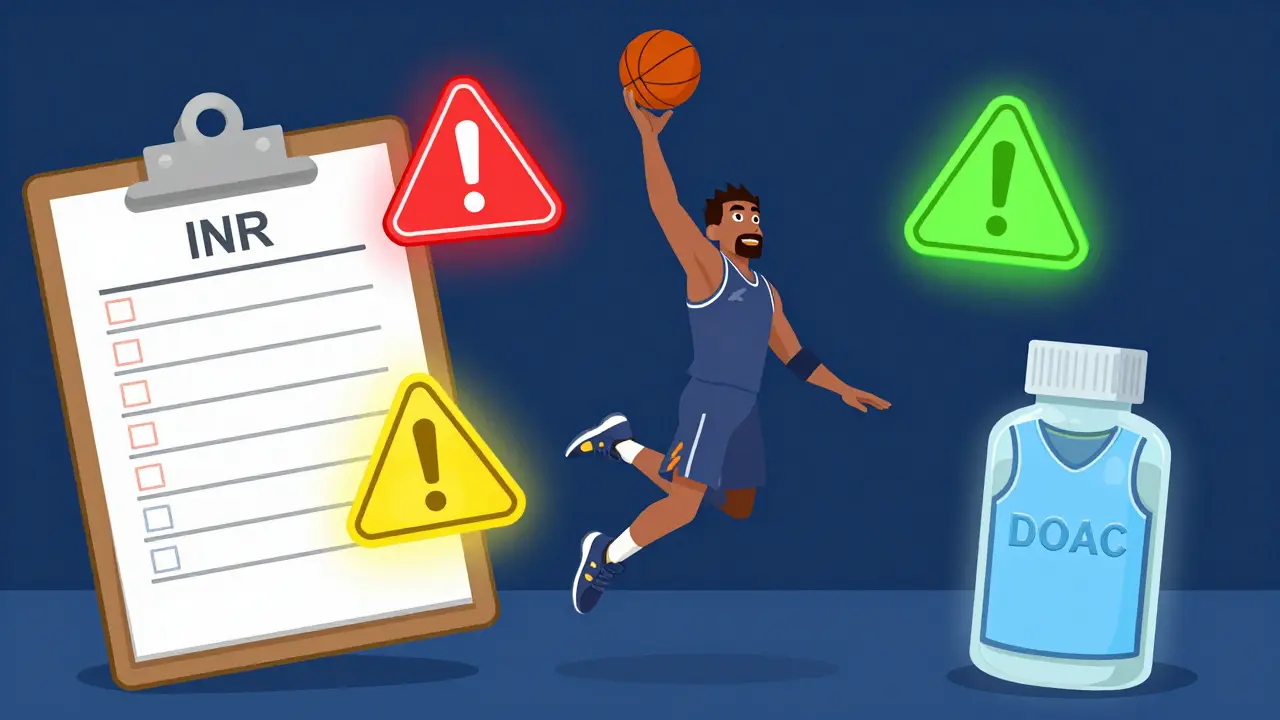
There are two main types of blood thinners used in athletes: warfarin and direct oral anticoagulants (DOACs). They work differently, and that matters a lot.Warfarin has been around for decades. It’s cheap. But it’s unpredictable. Your INR level-the measure of how thin your blood is-can swing wildly based on what you eat, what other meds you take, or even how much you sleep. You need weekly blood tests. And if you want to reduce your risk before a game? You can’t just skip a dose. Warfarin sticks around for days. A single missed dose won’t lower your risk fast enough.
DOACs like apixaban, rivaroxaban, and dabigatran are newer. They clear your system faster. Apixaban lasts 8-15 hours. Rivaroxaban, 5-13 hours. That’s a game-changer. You can time your dose so that by game time, your blood isn’t as thin. Studies show this approach reduces bleeding risk by 37% during competition without increasing the chance of clots.
A 2025 JAMA study of over 160,000 patients found apixaban had the lowest risk of both new clots and major bleeding compared to rivaroxaban and warfarin. For athletes, that makes it the preferred choice-unless they have a mechanical heart valve. In that case, warfarin is still the only option.
Four Proven Strategies to Stay Active Safely
If you’re an athlete on anticoagulants, you’re not out of the game. Here’s what works in real life:- Switch to low-risk sports-Running, swimming, or cycling with a helmet and pads can cut major bleeding risk from 8.2% to 1.9%. Protective gear isn’t optional-it’s essential.
- Adjust warfarin before events-Some doctors reduce the dose 3-4 days before a competition to bring INR down to 1.5-1.8. This lowers bleeding risk but increases clot risk slightly-from 0.2% to 0.8% per event. Only do this under strict supervision.
- Use LMWH with timed breaks-Low molecular weight heparin (like enoxaparin) is given as a daily shot. You can skip the dose 24 hours before competition. This maintains clot protection while giving your blood time to thicken slightly. Studies show a 42% drop in bleeding events with this method.
- Time your DOAC dose-This is the most precise approach. A professional cyclist in a 2023 case study took apixaban at 8 a.m. on the day before his race. By race day at 10 a.m., his drug levels were below the therapeutic range-safe for contact-but still high enough to prevent clots. This requires special blood tests (anti-Xa assays) to confirm levels. Not every clinic can do this-but more are starting to.
What the Experts Say
Dr. Paul D. Thompson, who helped write the first official guidelines for athletes on blood thinners, puts it simply: “You’re not choosing between being active or being safe. You’re choosing how to be both.”Dr. Matteo Palamà, who led a major 2023 review in the European Heart Journal, says DOACs are ideal for athletes because they don’t cause a dangerous “rebound” effect when stopped briefly. That’s not true with older drugs like warfarin.
But there’s a problem: almost no clinical trials include athletes. Only 0.3% of participants in major anticoagulation studies are competitive athletes. That means most guidelines are based on data from older, sedentary patients. We’re guessing what works for runners and cyclists based on what works for 70-year-olds with atrial fibrillation. It’s not ideal.

Rules and Regulations in Sports
Professional leagues are catching on. The NBA requires players on warfarin to keep their INR below 2.0 to play. The Union Cycliste Internationale (UCI), which governs cycling, allows DOACs but requires athletes to skip their dose 24 hours before competition and provide documentation.The World Anti-Doping Agency confirmed in 2020 that therapeutic anticoagulation isn’t doping-as long as it’s properly reported. That’s important. Athletes shouldn’t fear being penalized for managing a medical condition.
Today, 78% of athletic trainers consult formal anticoagulation guidelines before clearing an athlete to play-up from just 32% in 2015. That’s progress.
The Future: Personalized Medicine for Athletes
The next big leap is precision dosing. In a 2023 NIH study, researchers used wearable sensors to track impact forces in 12 sports. They combined that with blood tests and pharmacokinetic models to predict the safest time to compete for each athlete.The result? 92% of athletes could find a dosing window that kept them protected and safe. 68% were able to continue their sport with minimal changes to their routine.
New devices like the CoaguChek INRange system-cleared by the FDA in March 2023-let athletes test their INR at home with 95% accuracy. No more weekly clinic visits. Just a finger prick and a quick readout.
By 2028, the American College of Sports Medicine predicts a 40% increase in athlete anticoagulation consultations. As more people stay active into older age, and as more athletes develop conditions like AF, this won’t be a niche topic anymore. It’ll be standard care.
What You Should Do Now
If you’re on blood thinners and want to play sports:- Don’t guess. Talk to a cardiologist who understands sports medicine.
- Get your sport classified-high, intermediate, or low risk.
- Ask about switching to apixaban if you’re on warfarin and don’t have a mechanical valve.
- If you’re in an intermediate-risk sport, ask about timed dosing or LMWH interruption.
- Wear protective gear-even in low-risk sports. Helmets, pads, and mouthguards save lives.
- Track your medication schedule. Use a calendar or app. Missing a dose can be dangerous.
Being on anticoagulants doesn’t mean you have to sit on the bench. It means you need a smarter plan. With the right approach, you can still compete, train, and stay healthy-without putting your life at risk.





11 Comments
Anu radha
I know someone who plays pickleball on warfarin and swears by her helmet and knee pads. She says the biggest thing isn’t the sport-it’s knowing when to back off. I just hope more doctors talk to patients like real humans, not just lab values.
Victoria Rogers
lol so now we’re giving medical advice to athletes? next they’ll let you play rugby with a pacemaker. america is so soft now. back in my day we just taped our ribs and played through the pain. why do we need all these fancy blood tests? just stop being weak.
CAROL MUTISO
Let’s be real-this isn’t just about anticoagulants. It’s about how we define courage. Is it charging into a tackle with a bleeding risk? Or is it showing up every day, adjusting your meds, wearing the pads, and still showing up even when the system doesn’t have your back? The real hero isn’t the one who plays hard-it’s the one who plays smart and refuses to be erased by outdated norms. Also, apixaban is the MVP here. 🙌
Erik J
Has anyone looked at how DOAC clearance varies by muscle mass? I’m curious if athletes metabolize them differently than sedentary folks. The half-lives listed are from general populations. What if a 220lb linebacker clears rivaroxaban faster than a 140lb office worker? No one’s studied that.
BETH VON KAUFFMANN
Let’s not romanticize this. The 1.3% bleeding rate in low-risk sports? That’s still 1 in 77 athletes. That’s not ‘safe.’ That’s statistically acceptable to bureaucrats. And the ‘timed dosing’ strategy? Sounds like a gamble with someone’s brain. If you’re going to play contact sports, just get a VAD and be done with it.
Martin Spedding
DOACs? More like DOAC-FAIL. You think skipping a dose before a game is safe? Bro, your clot risk spikes faster than your ex’s Instagram likes. This whole thread is just rich people with fancy watches trying to play rugby. Get a hobby.
Jessica Salgado
I had a cousin who was on warfarin after a pulmonary embolism and still ran marathons. She used to test her INR every morning with a finger prick and adjust her dose like it was a coffee schedule. She didn’t just survive-she thrived. But no one told her it was possible until she found a sports cardiologist who actually listened. That’s the real breakthrough: not the drugs, but the doctors who care.
amanda s
Why are we even letting these people play? It’s not fair to the other athletes. If you’re on blood thinners, you’re a liability. The NBA should ban you. No one wants to be the guy who accidentally kills someone on the court. This isn’t inclusion-it’s negligence.
Peter Ronai
Apixaban? Please. That’s just Big Pharma’s way of charging you $500 a month for a drug that’s barely better than warfarin. And don’t get me started on those ‘wearable impact sensors’-next they’ll sell you a $2000 smart sock that tells you not to jump. This is capitalism turning medical care into a video game.
Steven Lavoie
Coming from India, I’ve seen people play cricket with stents, pacemakers, even after heart surgery. We don’t have access to DOACs or wearable monitors, but we still play. It’s not about the tech-it’s about community. Someone’s grandma in Kerala plays badminton on warfarin and teaches kids how to fall safely. That’s the real medicine right there.
Brooks Beveridge
Hey everyone-just wanted to say this thread is amazing. 💪 Seriously. You’re not just talking about meds or sports-you’re talking about dignity, adaptation, and refusing to let a diagnosis define your limits. Keep pushing. Keep asking questions. And if you’re out there playing while on blood thinners? You’re not broken. You’re brilliant. 🙏❤️