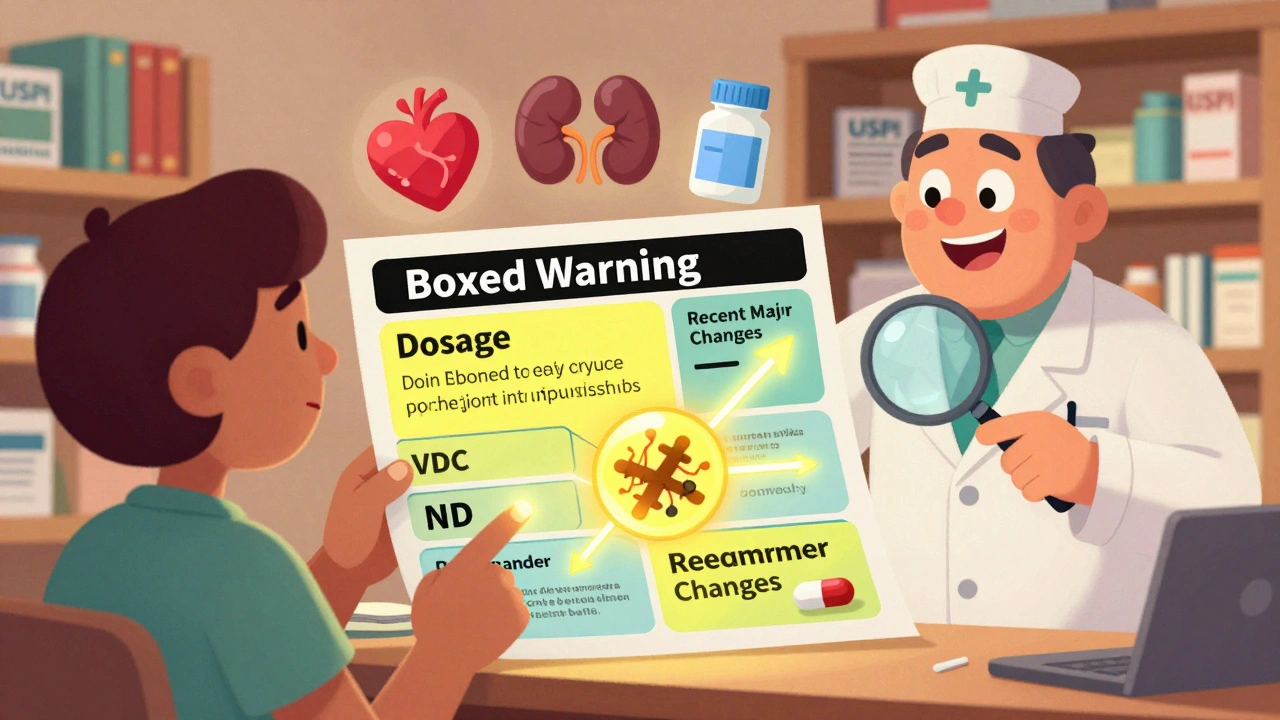
When you or someone you care about is prescribed a new medication, the label that comes with it isn’t just a piece of paper-it’s a legal document packed with life-saving details. But it’s also dense, packed with medical jargon, and organized in a way that can feel overwhelming. The U.S. Food and Drug Administration (FDA) doesn’t make these labels easy to read by accident. They’re designed to give healthcare providers the exact information they need to prescribe safely. But if you’re not a doctor or pharmacist, knowing where to look and what to ignore can make all the difference.
What You’re Looking At: The FDA’s Standardized Drug Label
The official drug label you’re reading is called the United States Prescribing Information (USPI). It’s not created by the drug company alone-it’s reviewed, approved, and enforced by the FDA. Since 2006, all prescription drug labels in the U.S. have followed the same 17-section format, mandated under Title 21 of the Code of Federal Regulations. This standardization was introduced because, before then, drug labels varied wildly in format. A 2020 analysis from the NCBI Bookshelf found that over half of medication errors tied to dosing, timing, or route of administration were linked to confusing or inconsistent labeling.
The label has three main parts: the Highlights, the Table of Contents, and the Full Prescribing Information (FPI). The Highlights are just half a page long and meant to give you the most urgent info at a glance. But here’s the catch: the FDA requires this section to include a disclaimer saying it’s incomplete. That means if you only read the Highlights, you’re missing critical details.
Section 1: Indications and Usage
This is where you find out what the drug is officially approved to treat. Don’t assume it works for every condition your doctor might prescribe it for. For example, a drug might be FDA-approved only for type 2 diabetes, but a doctor might prescribe it off-label for weight loss. The label will only list the approved uses. Look for phrases like “indicated for the treatment of…” and pay attention to any restrictions-like age limits or prior treatment failures.
Also, you’ll see the drug’s Established Pharmacologic Class (EPC) here. That’s the FDA’s standardized way of describing how the drug works. For instance, “SGLT2 inhibitor” tells you it blocks a kidney transporter to lower blood sugar. Knowing this helps you understand how it fits with other meds you’re taking.
Section 2: Dosage and Administration
This section tells you how much to take, how often, and how to take it. But it’s not just “take one pill daily.” It includes adjustments for kidney or liver problems, weight-based dosing for children, and even instructions for patients on dialysis. The FDA updated guidance in March 2024 to require clearer presentation of these adjustments-because getting this wrong can lead to overdose or underdose.
Look for phrases like “reduce dose in patients with moderate renal impairment.” If you have kidney disease, diabetes, or are elderly, this section is non-negotiable. Don’t skip it. Even if your doctor gives you a dose, double-check that it matches what’s listed here.
Section 5: Warnings and Precautions (Including the Boxed Warning)
This is where the FDA puts its most serious red flags. And it starts with the Boxed Warning-the only section in the entire label that’s printed in a bold black border. It’s the FDA’s way of saying: “This drug can kill you if used incorrectly.”
Boxed Warnings cover things like liver failure, heart rhythm problems, suicidal thoughts, or severe allergic reactions. If your drug has one, read it like you’re reading a fire alarm-don’t skim. For example, some antidepressants carry a Boxed Warning for increased suicide risk in young adults under 25. That doesn’t mean you shouldn’t take it-but it means you need to monitor closely and report any mood changes immediately.
Below the Boxed Warning, the rest of Section 5 lists other serious risks: interactions with other drugs, risks during surgery, or conditions that make the drug unsafe. If you have high blood pressure, heart disease, or are pregnant, this section could change whether you take the drug at all.
Section 6: Adverse Reactions
This section lists side effects-but not all side effects are created equal. The FDA requires drug companies to report side effects observed in clinical trials, with frequency categories: very common (over 10%), common (1-10%), uncommon (0.1-1%), rare (0.01-0.1%), and very rare (under 0.01%).
What’s missing here? Real-world data. Clinical trials involve healthy volunteers and tightly controlled conditions. Side effects that show up after thousands of people use the drug over years might not appear here. But this is still your best starting point. If you’re told “headache is common,” and you get one, you know it’s likely not an emergency. But if you develop swelling in your throat or chest pain, don’t check this section-you call 911.
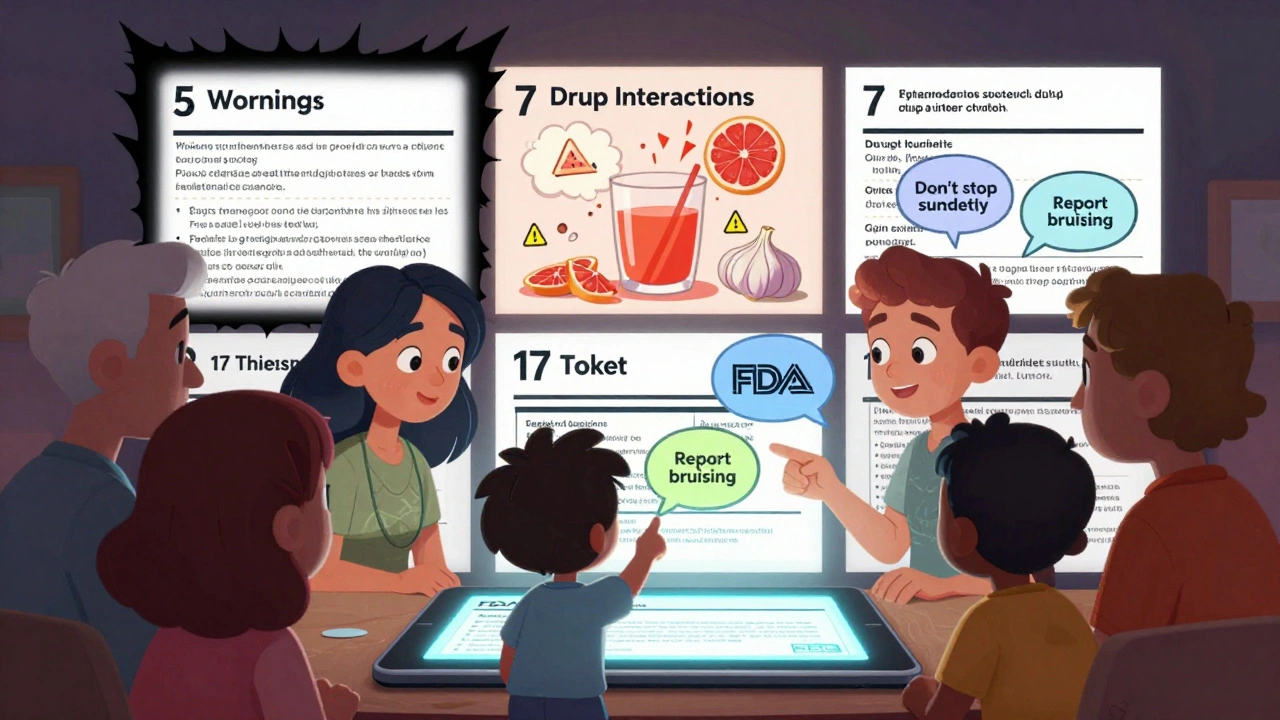
Section 7: Drug Interactions
Most people don’t take just one drug. The average American on prescription meds takes four. This section tells you which other drugs, supplements, or even foods can cause dangerous reactions.
For example, statins (cholesterol drugs) can cause muscle damage when taken with grapefruit juice. Blood thinners like warfarin can become too strong if you start taking garlic supplements. The label will list specific drugs to avoid, and sometimes even the mechanism-like “inhibits CYP3A4 enzyme.” If you’re unsure what that means, ask your pharmacist. They’re trained to spot these risks.
And don’t forget: over-the-counter meds, herbal products, and even vitamins can interact. A 2023 study by the Institute for Safe Medication Practices found that 12.7% of medication errors in pharmacies came from unrecognized interactions with supplements.
Section 8: Use in Specific Populations
This section answers questions like: Is it safe during pregnancy? Can I breastfeed while taking this? Is it approved for kids? For older adults?
Many drugs are tested mostly on healthy adults between 18 and 65. But older patients, pregnant women, and children often metabolize drugs differently. For example, some antidepressants are not recommended for teens because of suicide risk. Others are cleared for use in pregnancy but only in certain trimesters.
If you’re pregnant, nursing, or caring for a child or elderly parent, this section is essential. Don’t assume your doctor knows every detail-many don’t memorize all the nuances. The label is your backup.
Section 16: How Supplied / Storage and Handling
Most people skip this-but it’s critical for safety. Here you’ll find the National Drug Code (NDC), a 10-digit number broken into three parts: labeler code, product code, and package code. This number identifies the exact brand, strength, and packaging of your drug.
Why does this matter? Because look-alike, sound-alike drugs cause real harm. A pill labeled “Lisinopril 10 mg” from one manufacturer might look almost identical to another’s. The NDC tells you which one you’re getting. If you refill your prescription and the pills look different, check the NDC. If it doesn’t match your last fill, ask your pharmacist.
This section also tells you how to store the drug-refrigerated? Keep away from light? Don’t store in the bathroom. Improper storage can make a drug less effective or even dangerous.
Section 17: Patient Counseling Information
This is the FDA’s attempt to bridge the gap between clinical language and patient understanding. It’s a list of talking points that providers should use when explaining the drug to patients.
Examples: “Take on an empty stomach,” “Avoid alcohol,” “Do not stop suddenly,” “Report any unusual bruising.”
Here’s the problem: only 38.2% of providers use this section in real conversations, according to a 2024 audit of 2,500 patient visits. That means you might not hear these critical points unless you ask. So before you leave the office, say: “Is there anything in the Patient Counseling section I should know?”
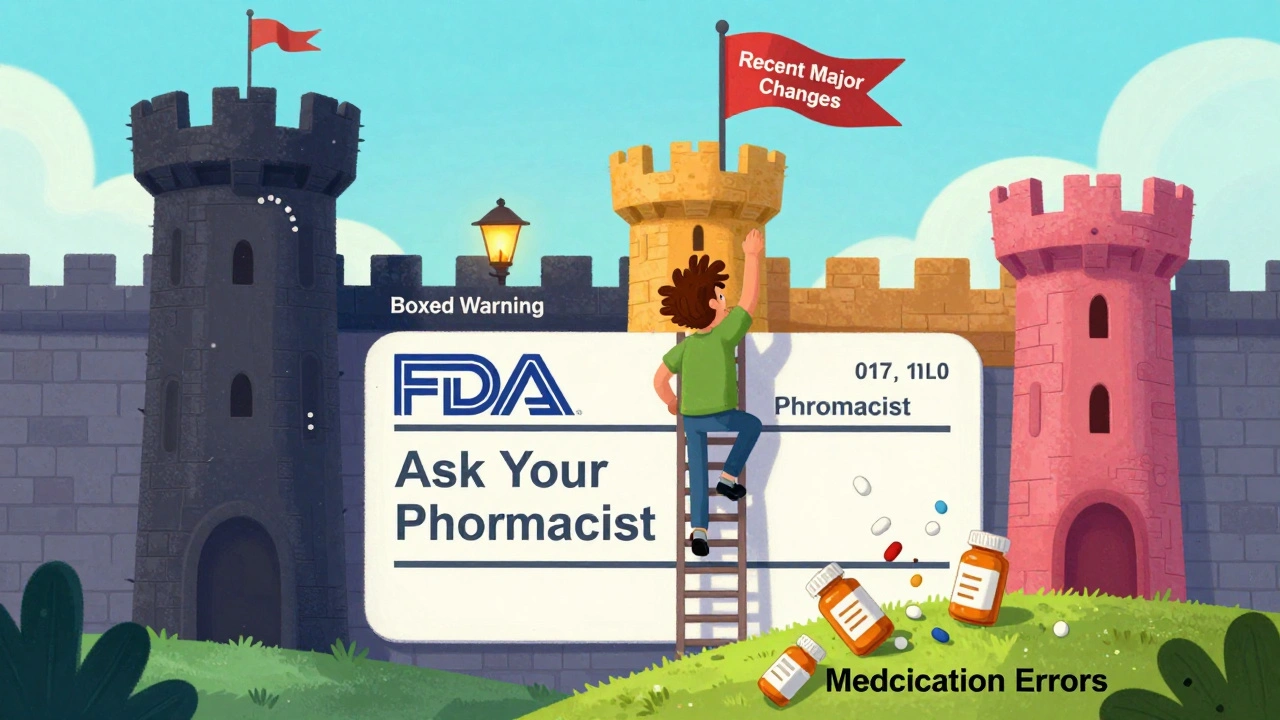
The Hidden Section: Recent Major Changes
Since 2018, every label must include a section titled “Recent Major Changes.” This lists every section of the label that was updated in the last six months. It’s a tiny box, usually at the top of the Full Prescribing Information.
Why care? Because drug safety updates happen constantly. A new warning about heart rhythm issues, a dosage change for kidney patients, a newly discovered interaction-these all get added here. A 2024 study in the Journal of Clinical Pharmacology found that this section reduced the lag between label updates and clinical adoption by 35%.
Before you take any new prescription, check this section. If something changed recently, ask your doctor or pharmacist: “What’s different now?”
How to Use This Information
For healthcare providers: Start with the Boxed Warning and Highlights. Then go to Sections 1, 2, and 7. That’s the core for prescribing. Use Section 17 to guide patient conversations.
For patients and caregivers: Don’t rely on the Highlights. Download the full label from the FDA’s website or ask your pharmacist for a printed copy. Focus on Sections 2, 5, 7, and 17. Write down the key points and bring them to your next appointment.
For pharmacists: Pay close attention to Section 16 (NDC) to prevent dispensing errors. Use Section 2 for dose adjustments and Section 7 for interaction checks. The American Pharmacists Association recommends reviewing these sections every time you fill a new prescription.
What’s Changing Soon
The FDA is testing a new approach called the Labeling Modernization Pilot Program. Fifteen drug companies are experimenting with digital labels that let you click to expand sections, toggle between professional and patient-friendly language, or even watch short videos explaining risks.
By 2027, the FDA expects most new drugs to include these digital components. But for now, the paper label is still the law. And until digital versions are universally adopted, the 17-section format is your only reliable source.
The goal? To reduce medication errors by up to 29%, according to a 2023 Johns Hopkins study. That’s not just a statistic-it’s a person avoiding a hospital stay, a family avoiding a tragedy.
Final Tip: Always Cross-Check
The FDA label is the gold standard-but it’s not perfect. Sometimes updates are delayed. Sometimes information is missing. Always cross-check with your doctor or pharmacist if something doesn’t make sense. If you see conflicting info between your pill bottle, your doctor’s note, and the FDA label, trust the label-but ask why the discrepancy exists.
Drug labels aren’t meant to be easy. They’re meant to be precise. And when you know how to read them, you’re not just following instructions-you’re taking control of your health.
Can I rely only on the Highlights section of the FDA drug label?
No. The Highlights section is designed to be a quick summary, but the FDA requires it to include a disclaimer that it’s incomplete. Critical details like dosage adjustments for kidney disease, drug interactions, and specific warnings are only in the Full Prescribing Information. Relying only on Highlights can lead to dangerous misunderstandings-especially for patients with chronic conditions or those taking multiple medications.
What is a Boxed Warning and why does it matter?
A Boxed Warning is the FDA’s strongest safety alert. It’s printed in a bold black border and highlights the most serious risks of a drug-like liver failure, heart rhythm problems, or increased suicide risk. These are risks that can cause death or permanent harm. If your drug has a Boxed Warning, you must understand it before taking it. It doesn’t mean you can’t take the drug, but it means you need to monitor closely and report any warning signs immediately.
How do I know if my drug’s label has been updated recently?
Look for the “Recent Major Changes” section at the top of the Full Prescribing Information. It lists every section of the label that was updated in the last six months. This could include new warnings, dosage changes, or added drug interactions. If you refill your prescription and notice new side effects or your doctor changed your dose, check this section. It’s updated whenever the FDA approves a safety revision.
What’s the NDC code and why should I care about it?
The NDC (National Drug Code) is a 10-digit number that uniquely identifies your drug’s manufacturer, strength, and packaging. It’s listed in Section 16. If you get a refill and the pills look different, check the NDC. If it doesn’t match your previous fill, your pharmacy might have switched brands. Look-alike, sound-alike drugs cause 12.7% of dispensing errors, according to ISMP. The NDC ensures you’re getting exactly what was prescribed.
Can I trust the side effects listed in the FDA label?
The side effects listed are from clinical trials, which involve a limited number of people under controlled conditions. Some rare or long-term side effects may not appear until after thousands of people use the drug. But the frequency categories (very common, common, rare) help you judge risk. If a side effect is listed as “common,” it’s likely to happen. If it’s “rare,” it’s unlikely-but still possible. Always report new or unusual symptoms to your doctor, even if they’re not listed.
Where can I find the official FDA drug label?
You can find the full FDA-approved label for any prescription drug on the Drugs@FDA website (https://www.accessdata.fda.gov/scripts/cder/daf/). Search by brand or generic name. The label you download there is the same one your doctor and pharmacist use. Always use this source over random websites or drug apps, which may be outdated or inaccurate.

13 Comments
James Kerr
Just read the full label for my new blood pressure med last night-mind blown. The Boxed Warning about dizziness? I had no idea it could make me fall. Thanks for breaking this down like I’m not a doctor 😅
Jim Schultz
Oh, so you’re telling me that the average person-yes, the one who can’t even read a nutrition label without squinting-is expected to parse 17 sections of FDA jargon? Brilliant. Absolutely brilliant. The FDA didn’t design this for patients-they designed it to cover their own liability. Pathetic.
Kidar Saleh
In the UK, we have the Summary of Product Characteristics-similar structure, but far less accessible. The fact that the FDA even tries to standardize this is admirable. Still, if you don’t have a pharmacy degree, you’re left guessing. We need plain-language summaries, mandatory with every script.
Chloe Madison
THIS. IS. EVERYTHING. I work in patient advocacy, and I hand out printed FDA labels to every senior I help. They don’t know the difference between ‘common’ and ‘rare’ side effects-until they start Googling and panic. Give them the real info. Trust me, they’ll thank you later.
Makenzie Keely
Section 16-the NDC code-is the most underrated part of the entire label. I once caught a pharmacy substituting my generic lisinopril with a different manufacturer’s version-same active ingredient, different fillers. My knees swelled up. Checked the NDC. Matched my last prescription. Called the pharmacy. They apologized. Saved me from a hospital visit. Always check the NDC.
Francine Phillips
Yeah i read the highlights and just take the pill
Katherine Gianelli
My grandma used to say, ‘If it’s not in the bottle, it’s not in the plan.’ But she didn’t know the bottle wasn’t the whole story. I printed out the full label for her diabetes med, circled the kidney dose part, and taped it to her pillbox. She’s been fine for two years now. Small steps, big wins.
Joykrishna Banerjee
Let me be blunt: if you can’t comprehend a 17-section prescribing document, you shouldn’t be on polypharmacy. The average patient is functionally illiterate when it comes to pharmacokinetics. This isn’t a labeling issue-it’s a societal failure. Stop blaming the FDA. Fix the education system.
Myson Jones
My pharmacist actually showed me the ‘Recent Major Changes’ section when I picked up my new antidepressant. I didn’t even know that existed. She said, ‘This is where they tell you if it just got more dangerous.’ I’m not gonna lie-I cried a little. Someone cared enough to show me.
parth pandya
u kno what i did? i just ask my doc to explain it in simple words. no need to read all that. they paid for med school not me lol
Gavin Boyne
So the FDA makes a 50-page legal document… and then says ‘just ask your pharmacist.’ Which is like handing someone a nuclear launch code and saying ‘just call the guy who gave you the coffee.’
Rashi Taliyan
I’m from India, and here, we get no labels at all-just a small slip with the name and dose. Sometimes not even that. I wish I’d known this when my mother was on heart meds. The silence around this is dangerous. Thank you for sharing.
Kara Bysterbusch
I downloaded the label for my child’s ADHD med. The ‘Use in Pediatric Populations’ section said ‘not approved for children under 6’-but my doctor prescribed it anyway. I asked why. He said, ‘Off-label use is common.’ Then I asked, ‘Is it safe?’ He said, ‘We’ll monitor closely.’ So I printed the label, highlighted the section, and put it in his file. Now he gets a different med. Knowledge is power.