MH Response Time Calculator
Malignant hyperthermia can cause rapid, life-threatening complications. The article states that survival rates are close to 100% if dantrolene is given within 20 minutes of first symptoms, but drop significantly after 40 minutes.
This calculator shows the approximate survival chance based on time to treatment.
Your Survival Chance
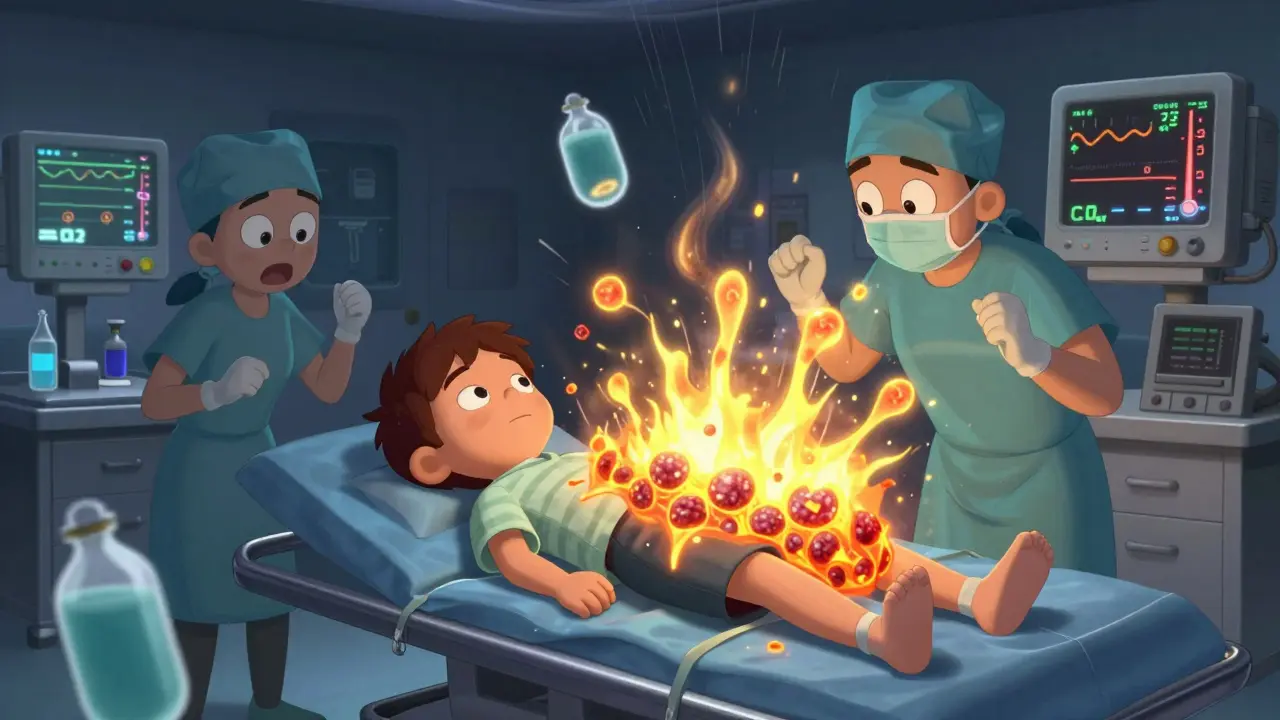
When you walk into a hospital for surgery, you expect to be safe. You trust the team to handle the anesthesia, monitor your vital signs, and keep you stable. But for a small number of people, a routine procedure can turn deadly in minutes-not because of a mistake, but because of a hidden genetic flaw. This is malignant hyperthermia, a rare but catastrophic reaction to certain anesthesia drugs. It doesn’t happen because of poor care. It happens because your body reacts to the drugs in a way no one could predict unless they knew your genes.
What Exactly Is Malignant Hyperthermia?
Malignant hyperthermia (MH) is a genetic disorder that causes your muscles to go into a dangerous, uncontrollable spasm when exposed to specific anesthesia agents. It’s not an allergy. It’s not an overdose. It’s a chemical chain reaction inside your muscle cells that turns your body into a furnace.
The trigger? Two types of drugs commonly used in general anesthesia: volatile gases like sevoflurane, desflurane, and isoflurane, and the muscle relaxant succinylcholine. These drugs are safe for 99.9% of patients. But if you carry a mutation in the RYR1 gene-found in about 70% of MH-susceptible people-your muscle cells release calcium like a broken valve. That calcium keeps your muscles locked in contraction. Your body burns through oxygen. Your metabolism goes into overdrive. And your core temperature can spike from normal to over 109°F (43°C) in under an hour.
This isn’t theoretical. In the 1960s, four young patients died during routine tonsillectomies in Australia. Their deaths led to the first formal description of MH. Today, it still kills. But only if it’s not caught fast.
How Do You Know It’s Happening?
There’s no blood test you can take before surgery to confirm you’re at risk. That’s why recognition during the procedure is everything. The signs are subtle at first, then explosive.
- Heart rate spikes-over 120 beats per minute in an adult, even if you’re not stressed or bleeding.
- End-tidal CO2 rises-past 55 mmHg, even when you’re breathing well. This is often the earliest clue.
- Muscle rigidity-especially in the jaw (masseter spasm) right after succinylcholine is given.
- Body temperature climbs-fast. More than 104°F (40°C) is a red flag. It can hit 110°F in 20 minutes.
- Brown or cola-colored urine-a sign your muscles are breaking down (rhabdomyolysis).
- Low blood pH-acidosis from the metabolic chaos.
One anesthesiologist on Reddit described catching it at 32 minutes into surgery when a 28-year-old man’s CO2 hit 78 mmHg and his heart rate jumped to 142. He’d been stable before. No signs of infection. No bleeding. Just a silent genetic time bomb ticking.
Why Is Timing Everything?
The difference between life and death isn’t just about treatment-it’s about speed. If dantrolene is given within 20 minutes of the first sign, survival rates are close to 100%. If it’s delayed past 40 minutes, half the patients die.
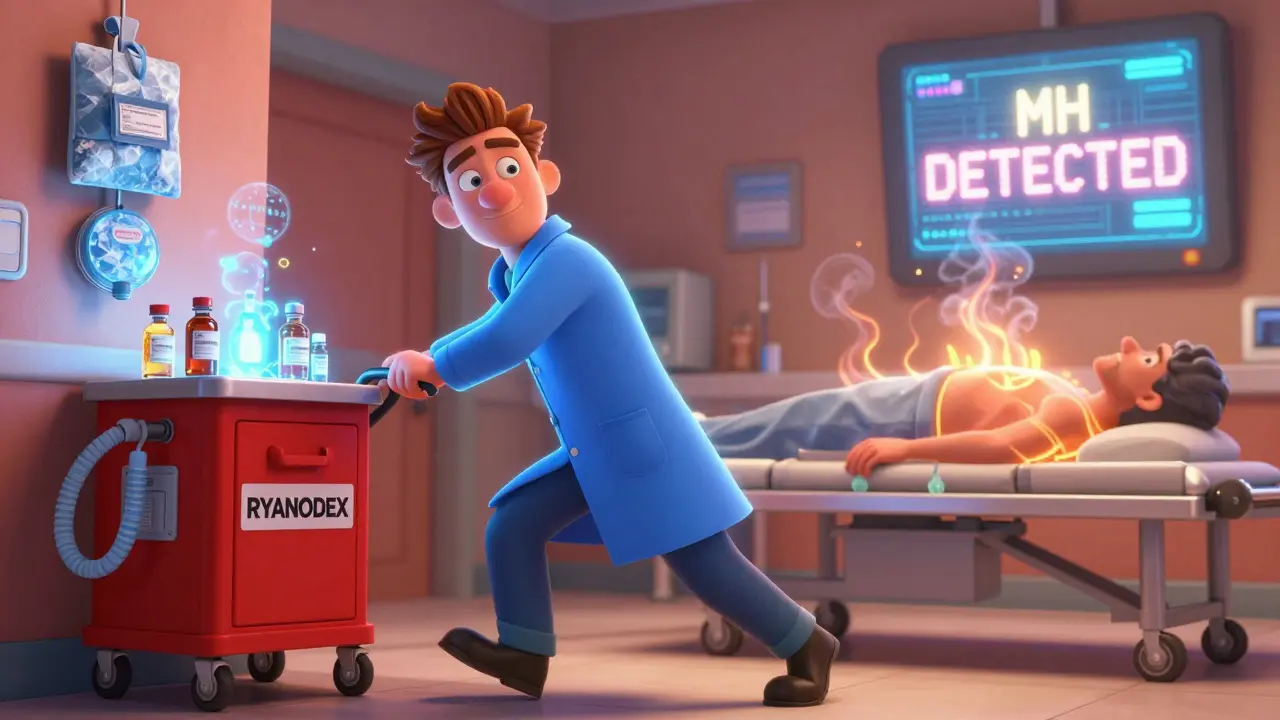
Dantrolene is the only drug that stops MH. It works by blocking calcium release in muscle cells. But it’s not easy to use. The old version, Dantrium®, took 22 minutes to mix and prepare. That’s too long when your patient is boiling alive.
That’s why Ryanodex® became the new standard. Approved by the FDA in 2014, it’s a powder that dissolves in just one minute. Each vial costs around $4,000. A single adult case may need 10 to 20 vials. That’s $40,000 to $80,000 in one drug, all in minutes.
Hospitals are required to keep at least 36 vials on hand-$144,000 worth of emergency medicine-just in case. But not all do. Rural hospitals often can’t afford it. Some have had stockouts. And if you’re having surgery in one of those places, you’re gambling.
Who’s at Risk?
You might think family history is the biggest clue. But here’s the shocker: 29% of MH cases happen in people with no known family history. That means you could be carrying the gene and never know it.
Children are at higher risk-especially those getting tonsillectomies. The incidence in pediatric cases is about 1 in 3,000, compared to 1 in 50,000 for adults. And while MH can strike anyone, it’s more common in people with certain muscle conditions like central core disease or multiminicore disease. But even healthy, athletic teenagers can be affected.
Genetic testing for RYR1 mutations exists. It costs $1,200 to $2,500 and has 95% accuracy for known mutations. But it’s not routine. Most people aren’t tested unless they’ve had a previous MH episode or have a close relative who did. And even then, not all mutations are detectable. The science is still catching up.
What Happens After the Crisis?
Surviving an MH episode doesn’t mean you’re out of danger. The muscle breakdown releases myoglobin into your blood, which can crash your kidneys. That’s why treatment doesn’t stop with dantrolene. Doctors give you:
- Ice packs and cold IV fluids to cool you down
- Sodium bicarbonate to fix acidosis
- Insulin and glucose to lower dangerous potassium levels
- Mannitol and furosemide to protect your kidneys
Patients often need to spend days in the ICU. Some need dialysis. Recovery can take weeks. And once you’ve had it, you’re at risk for life. You’ll never be able to receive the triggering anesthetics again.
What Are Hospitals Doing About It?
Leading hospitals now have MH emergency carts-pre-loaded with dantrolene, cooling gear, syringes, and blood gas kits-all within 30 seconds of any operating room. At Mayo Clinic, this cut response time from 22 minutes to under 5 minutes between 2015 and 2022.
Since 2018, the American Society of Anesthesiologists has required annual MH simulation drills for all anesthesia teams. Residents need at least three practice scenarios before they’re trusted to recognize the signs. Still, many facilities don’t comply. A 2022 survey found only 63% of rural surgical centers follow full MHAUS protocols.
There’s also a 24/7 hotline: 1-800-644-9737. Run by the Malignant Hyperthermia Association of the United States, it connects any hospital in crisis with an MH expert in seconds. Since 1997, it’s helped reduce deaths by 37%.
What’s Next for MH?
The future is coming fast. In 2023, the FDA approved an intranasal version of dantrolene for emergency pre-hospital use. It’s expected to hit the market in mid-2024. Imagine paramedics giving it to a patient on the way to the hospital-before they even reach the OR.
Researchers are also testing drugs like S107 that stabilize the RYR1 receptor, potentially preventing the calcium leak before it starts. And in the longer term, CRISPR gene editing could one day fix the mutation in embryos or even adults. Phase I trials are expected by 2027.
On the tech side, anesthesia systems like Epic are now adding AI alerts. If a patient’s CO2, heart rate, and temperature all spike together, the system auto-notifies the team. No more relying on one person to notice three subtle changes.
What Should You Do?
If you’ve had an MH reaction-or a close relative has-you need to:
- Get genetic testing for RYR1 or CACNA1S mutations.
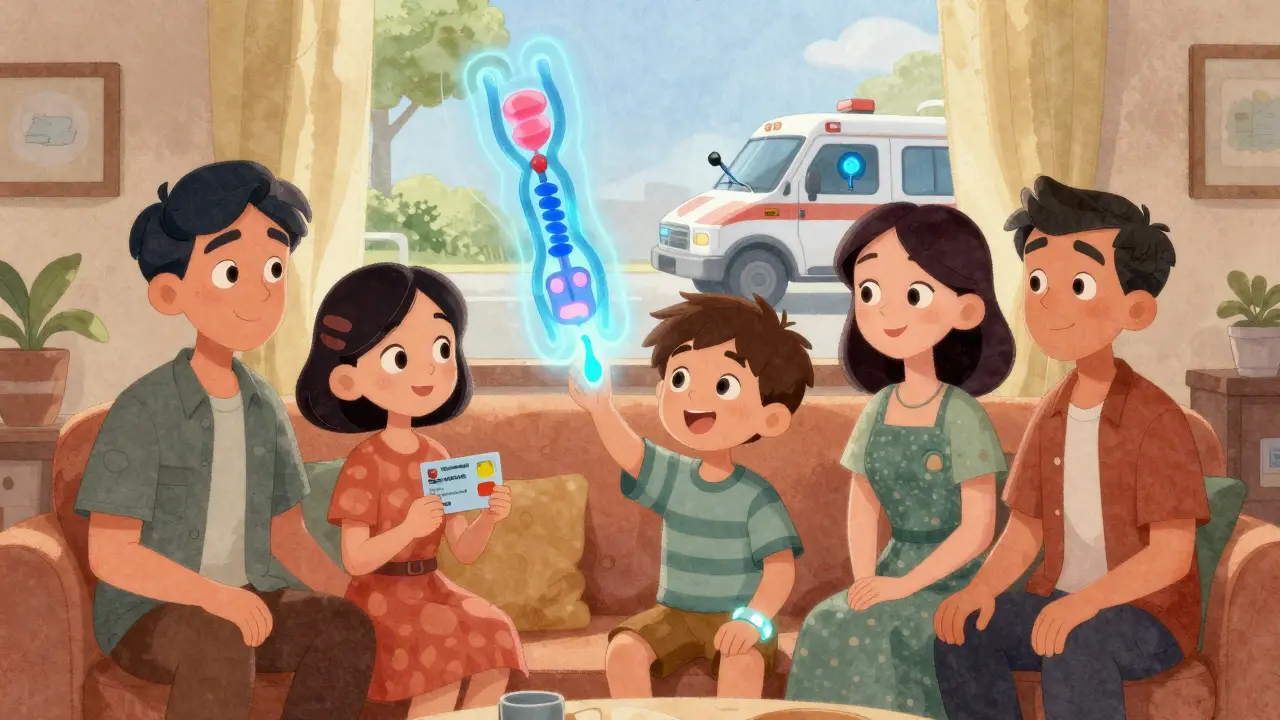
- Wear a medical alert bracelet that says “Malignant Hyperthermia Susceptible.”
- Carry a wallet card with your diagnosis and a list of safe anesthetics.
- Inform every surgeon and anesthesiologist before any procedure-even dental work.
If you’re healthy and have no family history, you’re still at risk. But you can ask: “Does your facility have dantrolene on hand and a written MH protocol?” If they hesitate, consider moving your surgery to a center that does.
Malignant hyperthermia is rare. But when it strikes, it strikes hard. The good news? We know how to stop it. The challenge is making sure every hospital, every anesthesiologist, and every patient is ready when it happens.
Can malignant hyperthermia be inherited?
Yes. Malignant hyperthermia is an autosomal dominant genetic disorder, meaning you only need one copy of the mutated gene-from either parent-to be susceptible. If a parent has the mutation, each child has a 50% chance of inheriting it. But not everyone with the gene will have a reaction; the trigger must be present. Genetic testing can identify the RYR1 or CACNA1S mutations, but not all cases are detectable yet.
What anesthesia drugs are safe if I’m at risk for MH?
Safe alternatives include total intravenous anesthesia (TIVA) with propofol, ketamine, etomidate, or barbiturates. Non-depolarizing muscle relaxants like rocuronium or vecuronium are safe. Local anesthetics like lidocaine and regional blocks (spinals, epidurals) are also safe. Avoid all volatile gases (sevoflurane, desflurane, isoflurane) and succinylcholine. Always inform your anesthesiologist in advance and confirm they’re using MH-safe protocols.
Is malignant hyperthermia the same as heat stroke?
No. While both involve high body temperature, malignant hyperthermia is caused by a genetic defect in muscle cells triggered by anesthesia, not by environmental heat. Heat stroke happens when your body can’t cool itself-like during extreme exercise in hot weather. MH is internal, rapid, and drug-induced. It doesn’t respond to standard heat stroke treatments like ice baths alone-it requires dantrolene to stop the muscle spasm at the cellular level.
Why do some hospitals not keep dantrolene on hand?
Cost and perceived rarity. Each vial of Ryanodex® costs about $4,000, and hospitals are required to stock at least 36 vials-over $144,000. Many small or rural facilities argue the chance of an MH event is too low to justify the expense. But with 1 in 3,000 pediatric cases and 29% of events occurring in people with no family history, the risk is higher than many realize. The FDA now mandates MH kits in all facilities performing general anesthesia, but enforcement varies.
Can you outgrow malignant hyperthermia?
No. Malignant hyperthermia susceptibility is lifelong. Once you have the genetic mutation, you’ll always be at risk when exposed to triggering agents. Even if you’ve had surgery before without a reaction, it doesn’t mean you’re safe. The reaction can occur on the first exposure, or after dozens. The only way to prevent it is avoiding the drugs and having a plan in place.
How accurate is genetic testing for MH?
Current genetic tests for RYR1 mutations have about 95% sensitivity for known variants, but they don’t catch all possible mutations. Only about 70% of MH-susceptible individuals have a detectable RYR1 mutation, and another 1% have CACNA1S mutations. The rest may have unknown or rare variants. A negative genetic test doesn’t rule out susceptibility. The gold standard remains the in vitro contracture test (IVCT), but it’s invasive and only available at specialized centers.




13 Comments
Jon Paramore
MH is a classic RYR1 calcium dysregulation disorder. The end-tidal CO2 rise is the earliest and most reliable sign-often precedes tachycardia. Dantrolene works by inhibiting ryanodine receptor-mediated Ca2+ release. Ryanodex is a game-changer: 1-minute reconstitution vs. 22 minutes for Dantrium. Hospitals without ≥36 vials are operating with unacceptable risk, especially in pediatrics where incidence hits 1:3,000.
Grace Rehman
So we spend $144k on a drug that might save one person in a decade... but we'll bankrupt the system trying to save everyone who might die from a gene they didn't know they had. We're treating a ghost with gold. What if the real problem isn't the drug but the belief that we can control nature with enough money and vials?
Siobhan K.
Grace, you're missing the point. It's not about controlling nature-it's about not letting people die because a hospital couldn't afford a $4k vial. The fact that 29% of cases occur without family history means we're all playing Russian roulette with anesthesia. This isn't philosophy. It's triage.
Brian Furnell
Wait-so if you have a mutation in RYR1, and you’ve never had a reaction before, does that mean the mutation is latent? Or is it just that you’ve never been exposed to the trigger? And if you’ve had anesthesia twice without incident, can you assume you’re safe? I’ve read conflicting info on penetrance... the literature says 30-50% penetrance, but is that still accurate? Also, what about CACNA1S variants? Are they clinically actionable the same way?
Meina Taiwo
Dantrolene saves lives. Stock it.
Adrian Thompson
They’re hiding the truth. MH is real, but the real danger is the pharmaceutical industry pushing expensive drugs while the FDA turns a blind eye. Why is Ryanodex $4,000 a vial? Because they own the patent. Why isn’t there a generic? Because the system is rigged. And now they want to give it intranasally? That’s not progress-that’s control.
Southern NH Pagan Pride
so i heard that the ryr1 gene is linked to the cia and they use it to track people who have had anesthesia... like in the backdoor of the anesthetic machines... they dont want you to know but the data gets sent to a server in denver... and if you ever go to the hospital again theyll know you have the gene... and then theyll deny you care... its all connected
Jackie Be
MY BROTHER ALMOST DIED FROM THIS AND NO ONE TOLD US UNTIL IT WAS TOO LATE!!! NOW WE WEAR THE BRACELETS AND CARRY THE CARDS AND I TELL EVERY DOCTOR I MEET!!! IF YOU’RE READING THIS AND YOU’RE ABOUT TO HAVE SURGERY ASK ABOUT DANTROLENE OR THEY’LL LET YOU DIE AND NO ONE WILL CARE!!!
Swapneel Mehta
It’s scary how much we don’t know about our own bodies. I’m healthy, active, never had surgery-but now I’m thinking about getting tested. If it costs $2,500 and could save my life… it’s not a question. It’s insurance.
Dan Adkins
It is, however, imperative to acknowledge that the current standard of care, as promulgated by the Malignant Hyperthermia Association of the United States (MHAUS), remains the only evidence-based protocol that has demonstrably reduced mortality. To deviate from this standard, absent a robust, peer-reviewed alternative, constitutes a departure from the accepted norms of clinical practice and may constitute negligence under tort law.
Erika Putri Aldana
why do we even do surgery anymore?? like if your body can just randomly explode from anesthesia what’s the point?? just eat kale and pray 🙏
Orlando Marquez Jr
It is noteworthy that the global distribution of RYR1 mutations demonstrates significant geographic heterogeneity, with higher prevalence observed in populations of Northern European descent. This raises important questions regarding equity in genetic screening protocols and resource allocation in low-resource settings where the burden of surgical care is increasing.
Cameron Hoover
One day we’ll look back at this and wonder how we ever lived without knowing. But for now, if you’re reading this-ask the question. Carry the card. Speak up. Someone’s life might depend on it.