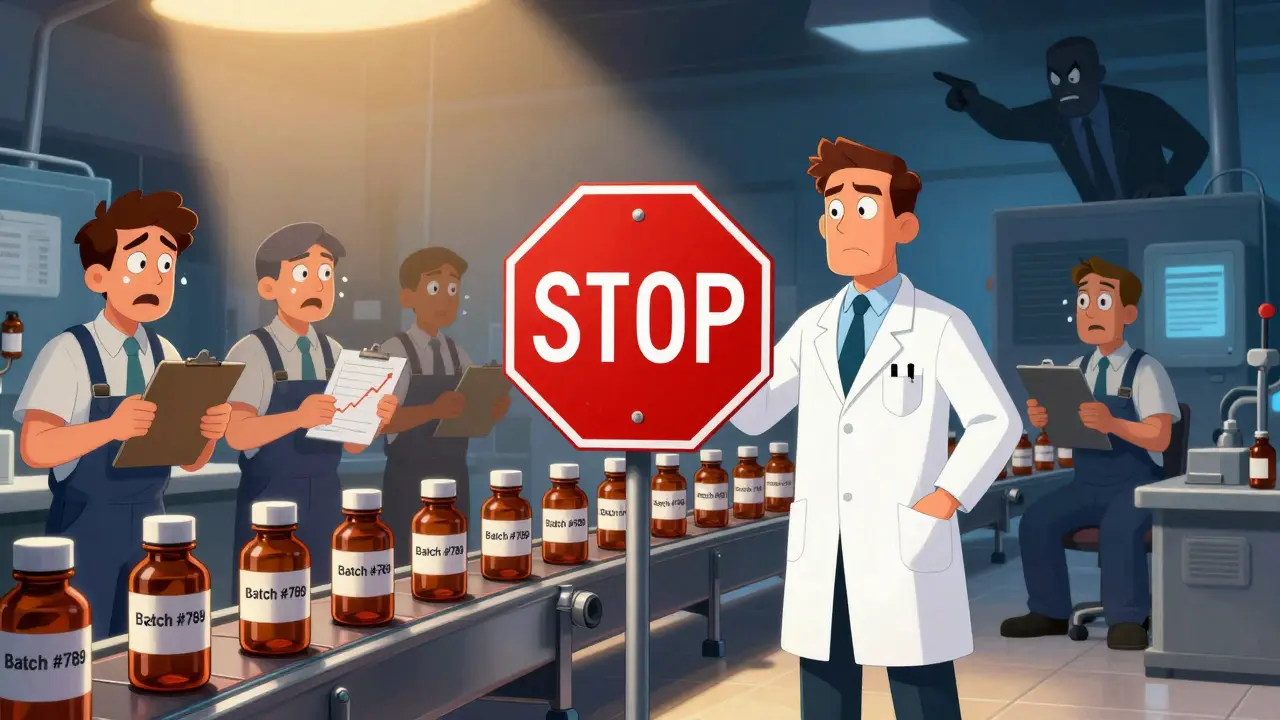
When a batch of medicine is released, someone has to say yes or no. That decision shouldn’t come from the same person who’s being measured on how many units they produced that day. If it does, someone’s getting hurt - not immediately, not obviously, but eventually. That’s the core problem quality assurance units (QUs) were built to solve.
What Exactly Is a Quality Assurance Unit?
A Quality Assurance Unit isn’t just another department. It’s a legally mandated, independent check on production. In pharmaceuticals, nuclear facilities, and other high-risk industries, regulations like FDA’s 21 CFR 211.22 and the EU’s EudraLex Annex 1 demand that quality decisions be separated from production goals. The QU doesn’t make the product. It doesn’t run the machines. It doesn’t get paid based on output. Its only job is to say whether what was made meets the standard - and to stop it if it doesn’t.This isn’t optional. The FDA has issued over 68% of its 2024 warning letters for failures in QU independence. That means nearly seven out of ten companies got flagged because their quality team was too close to production - reporting to a plant manager, sharing budgets with manufacturing, or worse, having the same person wear both hats.
Why Independence Isn’t Just Good Practice - It’s the Law
Think about it: if your production team is under pressure to hit daily targets, and the person who approves each batch works in the same office, reports to the same boss, and shares the same bonus plan - who do you think wins when there’s a borderline issue? The safe choice? Or the fast one?Regulators know this. That’s why the FDA’s 2006 guidance made it clear: quality decisions must remain objective and focused on product quality rather than production metrics or efficiency considerations. The International Atomic Energy Agency saw the same problem in nuclear plants after Three Mile Island. They built oversight models where inspectors can’t be responsible for the areas they’re checking. No exceptions.
In pharma, the QU has the legal right to reject components, packaging, in-process materials, and finished batches. No approval from production. No discussion. Just a stamp: REJECT. And if the QU says no, the batch doesn’t move. That’s not a suggestion. That’s the law.
How Independence Actually Works in Practice
You can’t just say “we’re independent” and call it done. Real independence has structure.- Reporting lines: The QU must report directly to senior leadership - ideally the CEO, CFO, or Board. Not to the plant manager. Not to operations. If they have to go through production to get to the top, independence is a myth.
- Separate budget: 94% of compliant facilities with over 500 employees have a dedicated QU budget. No borrowing from production funds. No cost-cutting pressure on QA staff.
- Authority to halt: 92% of facilities with zero FDA 483 observations have documented procedures allowing the QU to place a quality hold without needing production approval.
- Documentation: 95% of warning letters cite inadequate documentation of QU authority. If you can’t show a chart proving the QU reports to the CEO, you’re already in violation.
Small companies struggle with this. FDA data shows 42% of warning letters to facilities under 50 employees involve QU independence failures. Why? Because one person wears five hats. The solution? Third-party oversight services. The market for outsourced quality units is growing at 14.2% annually - not because companies want to outsource, but because they can’t afford to break the law.
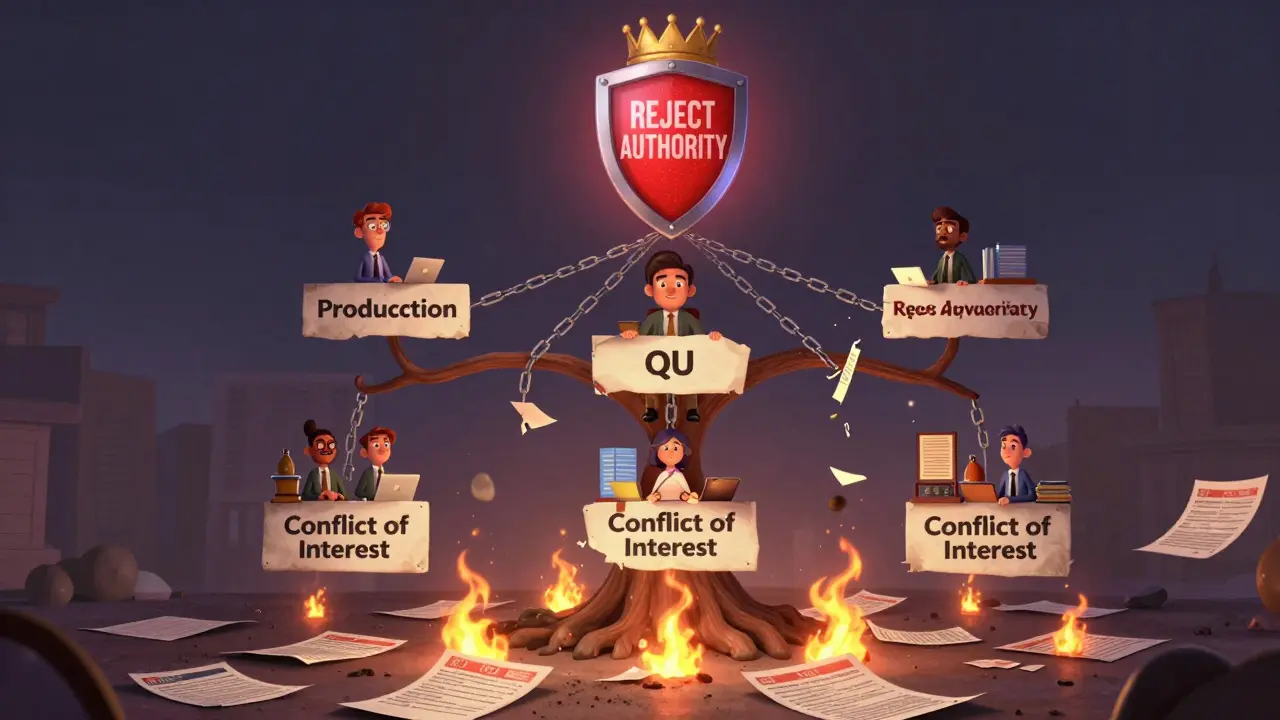
What Happens When Independence Fails
The consequences aren’t theoretical. They show up in warning letters, recalls, and sometimes hospital beds.In 2024, a mid-sized pharmaceutical company in Ohio tried to cut costs by merging QA and production under one manager. Three months later, two critical deviations went uninvestigated before batch release. The product had a contamination issue. Patients got sick. The FDA shut them down. The CEO lost their job. The brand never recovered.
It’s not always that dramatic. More often, it’s slow erosion. A QU staff member is pressured to “just sign off” during a production crunch. A batch is released because “it’s within spec, just barely.” A data entry error gets overlooked because “no one noticed until now.” These aren’t scandals. They’re quiet failures. And they’re why 63% of data integrity violations in pharma trace back to QU integration.
Meanwhile, companies with true independence see 28% faster resolution of critical deviations. They pass inspections 31% more often on the first try. Their quality culture is stronger. Employees trust the system.
Industry Differences: Pharma vs. Nuclear vs. ISO
Not all industries handle this the same way.In pharmaceuticals, the FDA is strict: no overlap. The QU must be completely separate. The EMA allows a little more flexibility - but only if there are clear, documented mechanisms to ensure quality decisions are truly independent. No gray areas.
In nuclear energy, oversight is layered. There’s peer checking, then management review, then independent oversight, then external regulators. The QU doesn’t just check batches - they audit processes, interview staff, and can shut down operations if they see a pattern of risk. They’re trained to speak up, even if it’s uncomfortable. The IAEA found that organizations with this model had 37% fewer critical compliance failures.
Meanwhile, many ISO 9001-certified manufacturers treat quality as advisory. Their QU can recommend, but not reject. That’s fine for furniture or toys. It’s not acceptable for insulin or reactor control rods.
What Skills Do Quality Assurance Staff Need?
This isn’t a paperwork job. It’s a high-stakes role.- Regulatory knowledge: 100% of QU staff must be trained in GMP. No exceptions.
- Statistical process control: 78% of QU roles require understanding of control charts, capability analysis, and trend detection.
- Conflict resolution: 65% of QU staff spend time mediating between production and quality. They need to say no - and do it without creating enemies.
- Experience: The average QU professional has 8.2 years in manufacturing. They’ve seen the mistakes. They know what happens when quality is ignored.
And they need authority. 87% of compliant organizations give their QU direct access to the CEO without going through production management. That’s not a perk. It’s a safeguard.
The Digital Age Is Changing the Game
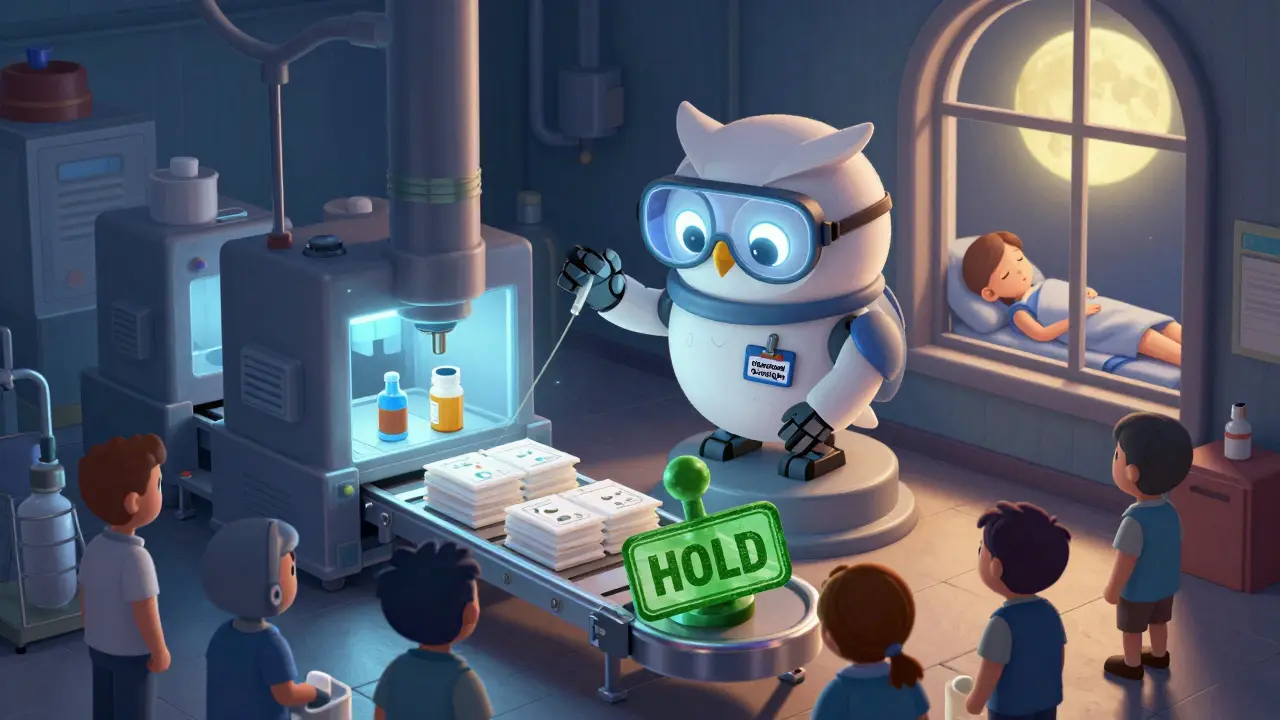
AI-driven production lines are making real-time quality decisions. Sensors flag anomalies. Algorithms auto-approve batches. Who’s watching the watchers?The FDA’s 2025 draft guidance on digital manufacturing warns that “real-time quality decisions blur traditional separation boundaries.” If an algorithm approves a batch, and the QU can’t override it - that’s not independence. That’s automation without accountability.
Future models are moving toward “algorithmic separation”: the system that makes the decision must be different from the system that audits it. The audit trail must be immutable. The QU must still have the final say. The tech is changing, but the principle isn’t.
How to Build or Fix a Quality Assurance Unit
If your QU isn’t independent, fixing it takes time - 6 to 9 months minimum. But it’s worth it.- Map the current reporting lines. Who does the QU report to? Is that person also managing production? If yes, that’s your problem.
- Redesign the structure. Move the QU to report to the CEO or legal/compliance officer. Give them their own budget.
- Document everything. Create an org chart. Write a policy. Get it signed by leadership. Keep it on file.
- Train production staff. Eli Lilly’s “quality ambassadors” program trained 200 production workers on QU procedures. It didn’t blur lines - it built trust. Quality isn’t the enemy. It’s the partner.
- Measure results. Track how many quality holds are issued. How many deviations are resolved faster? How many inspections passed on the first try?
Don’t wait for a warning letter. Don’t wait for a recall. The cost of fixing independence after a failure is far higher than doing it right from the start.
Final Thought: Quality Isn’t a Cost Center - It’s a Lifeline
The global quality assurance market is projected to hit $22.1 billion by 2029. That’s not because companies are spending more on paperwork. It’s because they’re finally realizing that independent oversight isn’t a burden. It’s the reason their product doesn’t kill someone.When a patient takes a pill, they shouldn’t have to wonder if it was approved by someone who was pressured to move it out the door. They should know someone, somewhere, had the power to say no - and did.
Can a production manager also be the quality manager?
No. Regulatory agencies like the FDA and EMA explicitly prohibit this. If the same person is responsible for both hitting production targets and approving product quality, a conflict of interest exists. Even if they’re honest, the perception - and the risk - is too high. The FDA has issued multiple warning letters for exactly this setup. The only exception is in very small operations, where a second qualified person must independently review quality decisions - but even then, the roles must be clearly separated in practice.
What happens if the quality unit doesn’t have authority to reject batches?
If the quality unit can’t reject batches, it’s not a true quality assurance unit - it’s an advisory group. In regulated industries like pharmaceuticals and nuclear, this is a direct violation of FDA 21 CFR 211.22 and EU GMP guidelines. Such facilities are at high risk for regulatory action, including warning letters, product recalls, or shutdowns. Without rejection authority, quality becomes optional - and that’s how unsafe products reach the market.
How small can a company be and still have an independent quality unit?
There’s no minimum size, but small companies (under 50 employees) struggle the most. FDA data shows 42% of independence violations occur in these firms. The solution isn’t to eliminate the QU - it’s to outsource. Many small manufacturers use third-party quality oversight services that provide independent review, audit, and batch release authority. This is compliant, cost-effective, and increasingly common. The key is ensuring the outsourced team has no ties to your production team.
Do quality assurance units need to be full-time staff?
Yes, in regulated industries. The FDA and IAEA require dedicated personnel with the time and authority to perform their duties. Part-time or兼职 staff cannot reliably conduct audits, review batch records, investigate deviations, or halt production when needed. ISPE benchmarks show QUs should make up 8-12% of total manufacturing staff. In smaller facilities, this may mean one full-time person - but they must be fully dedicated to quality, not split between roles.
How do you prove your quality unit is independent during an inspection?
Inspectors will ask for three things: (1) an organizational chart showing the QU reporting directly to senior leadership, not production; (2) documented procedures for batch rejection and quality holds that bypass production management; and (3) evidence of separate budgeting and reporting lines. If you can’t show these, you’re not independent - no matter what you say. 95% of warning letters cite poor documentation as the root cause of independence failures.




12 Comments
Luke Crump
So let me get this straight - we’re paying billions to make sure no one dies from a pill, but we’re still shocked when a CEO says ‘just sign off’? This isn’t QA - it’s performance art with a clipboard. We’ve turned life-or-death decisions into HR compliance bingo. The real scandal? We act like this is new.
Kristina Felixita
omg yes!! i’ve seen this in my cousin’s pharma job - qa person was literally in the same room as production and had to ask permission to hold a batch 😭 like… if you need to ask, you’re already broken. why does this keep happening??
Joanna Brancewicz
Regulatory independence isn’t bureaucracy - it’s risk mitigation architecture. When the QU reports to ops, you’re not managing quality, you’re managing liability exposure. The data is clear: separation = fewer recalls, faster audits, higher trust.
Lois Li
I work in a small lab with 30 people. We outsourced our QA last year. It cost us 12k a year. We’ve had zero FDA findings since. No one’s happy about the extra step… but no one’s sleeping with one eye open either. Sometimes the right choice is the boring one.
christy lianto
Let’s stop pretending this is about ‘cost’ - it’s about courage. The person who says no to a batch is the only one who’s not afraid of losing their job. That’s not a job description. That’s a moral stance. And we reward it with silence.
Ken Porter
USA regulations are overkill. In China, they have QA teams that work WITH production. Faster output. Lower cost. No recalls. Maybe we need to stop being so afraid of efficiency.
Manish Kumar
You know, in India, we used to have this concept called ‘guru-shishya parampara’ - the teacher-student lineage. The QA unit should be like that - not a cop, not a bureaucrat, but a wise elder who’s seen the mistakes, who’s walked the floor, who knows when to speak and when to stay silent. But now? It’s all spreadsheets and compliance theater. We’ve lost the soul of quality.
Dave Old-Wolf
Wait - so if the QA unit can’t reject a batch, is it even a QA unit? Or just a glorified note-taker? Because if your ‘authority’ is just a suggestion, then you’re not protecting patients. You’re protecting the schedule.
Prakash Sharma
Western countries act like they invented safety. In Russia, nuclear plants have QA inspectors who can shut down the reactor with a single signature - no meetings, no approval chain. If you’re not willing to give that power, you don’t deserve to make medicine.
Donny Airlangga
I used to think QA was just checking labels. Then I saw a batch of insulin get rejected because a single vial had a 0.02% impurity. That’s not paranoia. That’s precision. And someone had to say no. I respect that.
Evan Smith
So the algorithm approves the batch… and the QA guy just… nods? Cool. So we’re automating away the human who says no, and now we’re surprised when the AI misses a contaminant? Welcome to 2025, folks. We’re building a world where machines make decisions and humans just sign the paperwork. Great plan.
Aubrey Mallory
Small companies can’t afford a full-time QA team? Fine. But don’t pretend outsourcing is a loophole. The outsourced team must be legally and structurally separate - no shared email, no shared HR, no shared coffee machine. If they’re not truly independent, you’re just outsourcing your liability. And that’s not compliance. That’s cowardice.