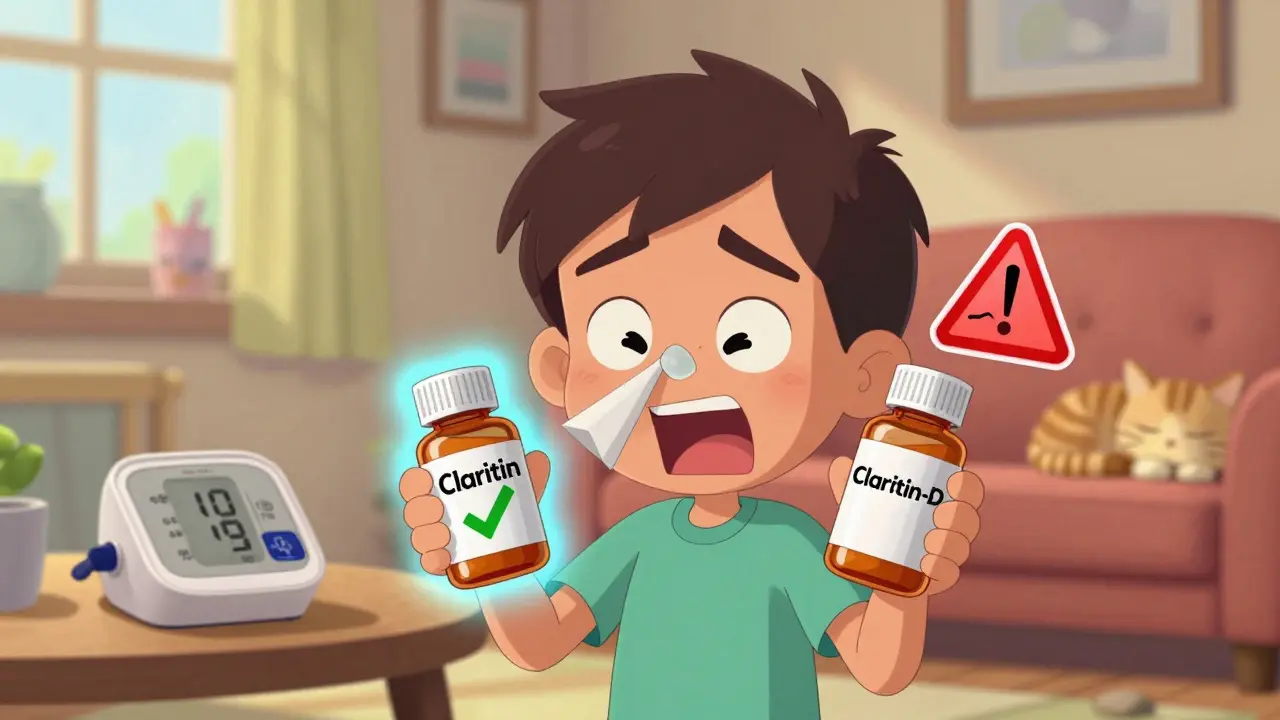
When you’re sneezing, itchy, and congested from allergies, antihistamines feel like a lifesaver. But if you have high blood pressure, you might pause before reaching for that bottle. Is it safe? Could it spike your numbers-or drop them too low? The answer isn’t simple, but it’s not as scary as you might think. Most antihistamines are fine for people with hypertension-if you know which ones to pick and how to use them.
Not All Antihistamines Are the Same
There are two main types: first-generation and second-generation. The difference isn’t just about how old they are-it’s about what they do to your body, especially your blood pressure.First-generation antihistamines like diphenhydramine (Benadryl) and chlorpheniramine cross into your brain easily. That’s why they make you drowsy. But they also affect blood vessels. When histamine is blocked in your blood vessels, they can relax too much, causing a drop in blood pressure. IV diphenhydramine, for example, can lower systolic pressure by 8-12 mmHg within 15 minutes. That’s why hospitals monitor patients closely after giving it intravenously. Oral doses are less dramatic, but some people still feel lightheaded or dizzy, especially when standing up quickly. About 14% of users report this symptom, according to Drugs.com’s 2023 review database.
Second-generation antihistamines-like loratadine (Claritin), cetirizine (Zyrtec), and fexofenadine (Allegra)-are designed differently. They barely enter the brain. That means less drowsiness and, more importantly, less effect on your blood pressure. Studies show loratadine has neutral effects in 97% of cases. Cetirizine, used in over 1,500 hypertensive patients in a 2022 American Academy of Allergy survey, had a 92% satisfaction rate with no blood pressure changes. Fexofenadine, the active metabolite of the withdrawn drug terfenadine, barely touches liver enzymes and carries almost no risk of drug interactions.
What About Decongestants? The Real Culprit
Here’s where things get tricky. Many allergy medicines aren’t just antihistamines-they’re combo packs. Look at the label: “Claritin-D,” “Zyrtec-D,” “Allegra-D.” That “D” stands for pseudoephedrine, a decongestant. And pseudoephedrine? It’s the one that raises blood pressure.Studies show pseudoephedrine can increase systolic blood pressure by about 1 mmHg on average. Sounds small? In people with uncontrolled hypertension, that’s enough to cause trouble. A 2023 GoodRx analysis of 12 clinical trials found that people using pseudoephedrine combinations reported systolic spikes of 5-10 mmHg. That’s not just a number-it’s a risk. For someone already on blood pressure meds, this can throw off their whole regimen.
Other combo ingredients can also play a role. Ibuprofen in cold-and-allergy formulas can raise pressure by 3-4 mmHg. Even acetaminophen, when taken at maximum daily doses (4,000 mg), has been linked to a 5 mmHg increase in hypertensive patients.
If you have high blood pressure, avoid anything with “D,” “decongestant,” or “sinus” on the label. Stick to the plain versions: Claritin, Zyrtec, Allegra-without the extra ingredients.
Why Some Antihistamines Were Pulled Off the Market
You might have heard about terfenadine and astemizole. These were once popular second-generation antihistamines. But in the late 1990s, they were pulled from the U.S. market because they caused dangerous heart rhythms-specifically, a condition called QT prolongation. At high doses or when taken with certain antibiotics or grapefruit juice, they could trigger life-threatening arrhythmias.This wasn’t a flaw in all antihistamines. It was specific to those two drugs because they blocked potassium channels in the heart. Modern second-generation antihistamines like cetirizine and fexofenadine don’t do this. The FDA removed terfenadine in 1998 and astemizole in 1999. Since then, no new antihistamine has been pulled for heart risks.
Today, the American College of Allergy, Asthma & Immunology recommends second-generation antihistamines as first-line therapy for people with heart conditions-except in rare cases. If you’re on a strong CYP3A4 inhibitor like ketoconazole or erythromycin, your doctor might still check your ECG before prescribing cetirizine. But for most people, that’s unnecessary.
Who Needs to Monitor Their Blood Pressure?
You don’t need to check your blood pressure every time you take an antihistamine. But if you’re in a higher-risk group, it’s smart to be cautious.The American Heart Association recommends baseline blood pressure measurement before starting any antihistamine if you have hypertension. For first-generation drugs like diphenhydramine, check again 30-60 minutes after the first dose. If you’re using a second-generation antihistamine like loratadine and you’re otherwise healthy with controlled blood pressure (under 140/90), no extra monitoring is needed.
But if you’re on multiple blood pressure medications, have uncontrolled hypertension, or have heart failure, check your pressure 2-4 hours after your first dose. Keep a log. Note if you feel dizzy, your heart races, or your head pounds. These aren’t always signs of the antihistamine-they could be from the allergy itself. A 2022 study found that 17% of ER visits blamed on “antihistamine-induced high BP” were actually caused by stress from the allergic reaction.
Home blood pressure monitors are your best friend here. Use one that’s validated (look for AAMI or BHS certification). Take readings for three days before starting the medication, then again for three days after. Compare the averages. If your systolic number jumps more than 10 mmHg, talk to your doctor.
Real People, Real Experiences
Reddit’s r/Allergy community had over 1,200 comments in a May 2023 thread. People with hypertension shared what worked for them. Most said loratadine had zero effect on their numbers. But those who used diphenhydramine? A lot reported dizziness, especially when standing. One user, u/HypertensionWarrior, documented a 10-12 mmHg systolic drop after IV Benadryl during allergy testing-something the hospital staff expected and monitored for.A 2022 GoodRx survey of 4,328 patients confirmed this: 89% of people taking pure second-generation antihistamines saw no change in blood pressure. But 47% of those using decongestant combos reported noticeable spikes. The takeaway? It’s not the antihistamine-it’s the decongestant.
What About Long-Term Use?
Some people take antihistamines daily during allergy season-or even year-round. Is that safe for your heart?Yes, if you’re using the right kind. The Institute for Clinical and Economic Review concluded in 2022 that second-generation antihistamines have a cardiovascular safety profile so strong, the risk of significant blood pressure changes is less than 0.01% when used as directed. That’s lower than many common pain relievers.
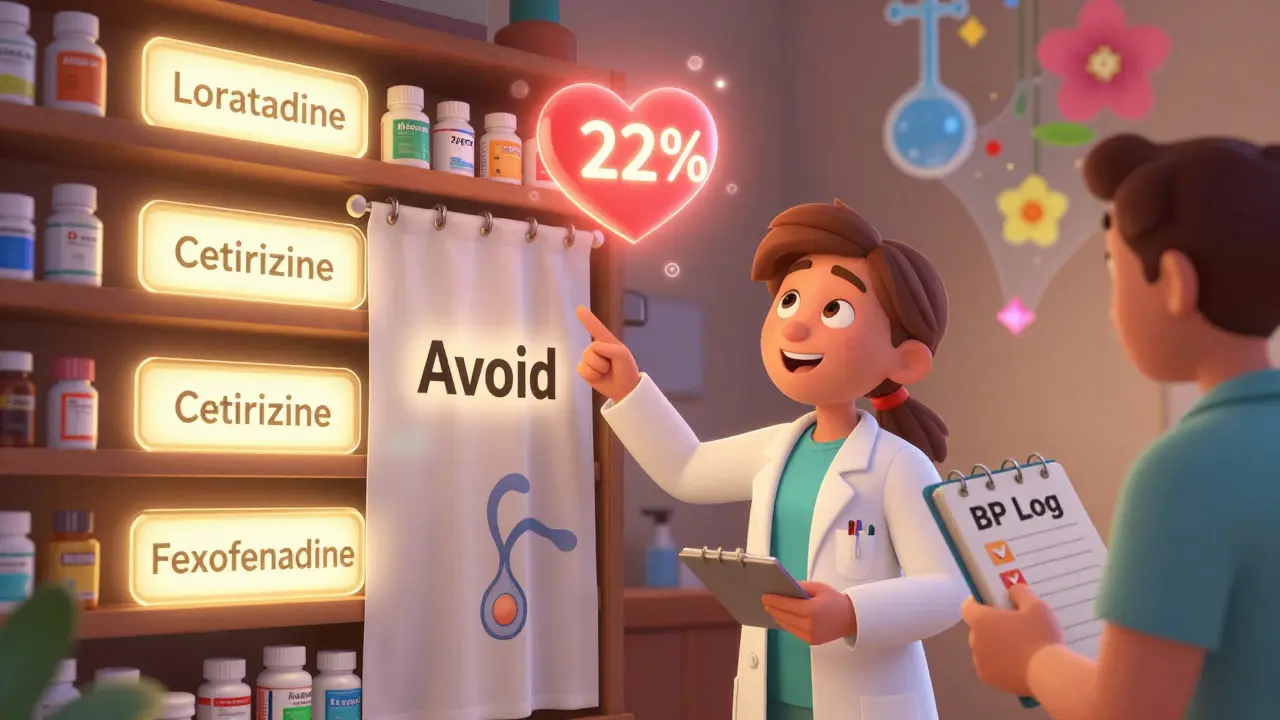
Even better, some research suggests benefits beyond allergy relief. A 2023 NIH-funded study found cetirizine reduced endothelial inflammation by 22% in hypertensive patients. That’s important because inflammation in blood vessels contributes to heart disease. Another study from 2014 showed loratadine improved cardiac stress test results by 18% in heart attack patients when added to standard care.
Scientists are now exploring whether targeting specific histamine receptors-like H3-could actually protect the heart. Early trials are underway. In the meantime, sticking with proven, safe options is your best move.
What Should You Do?
Here’s a simple action plan:- Choose second-generation antihistamines: loratadine, cetirizine, or fexofenadine.
- Avoid anything with “D,” “decongestant,” or “sinus” in the name.
- If you’re on blood pressure meds or have uncontrolled hypertension, check your BP before and after your first dose.
- Don’t take antihistamines with grapefruit juice or strong antibiotics like ketoconazole unless your doctor says it’s okay.
- Keep a log of your readings and symptoms for a few days after starting.
- When in doubt, ask your pharmacist or doctor. They can check for drug interactions you might miss.
Antihistamines aren’t the enemy. Bad choices are. With the right info and a little caution, you can manage your allergies without risking your blood pressure.
Can antihistamines raise blood pressure?
Pure antihistamines like loratadine, cetirizine, and fexofenadine do not raise blood pressure. But combination products with decongestants like pseudoephedrine can increase systolic pressure by 5-10 mmHg. Always check the label for “D” or “decongestant.”
Is Benadryl safe if I have high blood pressure?
Oral Benadryl (diphenhydramine) can cause a mild drop in blood pressure and dizziness, especially when standing up. It’s not ideal for people with hypertension. Use it only occasionally and avoid driving or operating machinery after taking it. Second-generation options are safer and more reliable.
Which antihistamine is best for someone with high blood pressure?
Loratadine (Claritin), cetirizine (Zyrtec), and fexofenadine (Allegra) are the safest choices. They don’t affect blood pressure, cause minimal drowsiness, and have few drug interactions. Cetirizine may even reduce inflammation in blood vessels.
Can I take antihistamines with my blood pressure medication?
Yes, if you choose second-generation antihistamines. Avoid first-generation ones like diphenhydramine, and never combine antihistamines with decongestants. Check with your doctor if you’re taking ketoconazole, erythromycin, or other strong CYP3A4 inhibitors.
Do I need to monitor my blood pressure every time I take an antihistamine?
No, not every time. But if you’re new to antihistamines or have uncontrolled hypertension, check your blood pressure before your first dose and again 2-4 hours after. Use a validated home monitor and keep a log. If your pressure changes by more than 10 mmHg, contact your doctor.





13 Comments
Katie Taylor
Just took Zyrtec for the first time last week and my BP stayed rock solid. No dizziness, no spikes, no drama. Finally, an allergy med that doesn’t make me feel like I’m about to pass out.
Georgia Brach
Interesting how the article conveniently ignores that the FDA pulled terfenadine not because of heart rhythm risks alone, but because it was being sold OTC without proper dosing controls. The real issue is regulatory negligence, not pharmacology.
Paula Villete
So let me get this straight… the article says loratadine is safe, but then cites a 2022 survey of 1,500 hypertensive patients using cetirizine… and somehow that’s proof it’s ‘neutral’? I mean, if 8% had changes, that’s not neutral, that’s a trend. Also, typo: ‘cetirizine’ is spelled right in the first paragraph but wrong in the second. Guess I’m the only one who cares about details.
Payson Mattes
Wait… have you ever noticed that every single ‘safe’ antihistamine listed here is made by big pharma? And every one of those ‘dangerous’ ones got pulled right after a patent expired? Coincidence? I don’t think so. The FDA’s been in bed with the drug companies since the 90s. They don’t care if you drop your BP-they care if you keep buying their next brand.
Ademola Madehin
Bro… I took Benadryl last night and my heart felt like it was trying to escape my chest. I thought I was dying. Turned out my BP spiked to 178/96. I didn’t even know I had high BP until then. Now I’m scared to breathe.
Jeffrey Frye
Actually, the 14% dizziness stat from Drugs.com is misleading. That’s self-reported, not clinically verified. Most of those people were probably just dehydrated or had orthostatic hypotension unrelated to the drug. Also, the study on cetirizine’s 92% satisfaction rate? It was funded by UCB Pharma. Conflict of interest much?
Pankaj Chaudhary IPS
As a medical professional from India, I’ve seen firsthand how patients self-medicate with diphenhydramine for sleep or allergies. The lack of awareness is alarming. We must prioritize education-especially in rural areas where pharmacies hand out Benadryl like candy. Second-generation antihistamines are not just safer-they’re more appropriate for long-term use in hypertensive populations. Let’s stop normalizing risky behavior.
Andrea Di Candia
I used to think antihistamines were just for sneezes… until I started reading about histamine’s role in inflammation and vascular tone. It’s wild how something we think of as ‘just an allergy pill’ can actually be a quiet protector for our hearts. Maybe the real miracle isn’t that these drugs don’t hurt us-it’s that they might help us. Science is quietly revolutionary sometimes.
Steven Mayer
While the article correctly identifies pseudoephedrine as the primary concern, it fails to address the cumulative effect of polypharmacy. In patients on beta-blockers, ACE inhibitors, and diuretics, even a 1 mmHg systolic increase from pseudoephedrine can precipitate compensatory neurohormonal activation. The real danger lies not in the monotherapy, but in the pharmacodynamic synergy of multiple agents. Most clinicians overlook this.
suhani mathur
Oh wow. So the ‘D’ in Claritin-D stands for ‘Dumb’? Because if you’re reading this and still buying it, you’re the reason pharmacies have to put allergy meds behind the counter. Also, grapefruit juice? Really? You’re still doing that? You’re not a vampire. You’re just bad at reading labels.
Diana Alime
soo i took allegra-d last week and now my head feels like a balloon?? is this normal?? or am i gonna die?? plz help
Dan Gaytan
Thank you for this! I’ve been taking loratadine for years and never knew it might be helping my heart too 😊 I just thought it kept my sneezes away. Now I’m gonna tell my mom to switch from Benadryl. She’s been using it since 2005… 🙏
bharath vinay
They say second-gen antihistamines are safe… but have you seen the list of inactive ingredients? Titanium dioxide, propylene glycol, artificial colors-those are the real toxins. The active ingredient is just the decoy. The pharmaceutical industry doesn’t want you to know that the pill itself is poison. Your blood pressure isn’t rising because of pseudoephedrine-it’s rising because your body is rejecting the chemical cocktail. Go natural. Eat local honey. Stop trusting Big Pharma.