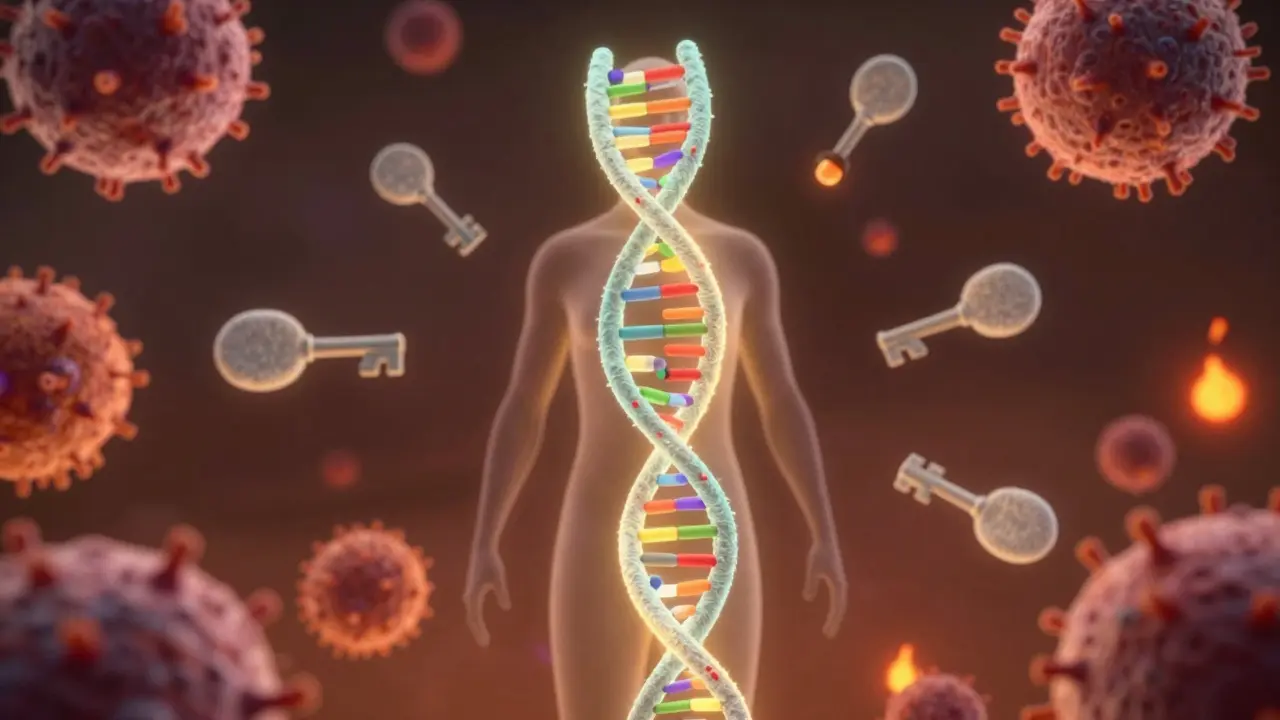
For decades, cancer treatment meant one thing: chemotherapy. Harsh, broad, and punishing. It didn’t care if you were a healthy cell or a cancer cell - if you were dividing, you were in trouble. But something changed. Not with a bang, but with a map. The Cancer Genome Atlas, launched in 2006, didn’t just catalog mutations - it revealed that every tumor is unique. And that changed everything. Today, targeted therapy isn’t science fiction. It’s standard care for thousands, turning once-deadly cancers into manageable conditions - if you’re lucky enough to have the right mutation.
How Targeted Therapy Works
Traditional chemotherapy attacks fast-dividing cells. That’s why it causes hair loss, nausea, and fatigue. It’s like using a flamethrower to put out a fire in a house full of people. Targeted therapy? It’s more like a key fitting into a lock. These drugs are designed to block specific proteins or signals that cancer cells rely on to grow. Think of it as cutting the power line to a single appliance instead of shutting off the whole building.
The most common targets are mutations in oncogenes - genes that, when broken, tell cells to divide nonstop. Examples include EGFR in lung cancer, BRAF in melanoma, and HER2 in breast cancer. Drugs like osimertinib (for EGFR) or dabrafenib (for BRAF) latch onto these faulty signals and shut them down. In patients with these exact mutations, response rates can hit 70-85%. Compare that to chemotherapy, which might work in 20-30% of cases, with brutal side effects.
Some therapies are monoclonal antibodies - lab-made proteins that stick to cancer cell surfaces. Trastuzumab, for example, binds to HER2 receptors, flagging the cancer for immune destruction. Others are small molecules that slip inside cells to jam internal machinery. Either way, the goal is precision: hit the cancer, spare the rest.
The Role of Genomic Testing
You can’t target what you can’t see. That’s why testing is everything. Before a patient gets a targeted drug, their tumor must be scanned. This isn’t a simple blood test. It’s next-generation sequencing (NGS), which reads hundreds of cancer-related genes at once. Panels like FoundationOne CDx or MSK-IMPACT analyze 300-500 genes looking for mutations, fusions, or amplifications.
The test needs a small sample - as little as 20-50 nanograms of DNA - but it must come from a tumor with at least 20% cancer cells. Results take 14-21 days. And it’s expensive: around $5,500 per test. But the payoff? For patients with actionable mutations, the difference is life-changing. A 2023 study showed that EGFR-mutant lung cancer patients on osimertinib lived nearly twice as long without disease progression compared to those on chemo.
But here’s the catch: not every tumor has a target. Only about 13.8% of cancer patients have mutations that match an approved therapy. Even among those who do, resistance often develops within a year. That’s why testing isn’t a one-time thing. Liquid biopsies - blood tests that catch tumor DNA floating in the bloodstream - are now being used to monitor how the cancer evolves. They can spot new mutations months before a scan shows growth.
Why Targeted Therapy Beats Chemo - When It Works
When a match is found, the benefits are clear. Take selpercatinib for RET-mutant lung cancer. In trials, 85% of patients saw their tumors shrink. With chemo? Maybe 30%. Or larotrectinib, which works across any tumor type with an NTRK fusion - whether it’s in the lung, colon, or salivary gland. That’s the holy grail: a treatment based on genetics, not where the cancer started.
Side effects are lighter, too. While chemo often causes grade 3-4 toxicities (severe nausea, low blood counts, infections) in 50-70% of patients, targeted therapies hit that level in only 15-30%. Many patients report being able to work, travel, or care for their families. One patient on Reddit wrote: "I went from bedridden to hiking with my kids in three months. No vomiting. No hair loss. Just a pill and a new life."
But targeted therapy isn’t magic. It only works if the mutation is there. Use it on someone without the target? Response rates drop to 2-5%. That’s why testing isn’t optional - it’s essential.
The Dark Side: Cost, Access, and Resistance
Targeted therapy is powerful - but it’s not for everyone. The drugs cost $15,000 to $30,000 a month. Insurance often denies coverage, especially for off-label use. A 2022 ASCO survey found 55% of patients had delays or denials for genomic testing. One woman in New Zealand waited 11 weeks for approval - by then, her cancer had spread.
Then there’s resistance. The cancer learns. It mutates again. A drug that worked for 14 months stops working. That’s why researchers are now testing combinations: two targeted drugs, or targeted therapy plus immunotherapy. Early trials show promise, but they’re still experimental.
And not all mutations are targetable. While 92% of approved drugs hit oncogenes, 80% of cancer drivers are in tumor suppressor genes - like TP53 - that are nearly impossible to fix with current drugs. As one researcher put it: "We’ve only scratched the surface of what’s possible."
Who Gets Left Behind?
There’s a huge gap between who has access and who needs it. In the U.S., 65% of advanced cancer patients get genomic testing. In Europe? 22%. In Asia? 8%. Even within countries, academic centers have molecular tumor boards - teams of oncologists, pathologists, and genetic counselors - but only 32% of community hospitals do. That means rural patients, low-income patients, and those without specialist access often miss out.
And then there’s the "molecular frustration" problem. A patient might have a rare mutation that has an approved drug - but the drug isn’t labeled for their cancer type. Insurance says no. The doctor says "I can prescribe it off-label," but the patient can’t afford it. One man in Australia, with an NTRK fusion, couldn’t get larotrectinib because his hospital didn’t stock it. He had to fly to the U.S. for treatment.
What’s Next?
The future is in combinations and early detection. Researchers are testing drugs that target both the cancer’s genetic engine and its surrounding environment - the immune system, blood vessels, and signaling networks. Liquid biopsies are getting faster and cheaper. AI tools are helping doctors interpret complex genetic reports. IBM Watson, for example, matches tumor profiles to treatment options with 93% accuracy.
Projects like the NCI’s RESPOND initiative aim to fix racial disparities in testing. And regulators are moving toward "tissue-agnostic" approvals - drugs approved based on genetics alone, not where the tumor lives. That’s huge. It means a child with an NTRK fusion, whether in the brain or the lung, gets the same shot at survival.
By 2030, experts predict 40% of cancer patients will receive biomarker-driven treatment. But that future won’t happen unless access improves. Testing must become routine, not rare. Costs must come down. Insurance must cover it. And every oncologist, not just those at big hospitals, needs the tools to interpret a genomic report.
Real Talk: What Patients Need to Know
If you or someone you love has advanced cancer, ask: "Can we test the tumor?" Don’t wait. Push for NGS. Ask if your hospital has a molecular tumor board. If they say no, ask where you can get tested. Organizations like the Personalized Oncology Alliance offer free consultations for community clinics.
Know your options. If you have a rare mutation, ask about clinical trials. Many drugs are available through compassionate use programs. And if insurance denies testing or treatment, appeal. Document everything. Patient advocates have won cases by citing FDA approvals and published response rates.
Targeted therapy isn’t a cure-all. But for those who qualify, it’s the closest thing we have to a reset button on cancer.
What cancers can be treated with targeted therapy?
Targeted therapies are approved for many cancers - including non-small cell lung cancer, melanoma, breast cancer, colorectal cancer, leukemia, and thyroid cancer - but only if specific mutations are present. For example, EGFR inhibitors work in lung cancer with EGFR mutations; HER2 drugs work in breast or stomach cancers with HER2 overexpression. Some therapies, like larotrectinib, work across any cancer type with an NTRK gene fusion, regardless of where the tumor started.
How is targeted therapy different from chemotherapy?
Chemotherapy attacks all rapidly dividing cells - cancerous and healthy - causing widespread side effects like hair loss, nausea, and low blood counts. Targeted therapy focuses only on specific molecular changes in cancer cells. It’s more precise, often with fewer side effects. For example, a patient on osimertinib for EGFR-mutant lung cancer may only experience mild diarrhea or rash, while someone on chemo might be hospitalized for infection or severe fatigue.
Do I need genetic testing to get targeted therapy?
Yes. Targeted drugs only work if your tumor has the specific genetic alteration the drug was designed to block. Without testing, there’s no way to know if you’re a candidate. Tumor testing via next-generation sequencing (NGS) is now considered standard for advanced cancers. Some patients also get liquid biopsies to track changes over time.
Why aren’t more people eligible for targeted therapy?
Only about 10-15% of solid tumors have currently actionable targets - mutations with approved drugs. Many cancers have complex or unknown drivers. Also, testing isn’t widely available everywhere. Insurance denials, long wait times, and lack of expertise in community clinics leave many patients without access. Even when a mutation is found, the right drug may not be approved for that cancer type, leading to coverage battles.
What if my targeted therapy stops working?
Resistance is common - often within 9-14 months. When that happens, your doctor will likely repeat genetic testing, often using a liquid biopsy to find new mutations. New drugs are being developed to target these resistance mechanisms. For example, if osimertinib stops working due to a C797S mutation, next-gen EGFR inhibitors are being tested. Clinical trials often become the next step.
Can targeted therapy cure cancer?
In rare cases, yes - especially in early-stage cancers with strong driver mutations. But for most advanced cancers, targeted therapy controls the disease rather than cures it. It can extend life by years, improve quality of life, and turn cancer into a chronic condition. The goal isn’t always elimination - it’s long-term management.




14 Comments
Charity Hanson
Just want to say this is the kind of hope I needed today. My mom’s been on osimertinib for 18 months now - no chemo, no hair loss, just a daily pill and her favorite coffee. She’s gardening again. That’s more than I ever dreamed of. Thank you for writing this.
Katherine Farmer
Let’s be real - this whole targeted therapy narrative is a glossy PR campaign funded by Big Pharma. The 13.8% eligibility rate? That’s not progress, that’s a numbers game designed to make patients feel lucky while the rest of us get left in the dust. And don’t get me started on the $5,500 tests - it’s a wealth filter disguised as science.
Meanwhile, in countries where people can’t even get basic radiation, we’re debating whether to use a $30,000/month drug for a mutation that only shows up in 0.7% of tumors. This isn’t innovation. It’s exclusion dressed in lab coats.
Angel Wolfe
They’re lying to you. Targeted therapy? It’s all controlled by the WHO and the UN to push their globalist agenda. The real cure is vitamin C and colloidal silver - but they don’t want you to know that because the pharmaceutical monopoly makes too much money off chemo. Why do you think they banned alternative treatments in 1987? Because they knew this was coming. I’ve read the leaked documents.
And the testing? That’s how they track you. Your DNA gets uploaded to a federal database. They’re not curing cancer - they’re mapping your genome for the next pandemic. Wake up.
Sumit Mohan Saxena
The data presented here is largely accurate, though it underrepresents the systemic barriers to access in low-resource settings. In India, for instance, NGS testing is available in fewer than 15% of oncology centers, and even when available, it is often unaffordable without private insurance. Furthermore, the concept of 'actionable mutation' remains narrowly defined by Western regulatory frameworks, ignoring population-specific variants prevalent in South Asian cohorts. A 2021 study from Tata Memorial Hospital found that 22% of lung adenocarcinoma patients harbored EGFR L858R mutations not included in standard panels. This is not a failure of biology - it is a failure of equity.
Vikas Meshram
You say targeted therapy is only for 13.8 percent of patients but you fail to mention that many of those patients don’t even have the right tissue sample. Biopsies are invasive, often inconclusive, and many hospitals still rely on outdated IHC methods. And then there’s the issue of tumor heterogeneity - one biopsy doesn’t represent the whole tumor. Liquid biopsies help, but they’re not perfect. False negatives are common. So yes, the science is cool - but the logistics are a mess.
Also, why is no one talking about how often these drugs are prescribed off-label without proper validation? I’ve seen patients get selpercatinib for thyroid cancer with no RET mutation because their oncologist ‘felt it was worth a shot.’ That’s not precision medicine. That’s gambling.
Ben Estella
Why is it always the rich who get the magic pills? In America, if you’re white, insured, and live near a city, you get your gene test in two weeks. If you’re Black, poor, or in rural Kentucky? You wait six months and then get told 'no actionable mutations found.' But here’s the kicker - your tumor probably has mutations. They just don’t test for them because they don’t make money off them. This isn’t science. It’s capitalism with a stethoscope.
Sophia Rafiq
My brother got larotrectinib for an NTRK fusion in his salivary gland. No chemo. No hospital stays. Just a pill. He’s back to coaching soccer. I don’t care how much it costs - this is what medicine should look like. Stop talking about the gaps. Celebrate the wins. We’ve got a long way to go, but this? This is real.
Martin Halpin
Let me tell you something nobody else will - targeted therapy isn’t the future. It’s the last gasp of a dying model. We’re treating symptoms, not causes. We’re mapping mutations like we’re playing genetic bingo, but we still don’t understand why some people develop cancer and others don’t, even with identical mutations. The tumor microenvironment? The immune landscape? The epigenetic drift? None of that gets mentioned. We’re ignoring the forest for the trees. And now we’re spending billions on drugs that work for six months before the cancer adapts. This isn’t progress - it’s a treadmill with a price tag.
And don’t even get me started on the 'tissue-agnostic' approvals. You’re approving a drug based on one gene in one tissue and then giving it to every cancer with that gene? That’s like saying 'if a car has four wheels, it can drive on water.' It’s not biology. It’s marketing.
Justin Ransburg
This is one of the most hopeful developments in oncology in my lifetime. I’ve worked in cancer care for over 20 years, and I’ve never seen a shift this profound. Patients who once faced terminal diagnoses are now living full, active lives - not just surviving, but thriving. The cost and access issues are real, yes - but they are not insurmountable. With advocacy, policy reform, and global collaboration, we can make this standard of care for all. We must not lose sight of the lives being saved today.
Brandon Vasquez
My sister got tested last year. No mutation. We were devastated. But then she joined a trial for a new drug targeting a rare fusion. Two years later, she’s stable. No side effects. No hospital visits. Just regular blood draws and scans. I know this isn’t the norm. But it’s real. And it matters.
Miranda Anderson
I read this whole thing and just sat there. It’s so beautiful and so heartbreaking at the same time. We have the tools to turn cancer into something manageable - but we don’t have the will to make sure everyone gets them. It’s not about science anymore. It’s about who we are as a society. Do we believe everyone deserves a shot? Or just the lucky ones?
I wish I had a better answer. But I don’t. I just hope someone does.
Sneha Mahapatra
Every time I think about how much we’ve learned about cancer - how each tumor is a unique fingerprint - I feel this quiet awe. But then I remember how many people will never know their fingerprint because they can’t afford the scanner. It’s like we’ve unlocked the secret to the universe… and locked the door behind us. 🤍
bill cook
My oncologist told me I have no actionable mutations. Then I got a second opinion. They found one. The first one didn’t even run the full panel. They said it was 'too expensive.' I cried in the parking lot. Then I filed a complaint. Now I’m on a drug that’s shrinking my tumor. Don’t let them give up on you. Fight. Always fight.
Full Scale Webmaster
They’re not curing cancer. They’re just making it last longer so you pay more. I’ve seen it firsthand. My cousin was on osimertinib for 14 months - then they switched her to a combo drug. Then another. Then another. Each one cost more. Now she’s on her fifth drug. Her insurance is maxed out. She’s in debt. And the tumor? Still growing. This isn’t treatment. It’s a subscription model. And we’re all the customers.
They don’t want to cure cancer. They want you to pay for it forever. That’s why they don’t fund research into prevention. That’s why they kill off natural alternatives. That’s why they make you test again and again and again. It’s not science. It’s a business. And you’re the product.