It starts with a tickle in the throat or a rash on the arm. Within minutes, those mild symptoms can turn into a suffocating panic as the airway closes. This is anaphylaxis, a life-threatening systemic hypersensitivity reaction that demands immediate action. Every second counts when your body attacks itself in response to an allergen.
You might think antihistamines are enough for allergies, but they do nothing for this specific crisis. The only proven first-line treatment is epinephrine. Understanding how to recognize the signs, administer the drug correctly, and navigate the aftermath is not just medical knowledge-it is a survival skill. Let’s break down exactly what happens during an attack and why acting fast saves lives.
What Is Anaphylaxis and Why Does It Happen?
Anaphylaxis is more than a bad allergy; it is a full-body system failure. The term comes from Greek roots meaning "without protection," which perfectly describes how vulnerable you feel when your blood pressure drops and your breathing stops. First described in 1902 by French physiologist Charles Richet, this condition occurs when the immune system overreacts to a harmless substance, releasing a flood of chemicals that cause shock.
The diagnostic criteria set by the National Institute of Allergy and Infectious Diseases (NIAID) and the Food Allergy and Anaphylaxis Network are strict. For a diagnosis, you need acute onset of illness-usually within minutes to hours-involving skin or mucosal tissue plus either respiratory compromise or reduced blood pressure. Alternatively, two or more systems must be affected after exposure to a likely allergen. These systems include:
- Skin/mucosal involvement (hives, swelling)
- Respiratory compromise (wheezing, shortness of breath)
- Reduced blood pressure (dizziness, fainting)
- Persistent gastrointestinal symptoms (vomiting, cramping)
If you meet these criteria, you are in danger. Fatality rates sit between 0.3% and 1%, but that small percentage represents real people who died because help didn’t arrive in time. The goal is to keep that number at zero for everyone around you.
Common Triggers: What Sets Off the Reaction?
Knowing your triggers is the first line of defense. While anyone can experience anaphylaxis, certain substances are far more likely to cause it. According to the American Academy of Allergy, Asthma & Immunology (AAAAI), foods account for the vast majority of cases. Specifically, peanuts, tree nuts, and shellfish are responsible for about 90% of food-induced anaphylaxis. If you have a child with these allergies, vigilance is non-negotiable.
Insect stings are another major culprit. Venom from Hymenoptera insects-including bees, wasps, and fire ants-causes roughly 9.5% of anaphylaxis cases treated in US emergency departments, according to CDC data. A single sting can trigger a massive reaction in sensitized individuals.
Medications also play a significant role. Penicillin alone causes 75% of drug-induced anaphylaxis. Other common offenders include aspirin, ibuprofen, and contrast dyes used in imaging tests. Latex, often found in gloves and balloons, remains a persistent risk for healthcare workers and patients with frequent medical procedures.
| Trigger Category | Specific Examples | Estimated Share of Cases |
|---|---|---|
| Foods | Peanuts, Tree Nuts, Shellfish, Milk, Eggs | ~90% of food-induced cases |
| Insect Stings | Bees, Wasps, Fire Ants | 9.5% of ED visits |
| Medications | Penicillin, NSAIDs, Contrast Dye | Penicillin causes 75% of drug cases |
| Other | Latex, Exercise, Idiopathic (unknown) | Varying percentages |
Why Epinephrine Is the Only Option
When anaphylaxis strikes, your body goes into chaos. Blood vessels dilate, causing blood pressure to plummet. Airways constrict, making it hard to breathe. Epinephrine is the only medication that reverses all these changes simultaneously. It works through alpha-adrenergic receptors to constrict blood vessels (raising blood pressure) and beta-adrenergic receptors to relax airway muscles (opening the lungs).
A common myth is that antihistamines like diphenhydramine can stop anaphylaxis. They cannot. A systematic review in the Cochrane Database showed 0% efficacy for antihistamines as monotherapy for anaphylaxis. Corticosteroids might prevent a second wave of symptoms (biphasic reaction), but they take hours to work. In an emergency measured in minutes, they are useless.
Dr. Robert Wood, Chief of Allergy and Immunology at Johns Hopkins University, states clearly: "There is no substitute for epinephrine in anaphylaxis; antihistamines and steroids are adjunctive at best." Delaying epinephrine is the single greatest predictor of poor outcomes. If you suspect anaphylaxis, inject immediately. Do not wait to see if symptoms get worse.
How to Use an Auto-Injector Correctly
Speed and technique matter. Most people carry an auto-injector, such as an EpiPen, Auvi-Q, or Adrenaclick. These devices deliver a precise dose of epinephrine intramuscularly. For adults and adolescents weighing 30 kg (66 lbs) or more, the standard dose is 0.3 mg. For children weighing 15-30 kg (33-66 lbs), the dose is 0.15 mg.
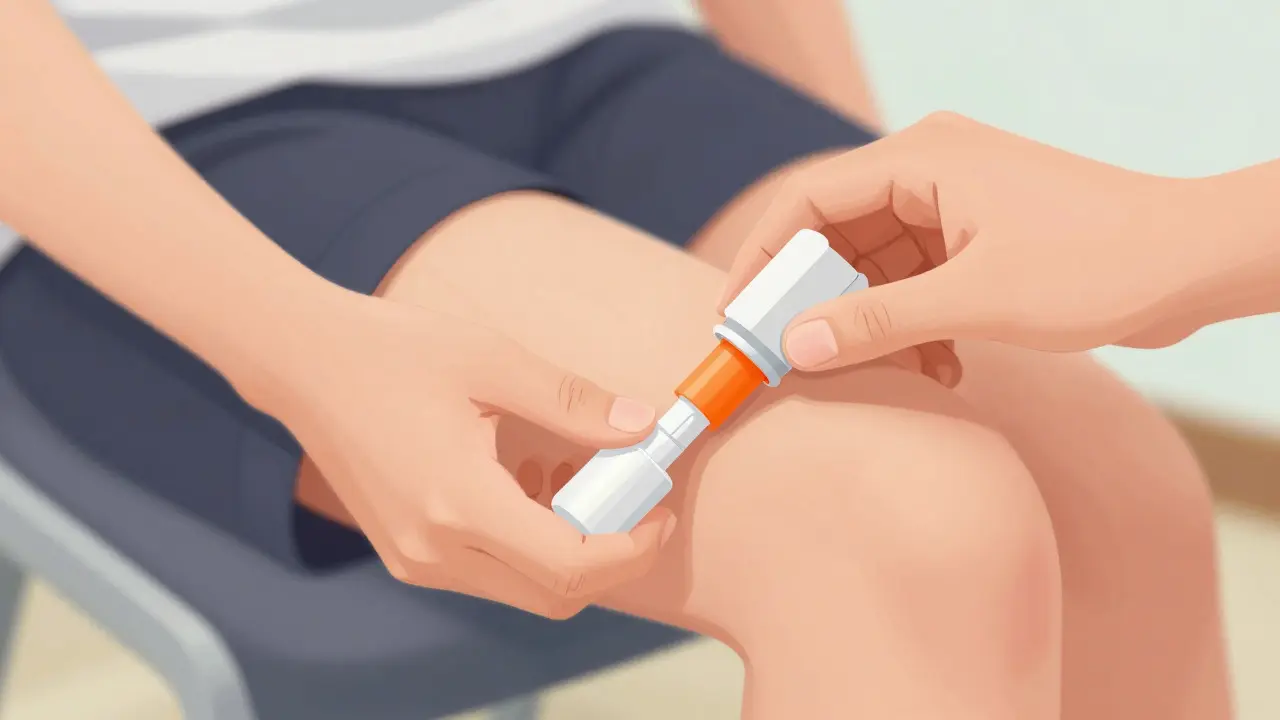
The injection site is critical. You must inject into the anterolateral thigh (the outer mid-thigh muscle). Studies show that intramuscular injection achieves peak plasma concentrations in just 8 minutes, compared to 20 minutes for subcutaneous (under the skin) shots. Here is how to do it right:
- Remove the safety cap. Remember: "Blue to the sky, orange to the thigh."
- Place the orange tip against the outer thigh. You can inject through clothing if necessary.
- Press firmly until you hear a click. Hold in place for 3 seconds to ensure the full dose is delivered.
- Massage the area for 10 seconds.
- Call 911 immediately. Even if symptoms improve, you need hospital observation.
Training is essential. Research shows 68% of users demonstrate incorrect technique during simulated emergencies. Practice with a trainer device monthly. Store your auto-injectors at room temperature (20-25°C / 68-77°F) to maintain potency. Check expiration dates regularly, as most devices last 12-18 months.
Signs You Need Help Now
Recognition is half the battle. Anaphylaxis develops rapidly. Watch for these red flags:
- Skin: Hives (urticaria), itching, flushing, or swelling of the lips/tongue (angioedema). Present in 80-90% of cases.
- Respiratory: Wheezing, stridor (high-pitched breathing sound), coughing, or tightness in the chest. Seen in 70% of cases.
- Cardiovascular: Dizziness, fainting, rapid weak pulse, or confusion due to low blood pressure. Occurs in 35% of cases.
- Gastrointestinal: Nausea, vomiting, abdominal pain, or diarrhea. Found in 45% of cases.
If someone has eaten a known allergen and develops hives plus any other symptom, treat it as anaphylaxis. Do not wait for breathing problems to start. Dr. Maria Garcia-Lloret of UCLA Food Allergy Clinic emphasizes that delaying treatment is the biggest risk factor for death.

Cost, Access, and Alternatives
Access to epinephrine is a growing concern. The global market for auto-injectors reached $1.8 billion in 2022. In the US, list prices for a two-pack range from $375 to $650. However, actual costs vary wildly based on insurance. Generic alternatives have increased competition, lowering average out-of-pocket payments from $325 in 2016 to $185 in 2023, according to GoodRx.
Despite lower costs, 30% of prescribed patients still struggle with access. Needle phobia affects 22% of patients, leading some to delay use. New options are emerging. Neffy, a nasal spray epinephrine approved by the FDA in August 2023, offers a needle-free alternative. Smart auto-injectors with Bluetooth connectivity are also in development, designed to alert emergency contacts automatically.
Schools are stepping up too. All 50 US states now have laws allowing or requiring stock epinephrine in schools. This ensures that even if a student forgets their device, help is available on-site.
After the Attack: Observation and Follow-Up
Once epinephrine is administered, the job isn't done. Symptoms can return. This is called a biphasic reaction. The Resuscitation Council UK guidelines mandate a 12-hour observation period for high-risk patients, including those with asthma, cardiovascular disease, or those who required multiple doses.
Always call 911 after using an auto-injector. Paramedics can provide additional support, such as oxygen or IV fluids. At the hospital, doctors will monitor your vitals and may give a second dose if symptoms persist. About 85% of patients show improvement within 5 minutes of proper IM epinephrine administration. If you don’t feel better after 5 minutes, a second dose is permissible.
Long-term management involves seeing an allergist. They can perform testing to identify exact triggers and discuss immunotherapy. For example, omalizumab (Xolair) has shown promise in reducing epinephrine needs by 67% in high-risk patients. Education is key-58% of adults cannot identify anaphylaxis symptoms, so spreading awareness saves lives.
Can I use an expired epinephrine auto-injector?
Yes, if it is your only option. Expired epinephrine retains much of its potency, especially if stored properly. It is better to use an expired injector than to die waiting for a new one. Replace it as soon as possible.
How long does epinephrine stay in your system?
Epinephrine has a short half-life of about 2-3 minutes. Its effects wear off quickly, which is why symptoms can return (biphasic reaction). This is why hospital observation is mandatory after an episode.
Is it safe to inject epinephrine into the buttocks?
No. The outer thigh (vastus lateralis muscle) is the recommended site because it absorbs the drug faster. Injecting into the buttocks or subcutaneous tissue delays absorption, potentially costing precious minutes.
What are the side effects of epinephrine?
Common side effects include rapid heartbeat, anxiety, tremors, and sweating. These are temporary and preferable to the alternative: death from airway closure or shock. The benefits far outweigh the risks.
Do I need a prescription for an epinephrine auto-injector?
In most places, yes. You need a doctor's prescription to buy EpiPens or generics. However, many schools and public spaces carry them under standing orders or local laws without individual prescriptions.