Codeine Safety Calculator
Enter Your Information
Your Results
Imagine taking a standard dose of codeine for a headache or after surgery-something millions of people have done without issue. But for a small group, that same dose can be deadly. It’s not about taking too much. It’s not about addiction. It’s about your genes.
How Codeine Turns Into a Silent Killer
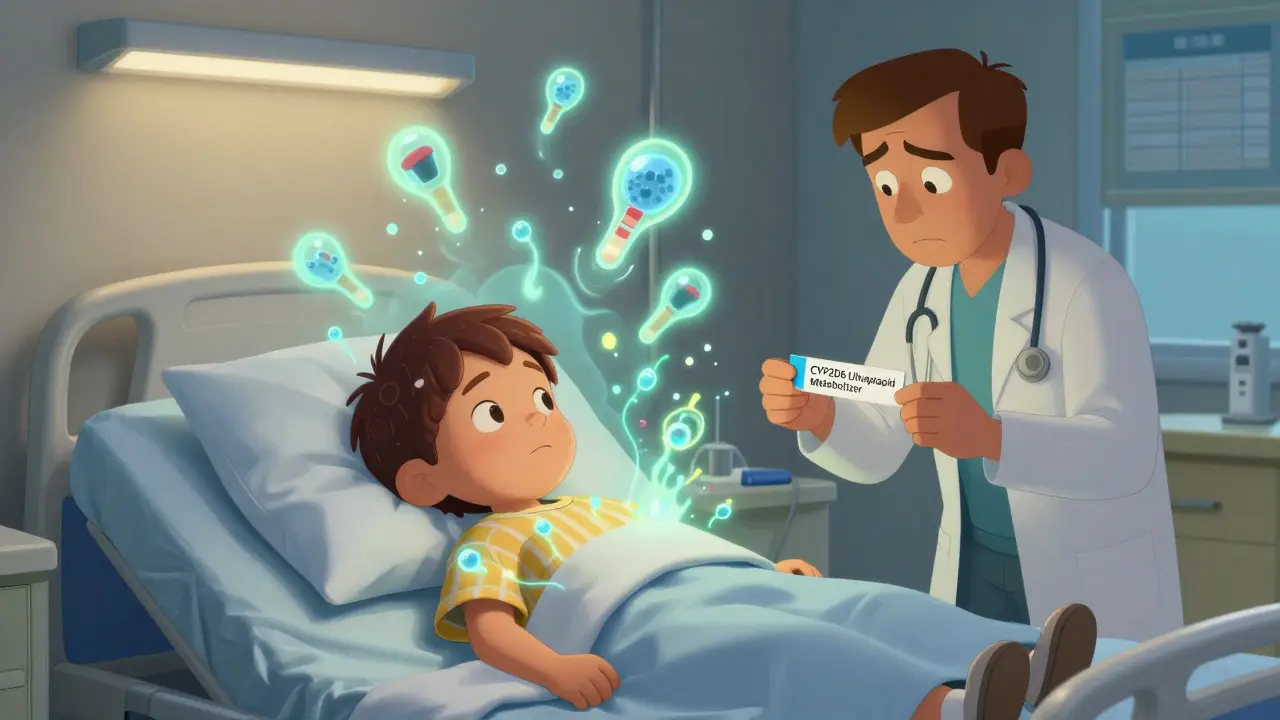
Codeine isn’t active on its own. Your body has to turn it into morphine to feel any pain relief. That conversion happens thanks to an enzyme called CYP2D6. Most people have one or two copies of the gene that makes this enzyme. They convert codeine slowly and safely. But some people have extra copies-three, four, even five. These are called CYP2D6 ultrarapid metabolizers. For them, codeine turns into morphine so fast that it floods the bloodstream.That flood doesn’t just make pain go away. It shuts down breathing. In fact, the U.S. Food and Drug Administration (FDA) reviewed 64 cases where codeine led to serious harm or death. Of those, 24 were fatal. Twenty-one of those deaths happened in children under 12. Post-surgery pain? A simple cough syrup? Both became death traps for kids with this genetic quirk.
The Numbers Don’t Lie
CYP2D6 ultrarapid metabolizers convert codeine into morphine 3.5 to 4.5 times faster than normal. That means a 10 mg dose can produce blood morphine levels that rival someone who just took 50 mg of pure morphine. The FDA found that in 13 out of 15 cases where blood levels were measured, morphine was far above the safe range. One 15-month-old child died after a standard dose following tonsil surgery. Autopsy confirmed: ultrarapid metabolizer. Toxic morphine levels. No chance to react.It’s not rare. In Europe and North America, about 3% to 7% of people are ultrarapid metabolizers. In North Africa and Ethiopia, it’s as high as 29%. That’s nearly one in three people. And yet, most doctors still prescribe codeine without asking about genetics. Why? Because until recently, testing wasn’t common. Now, it’s available-but still not routine.
Who’s at Risk? And Who’s Not
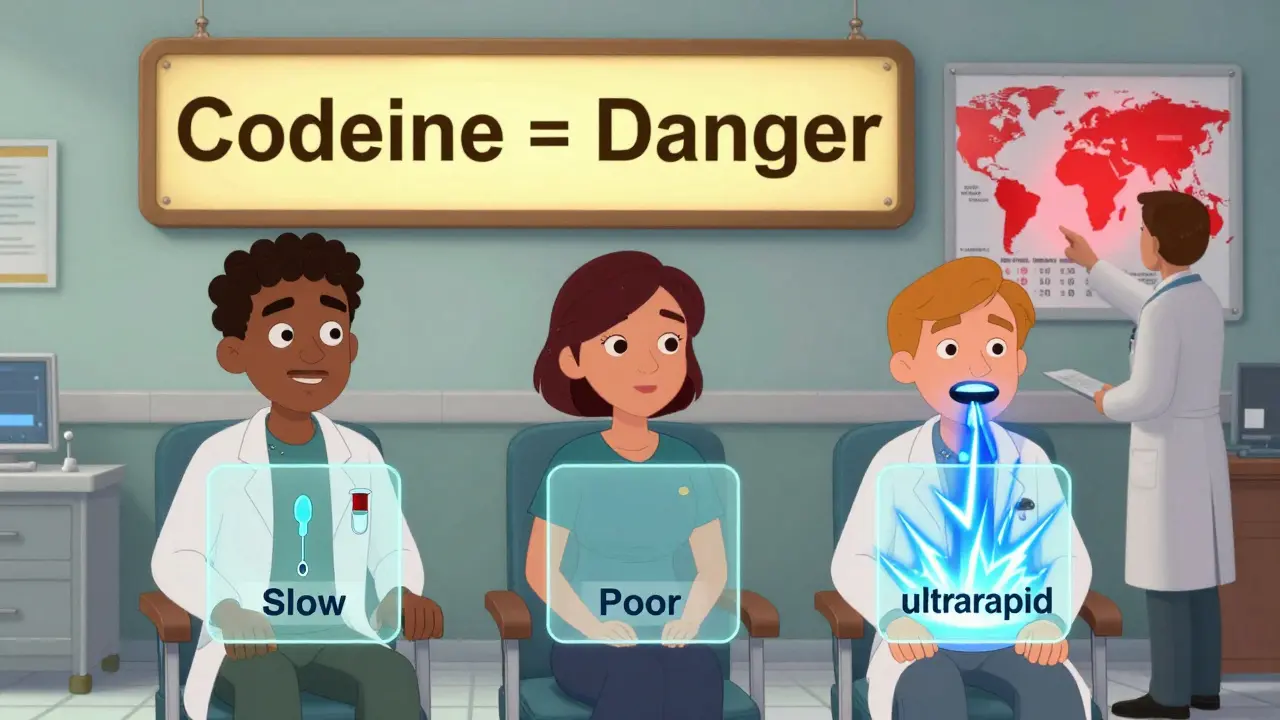
Your CYP2D6 status is fixed from birth. It doesn’t change. There are four categories:- Ultrarapid metabolizers: Activity score >2.25. High morphine production. High overdose risk.
- Normal metabolizers: 1.25-2.25. Safe with standard doses.
- Intermediate metabolizers: 0.25-1.0. May not get enough pain relief.
- Poor metabolizers: 0. No conversion. Codeine does nothing.
The problem? You can’t tell by looking. A person who feels nothing from codeine might be a poor metabolizer. Someone who gets dangerously sleepy might be an ultrarapid one. Symptoms of overdose include extreme drowsiness, trouble waking up, shallow breathing, bluish lips, and unresponsiveness. These signs often appear within hours of taking the drug.
Why This Isn’t Just a Pediatric Problem
The FDA’s 2013 warning focused on children because most deaths occurred in kids after tonsillectomies. But adults are at risk too. In Australia, researchers found that nearly 3% of adults are ultrarapid metabolizers-and they’re more likely to develop codeine use disorder. Why? Because they get a stronger high. That’s not addiction. That’s biology.And here’s the twist: some people with this gene might have been taking codeine for years without knowing the danger. One study showed that 7 out of 10 children who died after codeine had this genetic profile. Only 3 were normal metabolizers. That’s not luck. That’s a ticking time bomb.
What Should You Do Instead?
The Clinical Pharmacogenetics Implementation Consortium (CPIC) says it clearly: Do not use codeine or tramadol in ultrarapid metabolizers. The same goes for children under 12-regardless of genetics. The American Academy of Pediatrics and New Zealand’s Medsafe agree.So what’s safe? Opioids that don’t rely on CYP2D6:
- Morphine (direct-acting, no conversion needed)
- Hydromorphone
- Fentanyl
- Non-opioid options like acetaminophen or ibuprofen
Hydrocodone and oxycodone? They’re sometimes used-but they’re partially metabolized by CYP2D6 too. That means they’re not completely safe either. For ultrarapid metabolizers, the safest bet is to avoid all CYP2D6-dependent drugs.
Can You Get Tested?
Yes. Genetic tests for CYP2D6 are available through hospitals and private labs. Turnaround time? Usually 3 to 14 days. Cost? $200 to $500. Insurance often requires prior approval. In New Zealand, testing is available but not yet standard practice. Most GPs don’t order it unless there’s a red flag-like a family history of bad reactions to codeine.Some hospitals are starting pre-emptive testing-running the gene panel before prescribing anything. Vanderbilt University is testing a point-of-care system that could give results in two hours. If it works, it could change everything. Imagine walking into a clinic, getting a quick cheek swab, and walking out with a safe painkiller prescription-all in one visit.
Why Isn’t Everyone Tested Already?
Because healthcare moves slowly. Electronic records don’t automatically flag high-risk patients. Doctors aren’t trained in pharmacogenetics. And until recently, testing was expensive and slow. The FDA’s 2013 warning led to a 50% drop in pediatric codeine prescriptions in the U.S. But in many places, codeine is still sold over the counter in cough syrups. In New Zealand, Medsafe issued a similar warning in 2013-but people still ask for it.There’s also a false sense of safety. Codeine has been around for over a century. It’s cheap. It’s familiar. But familiarity doesn’t mean safe. For ultrarapid metabolizers, it’s a trap.
The Bigger Picture
This isn’t just about codeine. It’s about the future of medicine. We’re moving from one-size-fits-all to personalized care. Your genes aren’t just about ancestry. They’re about how your body handles drugs. That’s why pharmacogenomics is becoming part of standard care in cancer treatment, mental health, and now pain management.Dr. Mary Relling of St. Jude Children’s Research Hospital predicts codeine will become a drug of historical interest within the next decade. She’s not alone. As testing gets cheaper and faster, prescribing without genetic data will seem as outdated as bloodletting.
What to Do Now
If you or someone you care for has ever had a bad reaction to codeine-extreme sleepiness, trouble breathing, no pain relief-ask about genetic testing. If you’re planning surgery, especially for a child, ask your doctor: Is codeine really the best choice? Push for alternatives. If you’re a parent, don’t give codeine to a child under 12. Period. Even if it’s prescribed.The science is clear. The warnings are loud. The deaths are real. You don’t need to wait for a tragedy to act. Your genes are already telling you what’s safe. You just have to listen.
Can I be tested for CYP2D6 ultrarapid metabolizer status?
Yes. Genetic testing for CYP2D6 is available through clinical labs, often ordered by pharmacists, genetic counselors, or doctors specializing in pain management. The test usually involves a saliva or blood sample. Results typically take 3 to 14 days. Some hospitals now offer pre-emptive testing as part of routine care, especially before major surgeries.
Is codeine banned for children?
In the U.S., the FDA has restricted codeine use in children under 12 for pain and cough. Similar restrictions exist in New Zealand, the EU, Canada, and Australia. Codeine is no longer recommended for tonsillectomy or adenoidectomy recovery in children. Many pediatric hospitals have removed codeine from their formularies entirely.
If I’m an ultrarapid metabolizer, does that mean I can’t take any opioids?
No. You can still take opioids-but not ones that rely on CYP2D6. Morphine, hydromorphone, and fentanyl are safe alternatives because they don’t need to be converted by this enzyme. Oxycodone and hydrocodone are less ideal since they’re partially metabolized by CYP2D6. Always discuss alternatives with your doctor.
Can I find out my CYP2D6 status from direct-to-consumer DNA tests like 23andMe?
Some direct-to-consumer tests include CYP2D6 variants, but they often don’t report it clearly or accurately. These tests aren’t validated for clinical use. If you’re concerned about opioid safety, get a clinical-grade test ordered through a healthcare provider. It’s more reliable and comes with expert interpretation.
What if I’ve been taking codeine for years without problems?
That doesn’t mean you’re safe. CYP2D6 status doesn’t change. If you’ve never had an adverse reaction, you’re likely a normal or poor metabolizer. But if you ever feel unusually drowsy, dizzy, or have trouble breathing after taking codeine, stop immediately and get tested. Some people only show symptoms under stress-like after surgery or illness.

10 Comments
andres az
So let me get this straight - the FDA knew about this since 2013, but we’re still selling codeine cough syrup over the counter like it’s aspirin? This isn’t negligence, it’s corporate malfeasance. Pharma companies knew the gene variants were common in certain populations and pushed the damn drug anyway. They didn’t care about kids. They cared about profit margins. And now we’re supposed to trust the system? Ha. The system is rigged. They’ll test you after you’re dead and send you a bill for the autopsy.
They’ll say ‘it’s rare’ - but 7% of the population isn’t rare. That’s 23 million Americans. And they’re not even testing most of us. This is systemic genocide wrapped in a white lab coat.
Why isn’t this on the news every night? Why isn’t every pharmacy required to scan your DNA before dispensing? Because they don’t want to lose revenue. Codeine’s cheap. Morphine’s expensive. And they’ll keep killing until the lawsuits get too big to ignore. I’m not paranoid. I’m just paying attention.
Stephon Devereux
This is exactly why personalized medicine isn’t the future - it’s the present. We’ve been doing this in oncology for years. Why is pain management still stuck in the 1950s? The science is here. The tools are here. The data is overwhelming.
The real tragedy isn’t that some people overdose - it’s that we treat genetic risk like an anomaly instead of a predictable variable. We don’t prescribe warfarin without checking INR. We don’t give carbamazepine without HLA-B*15:02 screening. So why is codeine the exception?
It’s not about fear. It’s about consistency. If we’re going to call ourselves a data-driven healthcare system, then we need to act like it. Genetic testing should be as routine as a blood pressure check. It’s not expensive. It’s not invasive. It’s just common sense.
And yes, I know - doctors are overworked. But if we can’t prioritize safety over speed, then we’re not healing. We’re just delaying the inevitable.
athmaja biju
India has been using codeine for decades and we never had this problem. Why? Because we don’t rely on Western pharmaceutical propaganda. Our traditional medicine has always understood the body as a whole system. This gene nonsense is just another way for Big Pharma to sell more expensive tests and drugs. Who benefits? Not the patient. Not the child. The lab that charges $500 to tell you what your body already does.
My cousin took codeine after surgery. He slept for 12 hours. He woke up fine. No death. No tragedy. Just a good night’s rest. Meanwhile, Western doctors panic over a number on a screen and prescribe morphine - which is far more addictive. You’re trading one risk for a bigger one.
Stop overcomplicating. Stop overtesting. Stop pathologizing normal human variation. We’ve survived centuries without genetic reports. We’ll survive this too.
Robert Petersen
Hey - I just want to say thank you for writing this. I’ve been scared to speak up because I thought I was the only one who had this happen. My daughter had her tonsils out last year. They gave her codeine. She got so sleepy I couldn’t wake her up. We rushed to the ER. They said it was a miracle she was still breathing.
Turns out she’s an ultrarapid metabolizer. We didn’t know. No one asked. No one tested. But now we do. And I’m telling everyone I know. If you’re a parent, don’t let them give codeine to your kid. Not even once. Ask for Tylenol. Ask for ibuprofen. Ask for anything else.
This isn’t about being paranoid. It’s about being prepared. And if you’re reading this - thank you for being the person who might save a life by sharing this.
Craig Staszak
I’ve been a nurse for 22 years and I’ve seen this play out too many times. Codeine gets prescribed like candy. Especially after minor surgeries. Parents ask for it because they remember their own childhood. Doctors give it because it’s easy. No one thinks about the genes.
One time I had a 9-year-old come in after a tonsillectomy. Mom gave him the syrup because he was ‘crying too much’. He stopped breathing. We had to intubate. His gene test came back positive. He’s fine now. But he’s not going to forget it. Neither will I.
We need to stop pretending this is a rare edge case. It’s not. It’s a ticking clock in every pediatric ward. And we’re the ones holding the detonator.
alex clo
While the data presented is compelling, it is important to acknowledge that pharmacogenomic testing remains underutilized due to systemic barriers: lack of provider education, absence of EHR integration, and inconsistent reimbursement policies. The clinical guidelines from CPIC and AAP are unequivocal, yet implementation lags due to structural inertia rather than scientific uncertainty.
Moreover, the assertion that codeine should be entirely abandoned overlooks contexts in which alternatives are inaccessible - rural settings, low-resource countries, or emergency situations where rapid analgesia is required. A blanket prohibition without viable, scalable alternatives risks creating new inequities.
Progress requires not just awareness, but infrastructure. We must invest in point-of-care genomics, provider training modules, and policy reforms that make testing routine, not optional.
Joanne Tan
ok so i just read this and i’m kinda freaked out bc my mom used to give me codeine cough syrup when i was a kid and i’d get super duper sleepy and just pass out on the couch. i thought it was just ‘me’ or that i was a heavy sleeper. now i’m like… was i almost dead? like what if she’d left me alone for an hour? i’m 28 now and i’ve never told anyone this. i’m gonna call my doctor tomorrow and ask for a test. if you’ve ever had a weird reaction to codeine - don’t ignore it. it might’ve been your genes talking.
Steve DESTIVELLE
Consider the epistemological framework through which medical knowledge is constructed. The reductionist model of pharmacogenetics, while empirically grounded, operates within a paradigm that commodifies biological identity. The CYP2D6 enzyme is not merely a metabolic pathway - it is a site of ontological contestation, where the body is rendered legible only through the lens of capitalist biotechnology. The insistence on genetic testing as a solution presupposes that human variation can be neutralized through diagnostic intervention, thereby reinforcing a technocratic illusion of control.
Is the alternative to codeine truly morphine? Or is it merely the substitution of one pharmaceutical hegemony for another? The discourse of safety obscures the deeper question: why do we allow pharmaceutical corporations to determine the boundaries of physiological possibility? The death of a child is not an anomaly - it is the logical outcome of a system that prioritizes profit over personhood.
Neha Motiwala
I’m so angry right now. I have a 7-year-old. Last month he had a tooth pulled. They gave him codeine. I didn’t question it. I didn’t know. I thought it was safe because it was ‘prescribed’. I found him barely breathing at 3 a.m. I screamed. I called 911. He’s okay. But I will never, ever, ever trust a doctor again without demanding genetic testing. They didn’t warn me. They didn’t ask. They didn’t care. This is not medical care. This is negligence. This is criminal. And if this happens to one more child because someone didn’t read this post - I will scream it from the rooftops until they listen.
Alyssa Williams
I work in a hospital pharmacy. We started pre-emptive CYP2D6 testing for all pediatric surgery patients six months ago. The change? Zero codeine-related ICU admissions since. Zero. We’ve switched everyone to morphine or hydromorphone. Parents are thrilled. Kids recover faster. No one’s drowsy for days. The cost? Less than $100 per test. Insurance covers it. The only people still resisting? The doctors who don’t know the guidelines. So here’s my ask: if you’re a parent, ask. If you’re a provider, learn. If you’re a policymaker, fund it. This isn’t science fiction. It’s just good medicine.