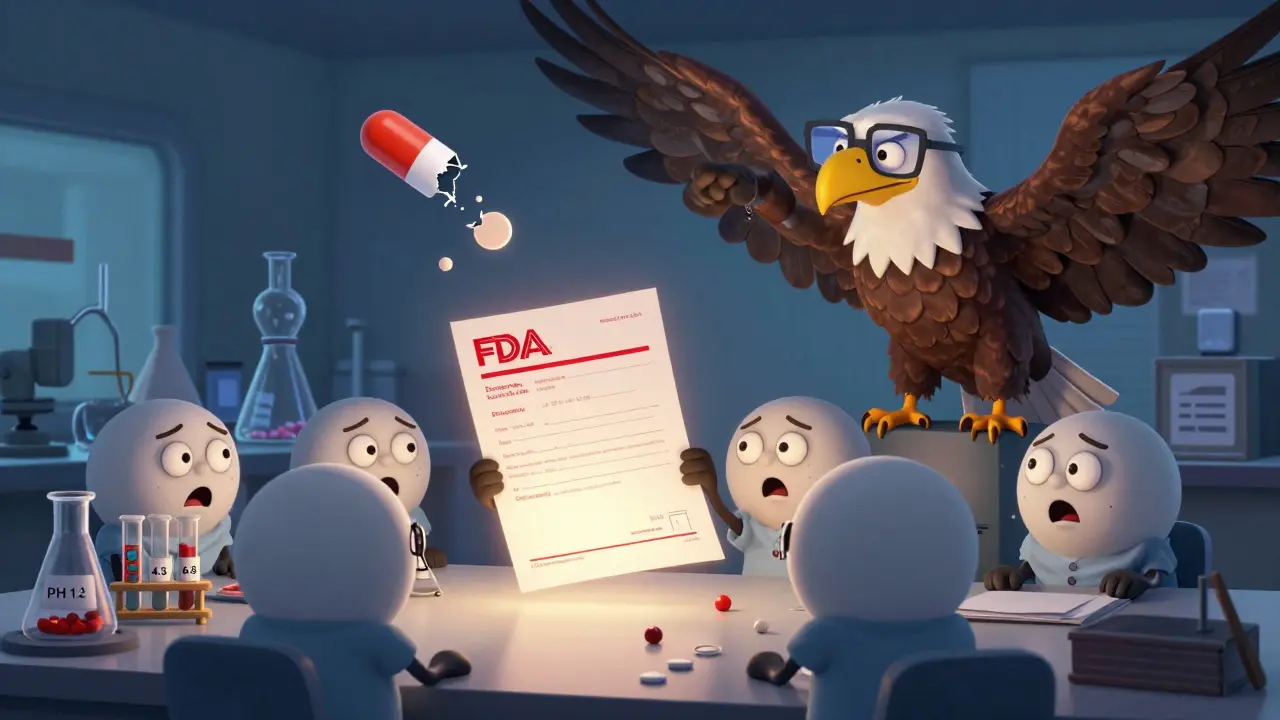
When a generic drug company submits an application to the FDA, they’re not just asking for permission to sell a cheaper version of a brand-name medicine. They’re asking the FDA to confirm that their product is therapeutically identical-same active ingredient, same dose, same performance in the body. If the FDA finds even one critical gap, they send a deficiency letter. These aren’t gentle suggestions. They’re roadblocks. And for many small companies, they’re the difference between launching a product in six months or waiting two years.
What Exactly Is a Deficiency Letter?
A deficiency letter from the FDA is a formal notice that your Abbreviated New Drug Application (ANDA) has serious problems. It doesn’t mean your application is rejected outright. It means: “We can’t approve this yet. Here’s what’s missing, wrong, or unclear.” The letter lists every issue that must be fixed before the FDA will consider approval again. These letters come after the initial review cycle and are the most common reason generic drugs don’t get approved on the first try.According to FDA data from 2023, over 70% of major deficiencies in ANDAs relate to quality issues-things like how the drug is made, what’s in it, and whether it behaves the same way as the brand-name version. The FDA doesn’t send these letters to be difficult. They’re required by law to ensure every generic drug works exactly like the original. If a generic fails to match the reference drug in dissolution, purity, or stability, patients could get inconsistent results. That’s not just a regulatory issue-it’s a public health risk.
The Top 5 Deficiency Categories (And Why They Keep Happening)
Not all deficiencies are created equal. Some are one-off mistakes. Others are systemic failures. Based on FDA’s FY2023-2024 data, here are the five most common reasons generic applications get stuck:
- Dissolution Issues (23.3% of deficiencies) - This is the #1 problem. Dissolution testing shows how quickly the drug breaks down and releases its active ingredient in the body. Many applicants use outdated methods-like Apparatus 2 for everything-even when their product is modified-release or has complex absorption patterns. The FDA expects dissolution methods to reflect real human conditions: pH 1.2 (stomach), 4.5 (upper intestine), and 6.8 (lower intestine). If your method doesn’t discriminate between your product and the reference drug across these conditions, you’ll get a deficiency.
- Drug Substance Sameness (19%) - The active ingredient in your generic must be chemically and physically identical to the brand’s. For small molecules, this is straightforward. But for peptides, complex APIs, or those with polymorphs, it’s not. The FDA wants data on crystal structure, particle size distribution, and impurity profile. One company submitted a peptide drug without circular dichroism or size-exclusion chromatography data. Result? A deficiency because they couldn’t prove the protein folded the same way.
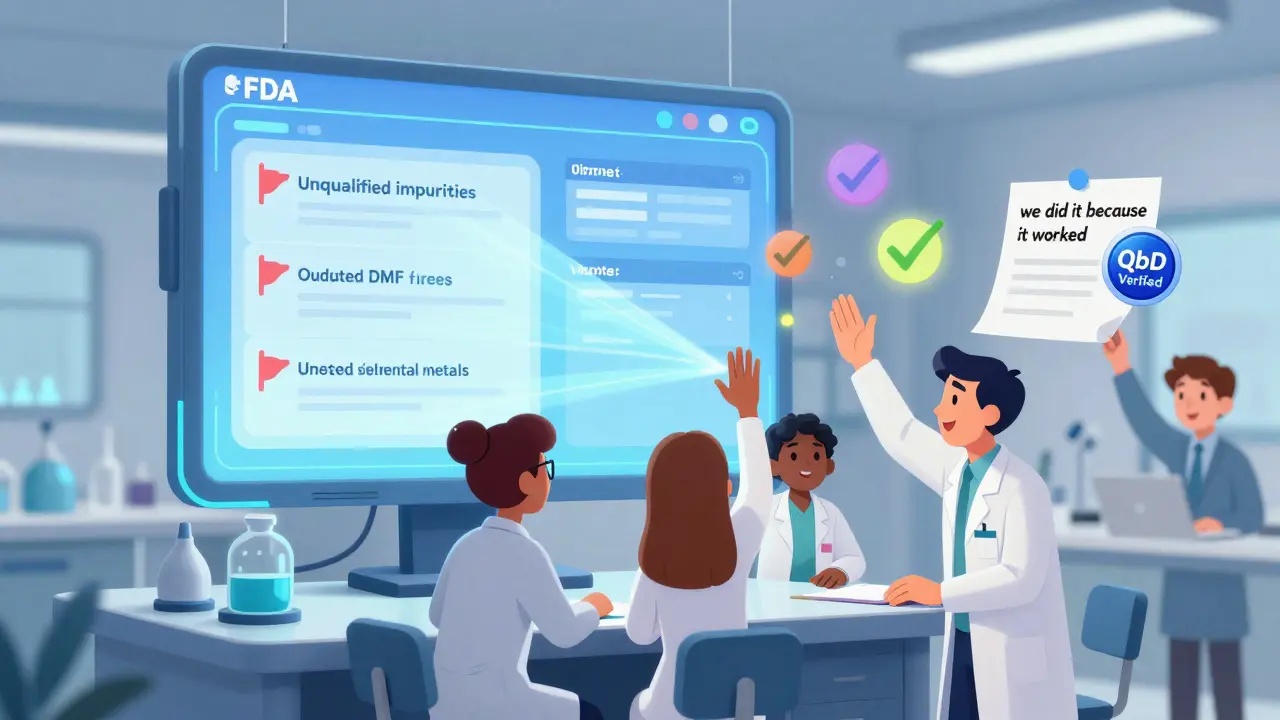
- Unqualified Impurities (20%) - Impurities are unavoidable, but they must be controlled. The FDA follows ICH Q3 guidelines. If your drug has an impurity above the threshold, you need toxicology data to prove it’s safe. Many applicants skip this step, assuming “it’s been done before.” But the FDA now requires each impurity to be qualified, especially if it’s a degradation product. One applicant had a nitrosamine impurity at 0.05%-below the threshold-but didn’t run a (Q)SAR analysis. That’s a deficiency.
- Drug Master File (DMF) Problems (82% of DS deficiencies) - If your drug substance comes from a third-party supplier, their DMF must be referenced and up to date. If the DMF is incomplete, outdated, or has its own deficiencies, your ANDA fails too. A single missing batch record in the DMF can hold up your entire application. The FDA doesn’t review the DMF for you-they expect you to verify it’s clean before submitting.
- Elemental Impurities (13%) - ICH Q3D sets limits for heavy metals like lead, cadmium, and arsenic. Many companies assume their excipients are “safe” and don’t test. But if your manufacturing equipment leaches nickel, or your raw material contains trace mercury, you need to quantify it. One company used a stainless-steel reactor without validating leachables. Their deficiency letter listed seven elemental impurities that weren’t tested.
Why Complex Drugs Fail More Often
Not all generics are the same. Immediate-release tablets? Fairly straightforward. Modified-release capsules? Peptide injectables? Topical creams with complex emulsions? These are complex generics, and they’re where most deficiencies live.
According to FDA data, complex generics face deficiency rates 40-65% higher than simple ones. Why? Because they involve more variables: multiple release mechanisms, unstable molecules, sensitive manufacturing processes. A modified-release tablet might need three different dissolution profiles-early, mid, and late release-each validated under different pH and agitation conditions. If you only test one, you’re not meeting the standard.
One case from 2023 involved a once-daily extended-release tablet. The applicant used a single dissolution method at pH 6.8. The FDA said: “Your product releases 70% of the drug in 1 hour at pH 1.2-that’s too fast. Patients with low stomach acid won’t get the same effect.” The company had to redesign the formulation and run new bioequivalence studies. That cost them $1.4 million and 18 months.

Who Gets Hit the Hardest?
It’s not random. Companies with fewer than 10 approved ANDAs in their portfolio have deficiency rates 22% higher than those with 50 or more. Why? Experience matters. Established players have learned the unwritten rules:
- They run pre-submission meetings with the FDA
- They use Quality by Design (QbD) principles from day one
- They validate methods with real biorelevant media, not just water
- They audit their DMF suppliers before submission
Companies that skip pre-submission meetings are 32% more likely to get a deficiency letter. That’s not a coincidence. It’s a pattern. The FDA offers these meetings for free. Use them. Ask: “What’s the most likely reason you’ll reject this?” Then fix it before you submit.
Even more telling: high-revenue generics (those with over $100 million in annual sales) have 18% fewer deficiencies than low-revenue ones. Why? Because companies betting big on a product invest in better science, better documentation, and better teams. It’s not about size-it’s about prioritization.
What’s the Real Cost of a Deficiency Letter?
It’s not just time. It’s money. Each additional review cycle adds an average of $1.2 million in costs: retesting, reformulating, hiring consultants, resubmitting, waiting. For a small company, that can mean going bankrupt.
One Teva regulatory manager reported on the FDA’s Generic Drugs Forum in April 2025 that unqualified impurity deficiencies typically delay approval by 14-18 months. Why? Because you need new toxicology studies, and those take time to design, approve, run, and analyze. And you can’t start them until the FDA tells you what impurity to test for.
On Reddit, a user from a small generic startup wrote: “We spent six months fixing our dissolution method because we used Apparatus 1 instead of Apparatus 2. The FDA said our method didn’t mimic how the drug behaves in the gut. We didn’t even know that was a thing.”
And here’s the kicker: 78% of generic companies say communication gaps with FDA reviewers lead to repeated deficiencies. You submit. You get a letter. You respond. You get another letter. Why? Because the first response didn’t fully address the concern. Or worse-you answered a different question than the one they asked.
How to Avoid a Deficiency Letter
You can’t eliminate risk. But you can drastically reduce it. Here’s what works:
- Do a pre-ANDA meeting. Don’t skip it. The FDA will tell you exactly what they’re looking for. Use the template responses they released in April 2025-they show you how to answer common issues.
- Use biorelevant dissolution media. Stop testing in water. Use pH 1.2, 4.5, and 6.8. Validate your method with the reference drug. If it doesn’t discriminate, your method is invalid.
- Qualify every impurity above ICH thresholds. Run (Q)SAR for mutagenicity. Run toxicology if needed. Don’t assume “it’s been done.”
- Verify your DMF. Get a copy of the DMF. Read it. Check for deficiencies. Ask the supplier for a letter of authorization. If the DMF is flagged, your ANDA is flagged.
- Document everything. The FDA doesn’t just want data-they want the story. Why did you choose this method? Why this particle size? Why this excipient? If your development report is 20 pages long and says “we did it because it worked,” you’re asking for trouble.
- Test elemental impurities. Use ICH Q3D. Don’t skip it because your excipients are “food grade.” The FDA doesn’t care. They care about what’s in your final product.
Companies that follow these steps see deficiency rates drop by 30-40%. The FDA’s own data shows that applications submitted under their “First Cycle Generic Drug Approval Initiative” had 15% fewer dissolution-related deficiencies in 2024.
What’s Changing in 2025-2026?
The FDA isn’t standing still. In 2024, they reorganized their Office of Generic Drugs into specialized teams for complex products. That means reviewers now know peptides from modified-release tablets. Less confusion. Fewer inconsistent letters.
By Q3 2026, the FDA plans to roll out AI-assisted pre-submission screening. It will scan your application for common errors-wrong apparatus, missing pH conditions, unqualified impurities-before you even hit submit. Early tests show it catches 35% of preventable mistakes.
And if you’re developing a high-impact generic, consider applying for the Competitive Generic Therapy (CGT) designation. These products get priority review, and 73% of CGT applications got approved on the first cycle in 2024-compared to just 52% for the industry overall.
The message is clear: the bar is rising. The FDA expects more. But they’re also giving you more tools to get it right. Use them.



11 Comments
sagar patel
Apparatus 1 vs 2 isn't even a debate anymore. If you're still using it for modified release, you're not just behind-you're a liability. FDA's been clear since 2020.
Michael Dillon
Yeah but let's be real-most small companies don't have $200k to burn on biorelevant dissolution testing. The FDA acts like everyone's Teva. Meanwhile, the rest of us are just trying to keep the lights on.
Katherine Blumhardt
I just submitted my ANDA last week and got a deficiency on elemental impurities 😭 I thought my excipients were 'food grade' so it was fine... guess not. Now I'm stuck for 8 months. Someone please tell me I'm not alone.
Bailey Adkison
Stop whining. If you can't afford proper QA, don't submit. The FDA isn't here to babysit amateurs. You want to make generics? Learn the rules before you waste everyone's time.
Harbans Singh
Hey, I'm a small startup from India and I'm trying to understand-what exactly counts as 'qualified' for an impurity? Is (Q)SAR enough or do we need actual animal studies? I'm trying to do this right but the guidelines feel like a maze.
Jason Jasper
DMF issues are the silent killers. I saw a client lose a $30M product because their API supplier had a single missing batch record. FDA doesn't care if it's 'just paperwork.' If it's not there, it's a deficiency. Always audit before you submit.
Mussin Machhour
Pre-submission meetings are FREE. Use them. I used to think they were a waste of time. Then I got my first deficiency letter. Now I go in with a checklist and a bottle of water. Best $0 I ever spent.
Sophie Stallkind
While the tone of this post is appropriately technical, I must emphasize that the underlying public health imperative cannot be overstated. Inconsistent bioequivalence in generic medications may lead to therapeutic failure, particularly in populations with narrow therapeutic indices such as those on antiepileptics or warfarin. Regulatory rigor is not bureaucracy-it is patient safety.
Gary Hartung
AI-assisted screening? Oh, great. So now the FDA is outsourcing judgment to algorithms? Next they'll replace reviewers with ChatGPT and call it 'efficiency.' We're not selling coffee beans here-we're talking about people's lives.
Ben Harris
Complex generics are the future and the FDA is still stuck in 2012. They want dissolution curves at pH 1.2, 4.5, 6.8? Fine. But they don't care that real patients have GERD, gastroparesis, or take PPIs. Real world ≠ lab conditions. Stop pretending otherwise.
Carlos Narvaez
CGT designation is the only way forward. If you're not applying for it, you're not playing the game. The 73% approval rate isn't luck-it's strategy. Stop treating this like a lottery.