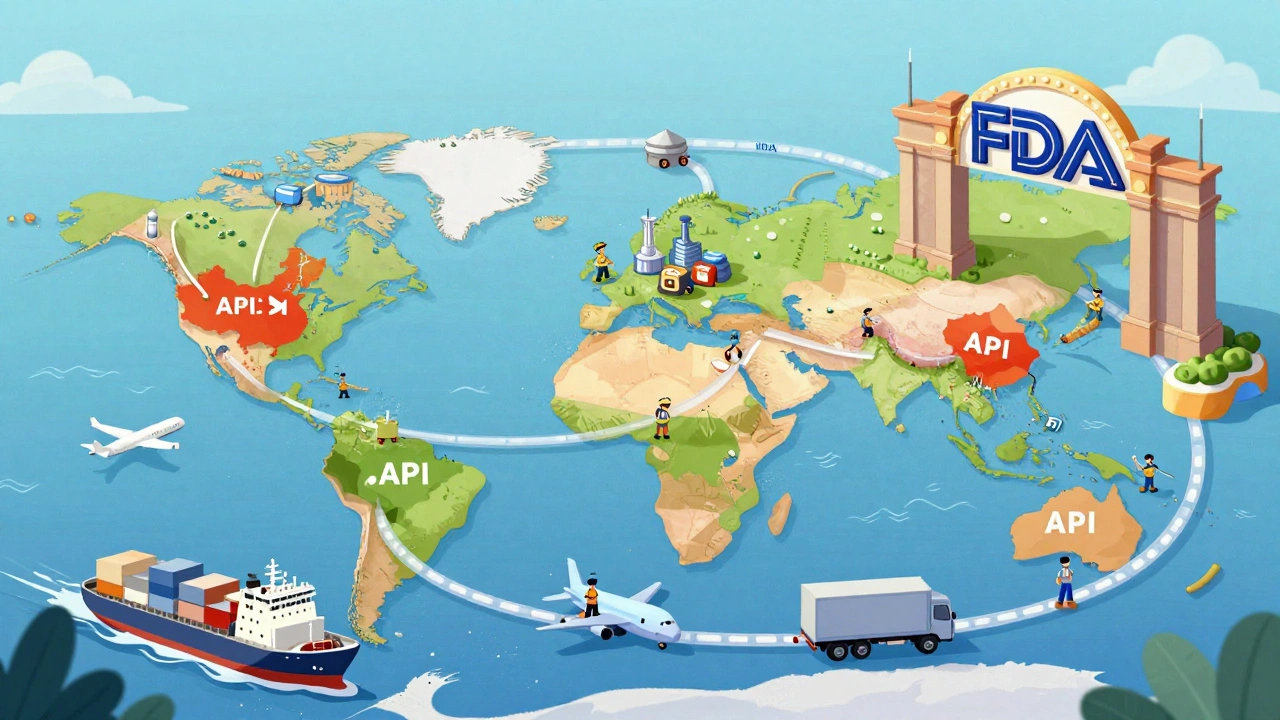
Every time you pick up a bottle of generic atorvastatin or metformin at the pharmacy, you’re holding a product that’s traveled across continents, passed through dozens of hands, and survived a maze of regulations-all for a few dollars. It’s not magic. It’s a supply chain. And it’s far more complicated than most people realize.
Where It Starts: The Raw Materials
It begins with chemicals. Not in a lab down the street, but often in a factory in China or India. About 88% of the active pharmaceutical ingredients (APIs) used in generic drugs are made outside the United States. That’s the hard truth. APIs are the parts of the drug that actually do the work-like lowering blood pressure or reducing blood sugar. The rest? Fillers, coatings, binders. Easy to make locally. But APIs? They need specialized equipment, strict controls, and years of regulatory approval. The U.S. used to make most of its own APIs. Now, it’s a global game. Factories in China and India produce APIs at a fraction of the cost. But that also means longer supply lines. A shipment can take weeks. A natural disaster, a political dispute, or even a shipping delay can ripple through the system. During the pandemic, 170 different generic drugs faced shortages because of API supply issues. That’s not rare anymore-it’s expected.Getting Approved: The FDA’s Gatekeeping Role
You can’t just make a pill that looks like Lipitor and sell it. The FDA requires every generic drug to go through an Abbreviated New Drug Application (ANDA). That means the manufacturer must prove their version is identical in strength, dosage form, and how it’s absorbed by the body. It doesn’t need to repeat the expensive clinical trials the brand did. But it must show bioequivalence-meaning your body treats it the same way. This isn’t a rubber stamp. The FDA inspects manufacturing sites. In 2010, they checked 248 foreign facilities. By 2022, that number jumped to 641. Why? Because quality control is the biggest risk. A single bad batch can mean a patient doesn’t get the right dose. That’s why Good Manufacturing Practices (GMP) aren’t optional. They’re enforced with fines, shutdowns, and import bans.Manufacturing: Volume, Not Luxury
Once approved, the drug moves into production. Generic manufacturers don’t compete on branding or advertising. They compete on price. And that means squeezing every penny out of production. Margins are razor-thin. In fact, generic manufacturers only keep about 36% of the money spent on their drugs. The rest? Goes to distributors, PBMs, pharmacies, and middlemen. Production lines run nonstop. One facility might make 100 million tablets of lisinopril in a month. Quality checks happen at every stage: raw material testing, in-process checks, final batch release. But with thousands of products and shrinking budgets, mistakes happen. That’s why drug shortages keep happening-not because of lack of demand, but because the business model can’t handle disruption.
The Middlemen: Wholesalers and PBMs
After manufacturing, the drugs go to wholesale distributors. These are the big players like McKesson, AmerisourceBergen, and Cardinal Health. They buy in bulk from manufacturers, store them in giant warehouses, and sell them to pharmacies. They don’t just move pills-they negotiate discounts. The standard is called the Wholesale Acquisition Cost (WAC). But that’s not what pharmacies pay. They pay less. A lot less. Here’s where it gets murky. Wholesalers offer “prompt payment discounts”-if a pharmacy pays within 10 days, they get a 3% or 5% cut. But many pharmacies can’t afford to pay upfront. So they take credit. And the discount disappears. Then there are Pharmacy Benefit Managers (PBMs). CVS Caremark, OptumRX, and Express Scripts control about 80% of the market. They don’t sell drugs. They negotiate with manufacturers, set reimbursement rules, and decide which drugs get covered. For generics, they use something called Maximum Allowable Cost (MAC). That’s a cap on how much a pharmacy can be reimbursed for a specific drug-say, 10 mg of atorvastatin. The MAC isn’t based on what the pharmacy paid. It’s based on an average of what others paid. Sometimes, it’s lower than what the pharmacy actually paid for the drug. That’s a problem. A 2023 survey found 68% of independent pharmacies say MAC pricing is below their acquisition cost. They’re losing money on every generic they sell. But if they don’t stock it, patients can’t get their meds. So they absorb the loss. Or worse-they stop carrying certain generics altogether.The Pharmacy: The Final Link
The pharmacy is where the chain ends. But it’s also where the pressure hits hardest. Pharmacies need to keep enough stock on hand. But with unpredictable supply and fluctuating prices, that’s a gamble. A shipment might be delayed. A competitor might get a better deal from a wholesaler. A PBM might suddenly lower the MAC. Large chains like Walgreens or CVS have leverage. They buy in massive volumes. They can negotiate better prices with wholesalers and even push back on MAC rates. But independent pharmacies? They’re caught in the middle. They rely on group purchasing organizations (GPOs) to pool their buying power. Even then, they’re often at the mercy of the system. And then there’s the dispensing fee. That’s the small amount pharmacies get paid on top of the drug cost-for counting pills, counseling patients, filing insurance. It’s not enough to cover the cost of running a pharmacy. That’s why many independents are closing. The system wasn’t built for them.




14 Comments
Declan Flynn Fitness
Been in pharma logistics for 15 years. The real nightmare isn't the factories-it's the PBM MAC lists. I've seen pharmacies forced to choose between losing money on metformin or telling diabetic patients to go elsewhere. It's not about profit. It's about survival.
And yeah, the FDA inspections are better now, but they're still playing whack-a-mole with overseas plants. One bad batch in Hyderabad can shut down half the country's supply of lisinopril for months.
Meanwhile, the big chains just shift inventory around. Independents? They get left holding the bag.
AI demand forecasting? Cool. But if the API shipment gets stuck in a port because of a labor strike in Mumbai, no algorithm can fix that.
Bottom line: we built a system that optimizes for cost, not resilience. And now we're reaping what we sowed.
Time to restructure the incentives. Not just tweak the margins.
Michelle Smyth
Oh, the glorious symphony of globalized capital-where the life-saving molecule is manufactured by underpaid laborers in Gujarat, shipped across oceans under the gaze of underfunded regulators, and then sold at a loss because some algorithm in Minneapolis decided $4.50 was the ‘fair’ price.
How poetic. We’ve outsourced our health to a spreadsheet.
And yet, we’re surprised when the pill doesn’t arrive?
It’s not broken. It’s working exactly as designed: for shareholders, not patients.
Souvik Datta
As someone from India who’s seen these factories firsthand-I can tell you, the quality isn’t always bad. Many Indian API plants are ISO-certified, FDA-compliant, and staffed by brilliant engineers.
The problem isn’t the workers. It’s the race to the bottom.
When a US wholesaler demands a 12% discount on top of a 30% margin squeeze from the manufacturer, guess who pays? The lab techs. The QA staff. The ones running the HPLC machines at 2 AM.
And then we wonder why turnover is 60% in these plants?
It’s not outsourcing. It’s exploitation dressed up as efficiency.
Priyam Tomar
Everyone’s acting like this is new. Newsflash: this system has been collapsing since 2008. The FDA didn’t suddenly wake up in 2022. They’ve been warning about this for a decade.
And yet, Congress keeps passing bills that cut drug pricing without fixing the supply chain.
It’s like trying to fix a leaking roof by lowering the rent.
Also, ‘blockchain’? Really? You think tracking pills with blockchain will fix a $2 API that’s now $18 because of tariffs? Get real.
Stop pretending tech is the answer. It’s not. It’s just noise.
Jack Arscott
Y’all are overcomplicating this 😅
Just make more APIs in the US. Done.
Why are we letting China control our medicine? 🇺🇸💊
Bring it home. Invest. Build. Simple.
Irving Steinberg
So what you're saying is… we're all just one hurricane away from running out of blood pressure pills?
And nobody thought to have a backup plan?
Wow. Just wow. We pay trillion dollar defense budgets but can't keep a few chemical reactors running?
Someone get me a lawyer. And a pill.
Also… why is this even a surprise? 🤡
Lydia Zhang
Generic drugs are cheap because the system is designed to be cheap. Not because it’s efficient. Just saying.
Kay Lam
I’ve worked in community pharmacies for over two decades and I can tell you the real crisis isn’t the API shortage or the FDA inspections or even the PBM MAC pricing-it’s the erosion of dignity in healthcare delivery.
Pharmacists used to be trusted advisors. Now we’re glorified pill counters paid $12 an hour to explain why the drug you’ve been taking for ten years suddenly costs $18 and isn’t covered.
And when you ask why, the answer is always ‘it’s the PBM’s policy’ or ‘the wholesaler raised prices’ or ‘the manufacturer couldn’t deliver’-but never ‘we’re going to fix this.’
Patients are left confused, anxious, and sometimes without their meds. And the system doesn’t care because it’s not broken-it’s optimized.
Optimized for profit. Not for people.
And until we stop treating medicine like a commodity and start treating it like a human right, this cycle will keep repeating.
It’s not complicated. It’s just cruel.
James Steele
Let’s be brutally honest: this isn’t a supply chain failure. It’s a moral failure wrapped in a neoliberal fantasy.
We’ve outsourced not just production, but responsibility. We’ve turned pharmacological necessity into a cost center. We’ve elevated shareholder value over patient safety. And now we’re surprised when the system fractures under its own weight?
The FDA isn’t toothless-it’s complicit. They inspect. They fine. But they never dismantle the structural incentives that make corner-cutting profitable.
And the PBMs? They’re not intermediaries. They’re rent-seekers. They extract value without creating it.
This isn’t capitalism. It’s predatory extraction with a white coat.
And we’re all complicit. We buy the $4 pill. We don’t ask questions. We assume it’s safe. We trust the system.
That’s the real tragedy.
Sean McCarthy
FACT: 88% of APIs come from abroad. FACT: FDA inspected 641 foreign sites in 2022. FACT: 170 generics had shortages during the pandemic. FACT: 68% of independent pharmacies lose money on generics. FACT: PBMs control 80% of the market. FACT: The Inflation Reduction Act will have negligible impact on generic pricing. FACT: No one is tracking the true cost from API to patient. FACT: The system is not broken-it is functioning as intended. FACT: The only solution is nationalization of API production. FACT: We are one geopolitical event away from a public health catastrophe. FACT: You’re still reading this instead of calling your rep. FACT: You’re part of the problem. FACT: The pills won’t fix themselves. FACT: Wake up.
Shashank Vira
How can anyone still believe in the myth of ‘free markets’ when the most essential commodity-life-saving medicine-is controlled by a handful of corporations, regulated by an underfunded agency, and distributed through a labyrinth of middlemen who profit from scarcity?
This isn’t economics. This is feudalism with a pharmacy logo.
The Indian and Chinese manufacturers? They’re not villains. They’re the new serfs-producing under brutal conditions to meet quotas set by American PBMs who don’t even know what an API is.
And we call this globalization?
It’s just colonialism with better logistics.
Walker Alvey
Wow. So the solution to a broken system is… more regulations? More inspections? More blockchain?
What if the problem isn’t that we don’t have enough oversight?
What if the problem is that we treat medicine like a product instead of a right?
But hey, let’s just keep adding layers to the bureaucracy while the pills disappear.
Classic.
Adrian Barnes
It is evident that the current paradigm of pharmaceutical supply chain management is fundamentally unsustainable, predicated upon an exploitative global labor structure and an institutionalized disregard for systemic resilience. The confluence of regulatory arbitrage, profit-maximizing PBM behavior, and the erosion of domestic manufacturing capacity constitutes a structural failure of public policy. To address this, one must implement a multi-tiered intervention: federal subsidies for API production within North America, mandatory supply chain transparency via blockchain-verified audits, and the establishment of a public non-profit distribution entity to bypass private intermediaries. Until such measures are enacted, the continued degradation of access to essential medicines is not merely an economic concern-it is a violation of the social contract.
Patrick Smyth
I just got my prescription filled today. The pharmacist looked me in the eye and said, ‘I’m sorry, we’re out. The shipment’s been delayed since last week.’
I cried.
Not because I’m weak.
Because I’m tired.
And I’m not alone.