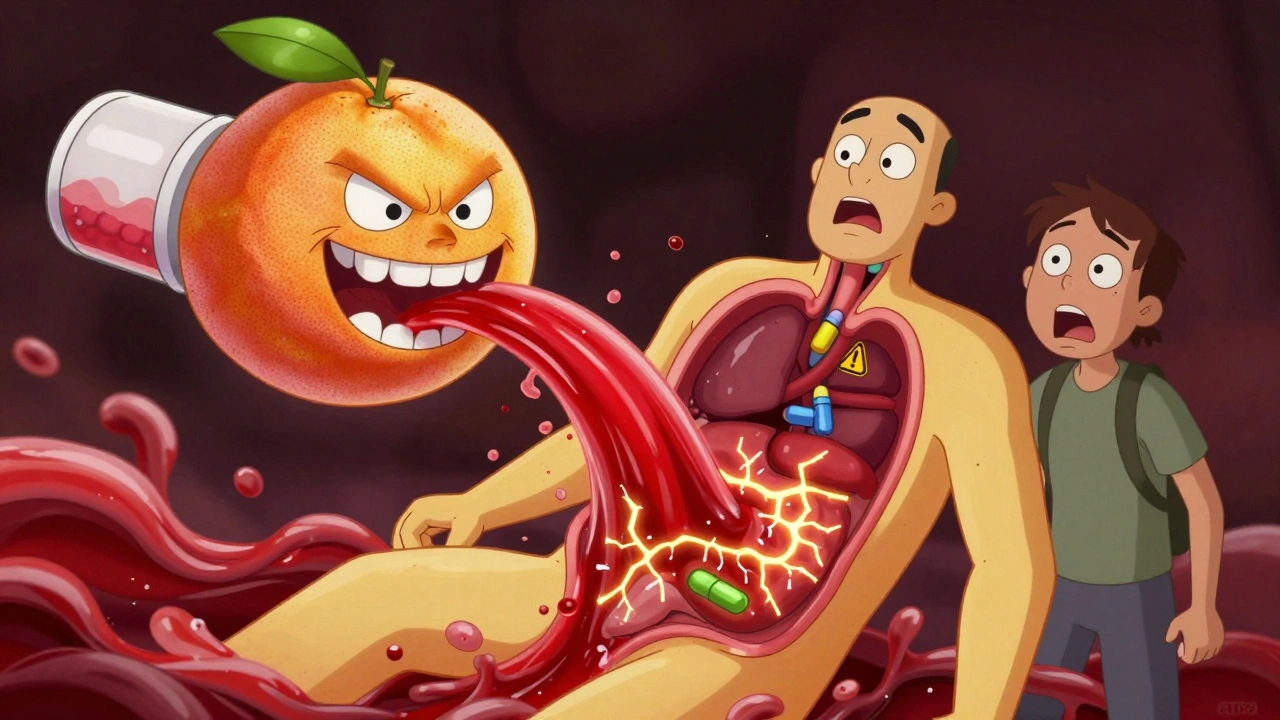
Grapefruit Medication Interaction Checker
Check if your medication interacts with grapefruit or grapefruit juice. The tool uses the latest clinical data to provide accurate information about potential interactions.
One small glass of grapefruit juice can turn a safe medication into a dangerous one. It’s not a myth. It’s not a warning you can ignore by just waiting a few hours. If you’re taking certain drugs, grapefruit - even a little bit - can send your body into a dangerous overdrive. And the worst part? You might not even know you’re at risk.
Why Grapefruit Changes How Your Medication Works
Grapefruit doesn’t just taste different. It changes how your body handles drugs. The culprits are chemicals called furanocoumarins, mostly bergamottin and 6’,7’-dihydroxybergamottin. These aren’t sugar or acid. They’re powerful blockers. They attack an enzyme in your gut called CYP3A4, which normally breaks down a huge number of medications before they even enter your bloodstream. When this enzyme gets shut down, your body absorbs way more of the drug than it should. Instead of 10% of the pill getting into your blood, it might be 30%, 50%, or even 300%. That’s not a little bump - it’s a flood. And for some drugs, that flood can cause serious harm. The effect isn’t short-lived. Unlike alcohol or caffeine, where timing matters, grapefruit’s effect lasts 24 to 72 hours. One glass in the morning can still be affecting your medication at bedtime. That’s why simply spacing out your juice and your pill won’t help. The only safe move is to avoid grapefruit completely while you’re on the drug.Medications That Can Turn Dangerous With Grapefruit
There are over 85 medications known to interact with grapefruit. Some are common. Some are life-saving. And some can kill you if taken with even a small amount of juice. Statins - the cholesterol-lowering drugs - are one of the biggest risks. Simvastatin (Zocor) is the most dangerous. Just 200 milliliters of grapefruit juice - about a cup - can triple your blood levels of this drug. That pushes your risk of muscle breakdown (rhabdomyolysis) through the roof. This can lead to kidney failure. Atorvastatin (Lipitor) and lovastatin (Mevacor) also spike dangerously. But pravastatin (Pravachol) and rosuvastatin (Crestor)? They’re safe. Why? Because they don’t rely on CYP3A4 to get processed. If you’re on simvastatin and love grapefruit, talk to your doctor about switching. Calcium channel blockers - used for high blood pressure and chest pain - are another major group. Felodipine (Plendil) sees a 355% increase in blood levels with grapefruit. Nifedipine (Procardia) jumps by 274%. Amlodipine (Norvasc) isn’t far behind. These spikes can cause your blood pressure to drop too low, your heart to race, or your legs to swell. For someone already on a tight dose, this isn’t just inconvenient - it’s an emergency. Immunosuppressants are the most terrifying. These drugs keep your body from rejecting a transplanted organ. But grapefruit turns them into poison. Cyclosporine levels rise by 50-60%. Tacrolimus? Up to 500%. Sirolimus? A staggering 1100% increase. That means your immune system gets crushed, leaving you wide open to deadly infections. One study showed transplant patients who drank grapefruit juice had a 40% higher chance of organ rejection - not because the drug didn’t work, but because they got too much of it. Other high-risk drugs include certain anti-anxiety meds like buspirone, some anti-arrhythmics like amiodarone, and even some cancer drugs like sunitinib. The FDA has mandated grapefruit warnings on 17 prescription drugs, and another 23 carry warnings in their prescribing info.It’s Not Just Grapefruit - Other Citrus Can Be Just as Bad
Many people think only grapefruit is the problem. It’s not. Seville oranges - the kind used in bitter marmalade - have the same chemicals. Pomelos, which look like giant grapefruits, are just as dangerous. Even limes, especially the Persian variety, contain enough furanocoumarins to cause issues. Sweet oranges, like navel or Valencia? Safe. Tangerines? Safe. Lemon juice? Safe. The difference is in the peel and the pulp. Grapefruit, Seville oranges, and pomelos have high concentrations of those enzyme-blocking compounds in their flesh and peel. Regular oranges don’t. So if you’re trying to avoid interactions, don’t assume all citrus is off-limits. There’s even one case report suggesting pomegranate juice might act similarly - though the evidence isn’t as strong. When in doubt, ask your pharmacist. Don’t guess.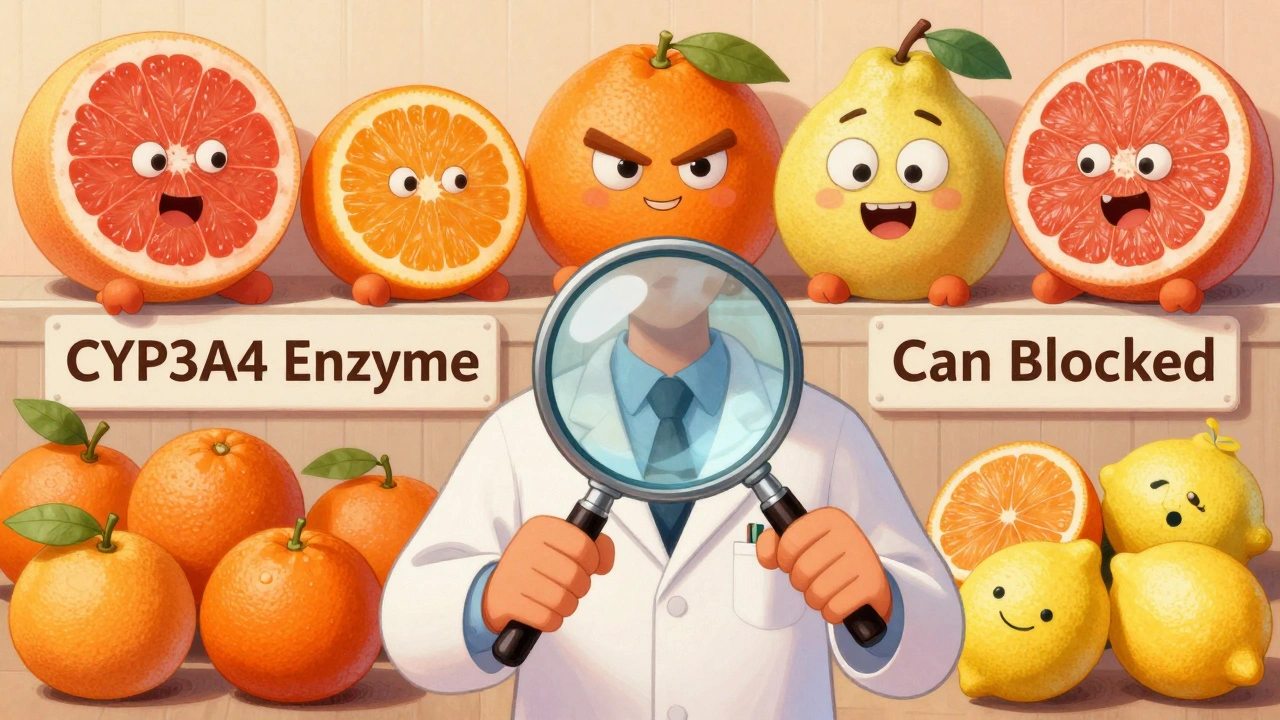
Who’s Most at Risk?
You might think this only matters to older people. It’s worse than that. It matters to anyone taking multiple medications - and that’s a lot of people. In the U.S., over half of adults 65 and older take five or more prescription drugs. Many of those drugs interact with grapefruit. And guess what? A 2017-2018 national survey found that 42.7% of older adults eat grapefruit at least once a week. That’s not a few people. That’s millions. But it’s not just seniors. People with heart disease, high cholesterol, high blood pressure, or who’ve had organ transplants are often on multiple interacting drugs. If you’re on a statin and a blood pressure pill and a daily aspirin, you’re already in the danger zone. Grapefruit doesn’t care if you’re 25 or 75. It only cares if you’re taking a drug it can mess with.What Should You Do?
Step one: Know your meds. Look at the label. Read the patient information sheet. If it says “avoid grapefruit,” don’t ignore it. Step two: Talk to your pharmacist. Not your doctor - your pharmacist. They see your full list of medications. They know which ones interact. And they’re trained to catch this stuff. In fact, 78.4% of community pharmacists in the U.S. now routinely screen for grapefruit interactions during medication reviews. Step three: Ask three questions:- Does my specific drug interact with grapefruit?
- How much, if any, can I safely consume?
- What other fruits or juices should I avoid?
What’s Being Done About It?
Hospitals and clinics are catching on. Electronic health records like Epic now have alerts built in. If you’re prescribed a drug that interacts with grapefruit, your doctor’s system will pop up a warning. That’s good - but it’s not foolproof. Many patients don’t tell their doctors they drink grapefruit juice. They think it’s harmless. The FDA now requires drug makers to test new medications for grapefruit interactions during development. Some companies are even trying to breed new grapefruit varieties with 85-90% less furanocoumarin. Early trials show promise. But right now, those aren’t available. Until they are, the only safe advice is: skip it.Final Reality Check
Grapefruit isn’t evil. It’s full of vitamin C, antioxidants, and fiber. But when it meets certain drugs, it becomes a silent threat. The FDA estimates grapefruit interactions cause about 10,000 adverse events in the U.S. every year. That’s not a small number. That’s hospitalizations. That’s kidney damage. That’s deaths. You don’t need to give up fruit. You just need to know which ones are safe and which ones aren’t. If you’re on medication, grapefruit isn’t a snack - it’s a risk. And risks like this are the ones you can actually control.Can I drink grapefruit juice if I take my medication at night and juice in the morning?
No. The enzyme-blocking effect from grapefruit lasts 24 to 72 hours. Even if you take your pill at night and drink juice in the morning, your body is still unable to properly break down the drug. Timing doesn’t prevent the interaction - only avoiding grapefruit entirely does.
Are all citrus fruits dangerous with medications?
No. Only grapefruit, Seville oranges, pomelos, and possibly some limes contain high levels of furanocoumarins. Sweet oranges, tangerines, and lemons are safe. Always check the specific fruit - don’t assume all citrus is the same.
What if I only eat half a grapefruit once a week?
Even small amounts can cause dangerous interactions. A single 200-milliliter glass of juice has been shown to triple levels of simvastatin. There’s no safe threshold for high-risk drugs. If your medication is on the list, avoid grapefruit completely - no exceptions.
Can I switch to a different statin to avoid the interaction?
Yes. Pravastatin (Pravachol) and rosuvastatin (Crestor) do not interact with grapefruit because they’re metabolized differently. If you’re on simvastatin or lovastatin and want to keep eating grapefruit, talk to your doctor about switching to one of these alternatives.
Do over-the-counter drugs or supplements interact with grapefruit?
Yes. Some OTC pain relievers, allergy meds, and herbal supplements like St. John’s Wort can interact. Always check the label and ask your pharmacist about all medications and supplements you take - not just prescriptions.
Why don’t drug labels always warn about grapefruit?
The FDA requires warnings on 17 specific drugs, but many others have the interaction listed only in the prescribing information - not on the bottle. If you’re unsure, check the full patient information sheet or ask your pharmacist. Don’t rely on the bottle alone.
Is grapefruit juice worse than eating the fruit?
Not necessarily. Both contain the same enzyme-blocking compounds. Juice may be more concentrated, but eating the whole fruit can still cause dangerous interactions. The key is the amount of furanocoumarins, not the form.
Can grapefruit affect my blood pressure medication?
Yes. Many blood pressure drugs - especially calcium channel blockers like felodipine, nifedipine, and amlodipine - are strongly affected. Grapefruit can cause your blood pressure to drop too low, leading to dizziness, fainting, or even heart problems. Always check if your specific blood pressure medication is on the interaction list.



13 Comments
Haley P Law
I can't believe I've been drinking grapefruit juice with my statin for YEARS 😭 I just thought it was 'healthy'... I'm switching to orange juice today. RIP my morning routine.
Andrea DeWinter
This is so important. I'm a pharmacist and I see this every single day. People think 'it's just a little juice' or 'I take my meds at night' - nope. The enzyme stays blocked for days. Always check with your pharmacist - they're the real MVPs. I keep a printed list in my office for patients. Save yourself the ER trip.
George Taylor
Wow... another 'health scare' article that's just fearmongering dressed up as science. I mean, really? 10,000 adverse events? That's less than 0.003% of the population. And you're telling me to give up a delicious fruit because of... enzyme inhibition? Please. I've been eating grapefruit with my meds for 15 years. I'm fine. Your alarmist tone is the real danger.
Chris Marel
I live in Nigeria and we don't have grapefruit here often, but I have a cousin in the U.S. who takes blood pressure meds. I just sent her this article. She didn't know any of this. Thank you for writing this so clearly. Sometimes the simplest things - like a fruit - can be deadly if we don't know.
Arun Kumar Raut
My uncle had a heart transplant. He never touched grapefruit after the doctors told him. I thought it was just a rule. Now I understand why. One sip can kill the gift of life. This is not about diet. This is about survival. Thank you for sharing this truth.
precious amzy
The epistemological framework of this piece is fundamentally flawed. It assumes a binary relationship between pharmacokinetic interference and moral obligation - as if human agency can be reduced to a biochemical equation. One must ask: is the prohibition of grapefruit not a symptom of a medical-industrial complex that pathologizes pleasure? The fruit, in its natural state, is innocent. The system is the poison.
William Umstattd
I can't believe people still don't get this. It's not a 'maybe.' It's not a 'sometimes.' It's a HARD, SCIENTIFIC, PEER-REVIEWED, FDA-MANDATED INTERACTION. If you're on simvastatin and you think 'I'll just have a spoonful' - you're not being clever. You're being a walking time bomb. And if you're reading this and you're still drinking it - please, for the love of God, stop. Your kidneys will thank you.
Brianna Black
I’m from the U.S., but my grandmother is from Italy - she always said, 'If it's bitter, it's good for you.' Grapefruit was her favorite. She died of kidney failure at 78. She was on a statin. I didn’t connect the dots until now. This article feels like a ghost whispering to me. I’m deleting grapefruit from my grocery list today.
Stacy Tolbert
I used to LOVE grapefruit. Now I can't even smell it without crying. My dad had a heart attack after drinking juice with his blood pressure med. He didn't even know it was a problem. He thought it was 'natural.' He's fine now, but he's on a different pill. I just... I just wish someone had told us.
Ronald Ezamaru
This is exactly why you need to talk to your pharmacist, not just your doctor. My doctor never mentioned grapefruit. My pharmacist caught it when I filled my new prescription. She said, 'You drink grapefruit juice? You're lucky you're still alive.' I switched to pravastatin. No more juice. No regrets.
Ryan Brady
America is so soft. We panic over grapefruit juice but let people eat sugar cubes for breakfast. Meanwhile, in Russia, they just take their meds and eat whatever. No warnings. No fear. Just real life. This article is a joke. You're all being manipulated by Big Pharma.
Iris Carmen
wait so lemon is safe?? omg i just drank grapefruit juice this morning and my blood pressure med is at night... is it too late??
Rich Paul
CYP3A4 inhibition via furanocoumarins - classic first-pass metabolism disruption. But honestly, the real issue is polypharmacy. If you're on 5+ meds, you're already playing Russian roulette. Grapefruit’s just the dice. Pravastatin and rosuvastatin are non-CYP3A4 substrates - yeah, but they’re more expensive. Pharma’s playing the long game. Just saying.