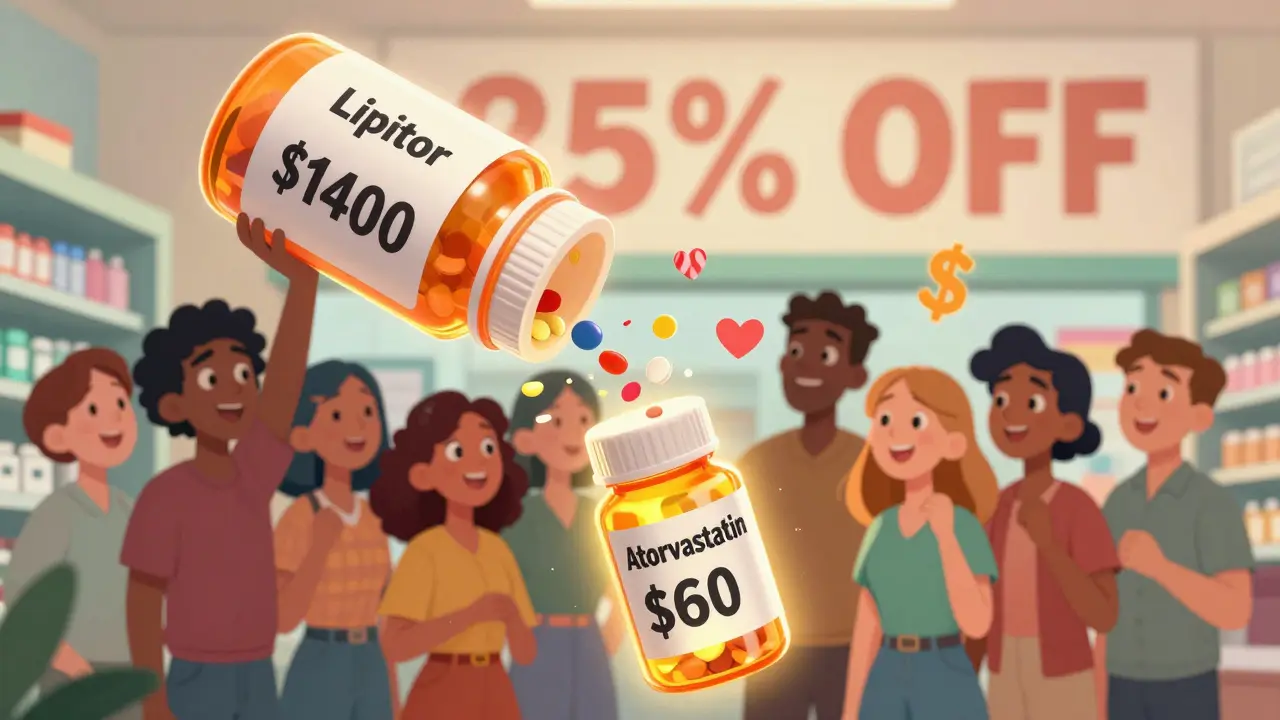
When you’re paying for prescriptions month after month, the sticker shock doesn’t get easier. That $150 pill for your blood pressure? The $300 insulin? There’s a better way - and it’s not a secret. Generic medications work just like the brand-name versions, but they often cost 85% less. For many people, switching to generics isn’t just smart - it’s the difference between taking your medicine every day or skipping doses because you can’t afford it.
What Exactly Is a Generic Medication?
A generic drug has the same active ingredient as the brand-name version. That means it’s the same chemical, working the same way in your body. If your doctor prescribes lisinopril for high blood pressure, the generic version is chemically identical to brands like Zestril or Prinivil. The FDA requires generics to deliver the same amount of medicine into your bloodstream at the same rate as the brand-name drug. That’s called bioequivalence. No guessing. No compromise.
The only differences? The shape, color, or filler ingredients - things like dyes or binders that don’t affect how the drug works. You might notice the pill looks different. That’s normal. And the name? It’s usually just the chemical name, like metformin instead of Glucophage.
Here’s the kicker: the same factories that make brand-name drugs often make the generics too. The FDA inspects them all the same way. No special treatment. No lower standards.
How Much Can You Actually Save?
Let’s talk numbers. The FDA says generic drugs cost, on average, 85% less than brand-name drugs. That’s not a guess. That’s based on real data from millions of prescriptions.
Take a common cholesterol drug: atorvastatin. The brand-name version, Lipitor, used to cost over $1,400 for a 30-day supply. Once the generic hit the market, the price dropped to under $60. That’s a 95% drop. Another example: the diabetes drug metformin. It used to cost $88 per milliliter. Now? Less than $10. That’s $3,800 down to $500 for a month’s supply.
Over the last decade, Americans saved more than $2.2 trillion by using generics. That’s not a typo. Two point two trillion dollars. That’s more than the annual GDP of most countries.
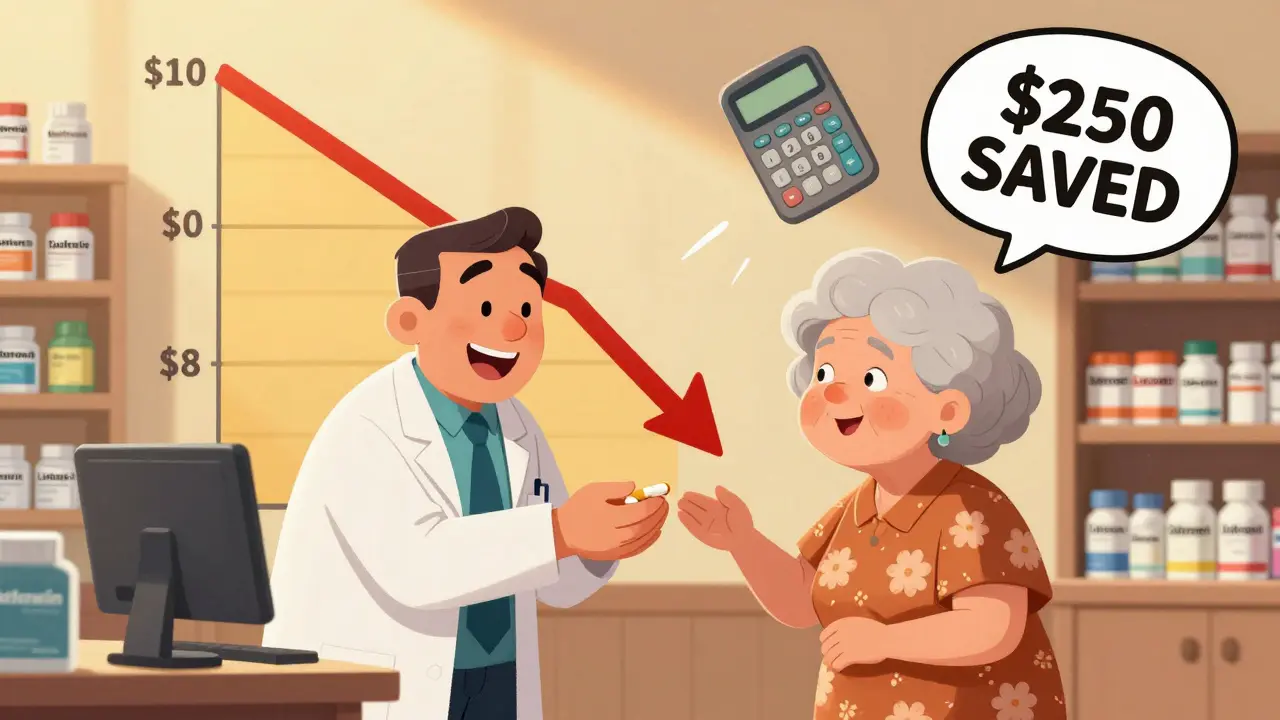
For individuals, the savings add up fast. One Reddit user said they switched from a $150 brand-name antidepressant to the generic version - and now pay $4 a month. Another person saving on thyroid medication said they cut their monthly drug bill by $250. If you’re on two or three maintenance meds, switching to generics could save you $200-$300 every month.
Why Do Generics Cost So Much Less?
It’s simple: they don’t have to repeat the same expensive research. Brand-name companies spend billions developing a new drug - testing it in labs, running clinical trials, proving it’s safe and effective. That cost gets baked into the price.
Generic manufacturers don’t need to do that. They just have to prove their version works the same way. The FDA lets them use a shortcut called the Abbreviated New Drug Application (ANDA). That cuts development time and cost dramatically. No need to retest safety. No need to re-prove effectiveness. Just prove bioequivalence.
And because there are often 10 or more companies making the same generic drug, they compete on price. That drives costs down even further. That’s why you can walk into Costco and get a 30-day supply of many common generics for under $20 - even without insurance.
Is There Any Risk in Switching?
Some people worry that generics don’t work as well. Maybe they tried one and felt different. But here’s the truth: if you’re taking a standard medication - like blood pressure pills, statins, or antibiotics - the chance of a real difference is near zero.
There are a few exceptions. Drugs with a narrow therapeutic index (NTI) need to be very precise in how they’re absorbed. Levothyroxine, used for thyroid conditions, is one of them. A small change in how much medicine enters your bloodstream can affect your hormone levels. For these, your doctor might recommend sticking with the same brand or generic consistently. But even then, switching between FDA-approved generics is safe - you just need to be monitored.
What about the side effects? Sometimes, the fillers in generics can cause minor reactions - like a rash or stomach upset - if you’re allergic to a dye or preservative. But that’s rare. And if it happens, your pharmacist can help you find another version with different inactive ingredients.
Most perceived differences? They’re psychological. You expect a blue pill to work better because it’s the one you’ve always taken. That’s the placebo effect. Not the drug.
How to Get Generics - Even With Insurance
You don’t need to fight your doctor or insurer to get generics. Pharmacists are legally allowed to substitute generics unless your doctor writes “Dispense As Written” on the prescription. And in most states, they’ll do it automatically.
But here’s what most people miss: your insurance formulary. Many plans put generics in the lowest cost tier. That means a $5 copay instead of $50. But sometimes, the cash price at a pharmacy is even lower than your insurance copay. Always ask.
Try this: Before you pay, ask the pharmacist, “What’s the cash price for the generic?” You’d be surprised. At Walmart, Target, or Costco, you can get 90-day supplies of common generics for $10 or less. For insulin, metformin, or sertraline? Often under $25 for three months.
And there’s a newer option: companies like the Mark Cuban Cost Plus Drug Company (MCCPDC). They sell generics directly to consumers with transparent pricing - no middlemen, no markups. On average, people save $5 per prescription compared to traditional pharmacies. For uninsured folks, that’s even higher - around $6 per script.
What to Do If Your Doctor Resists
Some doctors still default to prescribing brand names. Maybe they’re used to it. Maybe they’ve never been trained on generics. Don’t take “that’s what I always prescribe” as the final answer.
Ask: “Is there a generic version available? Is it safe for me? Can we switch?” Most doctors will agree - especially if you mention cost. One study found that when patients asked about generics, doctors switched prescriptions 80% of the time.
If your doctor says, “This one’s different,” ask for proof. Can they show you data that the brand works better? If not, it’s likely just habit.
Real Stories, Real Savings
A woman in Phoenix switched her daughter’s epilepsy meds from brand to generic and saved $400 a month. A retired teacher in Florida cut her diabetes drug bill from $120 to $8 a month. A veteran on Medicare paid $1.50 per pill for his blood thinner - instead of $18.
These aren’t outliers. They’re everyday people using the system the way it was designed to work.
What’s Next for Generic Drugs?
More drugs are coming off patent every year. In 2026 alone, dozens of high-cost medications will become available as generics. That includes drugs for Alzheimer’s, heart failure, and even some cancer treatments.
Biosimilars - the next generation of generics for complex biologic drugs like Humira or Enbrel - are starting to hit the market. They’re not exact copies, but they’re proven to work the same way and cost 15-35% less. Expect those prices to drop even further as more manufacturers enter the space.
The FDA is also speeding up approvals to cut backlogs. More generics = more competition = lower prices. Analysts predict the U.S. will save another $100-$200 billion annually over the next five years just by expanding generic use.
Bottom Line: You’re Not Overpaying - You’re Just Not Asking
There’s no magic trick. No secret hack. Just one simple step: ask for the generic. Every time. Every prescription. Even if you have insurance. Even if you think you can’t afford it otherwise.
Generics aren’t second-rate. They’re the same medicine, cheaper. And they’ve helped millions of people stay healthy without going broke. If you’re paying more than $20 a month for a common medication, you’re probably overpaying. It’s time to check.
Are generic medications as safe as brand-name drugs?
Yes. The FDA requires generic drugs to meet the same strict standards for quality, strength, purity, and stability as brand-name drugs. They’re made in the same type of facilities, inspected the same way, and must prove they deliver the same amount of active ingredient into your bloodstream at the same rate. There’s no difference in safety.
Can I switch from a brand-name drug to a generic without my doctor’s permission?
In most cases, yes - your pharmacist can substitute a generic unless your doctor specifically wrote "Dispense As Written" on the prescription. But it’s always smart to let your doctor know you’ve switched, especially if you’re on a medication with a narrow therapeutic index like levothyroxine or warfarin.
Why do some generics look different from the brand-name version?
By law, generics can’t look exactly like the brand-name drug - that would be trademark infringement. So they use different colors, shapes, or markings. But the active ingredient is identical. The difference is only cosmetic.
Is it true that generics cost 85% less?
Yes. The FDA and multiple independent studies confirm that generics cost, on average, 80-85% less than their brand-name equivalents. Some drugs have dropped over 90% in price after generic approval. The savings are real and well-documented.
What if I can’t afford even the generic?
Many pharmacies offer cash discount programs - Walmart, Target, and Costco often sell common generics for under $10 for a 30-day supply. You can also check the Mark Cuban Cost Plus Drug Company (MCCPDC) or patient assistance programs through nonprofit organizations. Always ask your pharmacist: "What’s the lowest price I can pay?"
Do generics take longer to work than brand-name drugs?
No. To get FDA approval, generics must be bioequivalent - meaning they enter your bloodstream at the same rate and in the same amount as the brand-name drug. There’s no delay in how quickly they start working.
Are all generic manufacturers the same?
All FDA-approved generics must meet the same standards. But different manufacturers may use slightly different inactive ingredients. If you notice side effects after switching to a new generic, talk to your pharmacist. They can help you find another version with different fillers.
Why do some doctors still prescribe brand-name drugs?
Some doctors aren’t aware of the cost difference. Others may have outdated beliefs about effectiveness. But research shows that when patients ask about generics, doctors agree to switch in 80% of cases. Don’t be afraid to ask - it’s your right.

14 Comments
lucy cooke
Oh my god, this is the most profound thing I’ve read all year. It’s not just about pills-it’s about capitalism’s grotesque exploitation of human suffering. We’ve been conditioned to believe that expensive = better, when in reality, the pharmaceutical industry is a gilded cage built on placebo branding and psychological manipulation. I cried reading about the $1.50 blood thinner. That’s not healthcare. That’s extortion with a stethoscope.
Trevor Davis
Hey, I just wanted to say thanks for writing this. My mom’s on metformin and insulin-used to pay $400 a month. Switched to generics last year. Now it’s $35. She’s got more money for groceries and her grandkids’ birthdays. Honestly? This post saved her life. Not just financially. Mentally too.
John Tran
Look, I get it, generics are cheaper, but let’s not ignore the elephant in the room-bioequivalence isn’t always perfect. I mean, sure, the FDA says it’s the same, but have you ever tried switching from one generic manufacturer to another? I did, and my anxiety spiked, my sleep went to hell, and I swear my left foot tingled for three days. I’m not saying generics are bad, I’m saying the system is a fucking Rube Goldberg machine built on assumptions and regulatory loopholes. And don’t even get me started on how some generics have different fillers that trigger histamine responses in sensitive people. I’m not a doctor, but I’ve been on 17 different meds in the last decade, and I’ve learned: if your body reacts weirdly after a switch, it’s not ‘just in your head.’ It’s your body screaming at you because some lab in India used a different dye.
mike swinchoski
You people are ridiculous. If you can’t afford your meds, you shouldn’t be taking them. Life isn’t fair. You think the government should pay for your laziness? Get a second job. Move to a cheaper state. Stop whining. I’ve been on lisinopril for 12 years. I pay $12 a month. You’re not broke-you’re entitled.
Trevor Whipple
bro i just tried to get my generic sertraline at walmart and they said it was $12 for 30 days… then i looked up the brand and it was like $180??? i thought i was getting scammed. turns out i was just living in america. also i think the generic made me less sleepy? or was that placebo? idk but i feel more awake now. also typo: i meant to say 'walmart' not 'walmart'
Lethabo Phalafala
This. This right here. I’m from Johannesburg, and my sister in Cape Town pays $0.80 for her generic thyroid med through the public health system. Meanwhile, my cousin in Ohio pays $75 for the same thing. This isn’t medicine-it’s a rigged game. And the fact that we’re still debating whether generics work? It’s insulting. If your life depends on it, you don’t get to choose based on marketing. You choose based on science. And science says: same pill. Same effect. Just cheaper. Period.
Lance Nickie
generics are just brand names with a bad haircut.
Milla Masliy
As someone who’s traveled to 47 countries and seen healthcare systems from Nepal to Norway, I can confirm: America’s drug pricing is a carnival sideshow. The fact that you need a PhD to understand why your $10 generic suddenly costs $40 because your insurance ‘switched’ to a different manufacturer is absurd. And yet, we’re told to be grateful for ‘affordable’ options that still cost more than a month of rent in Dhaka. The real tragedy? We’ve normalized this.
Priyanka Kumari
I work as a pharmacist in Delhi, and I see this every day. A man comes in for his father’s blood pressure medicine-brand name costs $120. Generic? $2.50. The father’s eyes filled with tears. He said, ‘I didn’t think I’d live to see this day.’ We don’t have fancy marketing here. We have people who need to live. Generics aren’t a loophole-they’re a lifeline. And yes, they work. I’ve watched people recover because they could finally afford to take their pills. No magic. Just humanity.
vishnu priyanka
bro i used to think generics were sketchy until i switched my zoloft and now i’m saving $150/month. also the pill looks like a tiny blue star now which is kinda cool. my dog even noticed i was happier. not sure if that’s the med or just not being broke all the time. either way, win.
Alan Lin
While I appreciate the sentiment and data presented, I must emphasize the critical importance of clinical vigilance when transitioning between pharmaceutical formulations. The pharmacokinetic parameters of bioequivalent agents, while statistically non-inferior, may exhibit inter-individual variability in absorption kinetics, particularly among geriatric populations or those with compromised gastrointestinal integrity. Therefore, a structured, physician-monitored transition protocol is not merely advisable-it is ethically imperative to prevent adverse clinical outcomes. Furthermore, the assertion that cost savings are universally accessible overlooks systemic disparities in pharmacy access and insurance formulary design, which disproportionately impact rural and low-income communities. This is not simply a matter of patient advocacy-it is a public health imperative requiring policy-level intervention.
Scottie Baker
Ugh. I’ve been on the same brand-name statin for 8 years. My doctor says it’s ‘better for me.’ I don’t care if it’s 90% more expensive. I’m not some lab rat for Big Pharma’s bottom line. If I want the blue pill, I’ll take the blue pill. And if you think I’m gonna switch just because you posted a blog? Go stick your generic up your ass.
Anny Kaettano
From a clinical pharmacology standpoint, the bioequivalence threshold (80–125% AUC and Cmax) is intentionally broad to accommodate inter-subject variability. What’s often overlooked is that multiple generic manufacturers can produce formulations with differing dissolution profiles-especially with extended-release agents. For patients on polypharmacy regimens, this can lead to cumulative variability in drug exposure. That’s why I always recommend sticking with the same generic manufacturer once you’ve stabilized. It’s not about brand loyalty-it’s about minimizing pharmacokinetic noise. Also, check out the FDA’s Orange Book for manufacturer-specific data. Knowledge is power.
lucy cooke
Wow. I didn’t expect someone to actually say that. But you know what? You’re right. It’s not about the pill. It’s about the system that makes us feel guilty for wanting to live. If I have to pay $150 to breathe, then I’m not just paying for medicine-I’m paying for the right to exist in a world that commodifies survival. And honestly? I’m tired of being told to be grateful for crumbs. Maybe the real generic is compassion. Let’s start prescribing that.