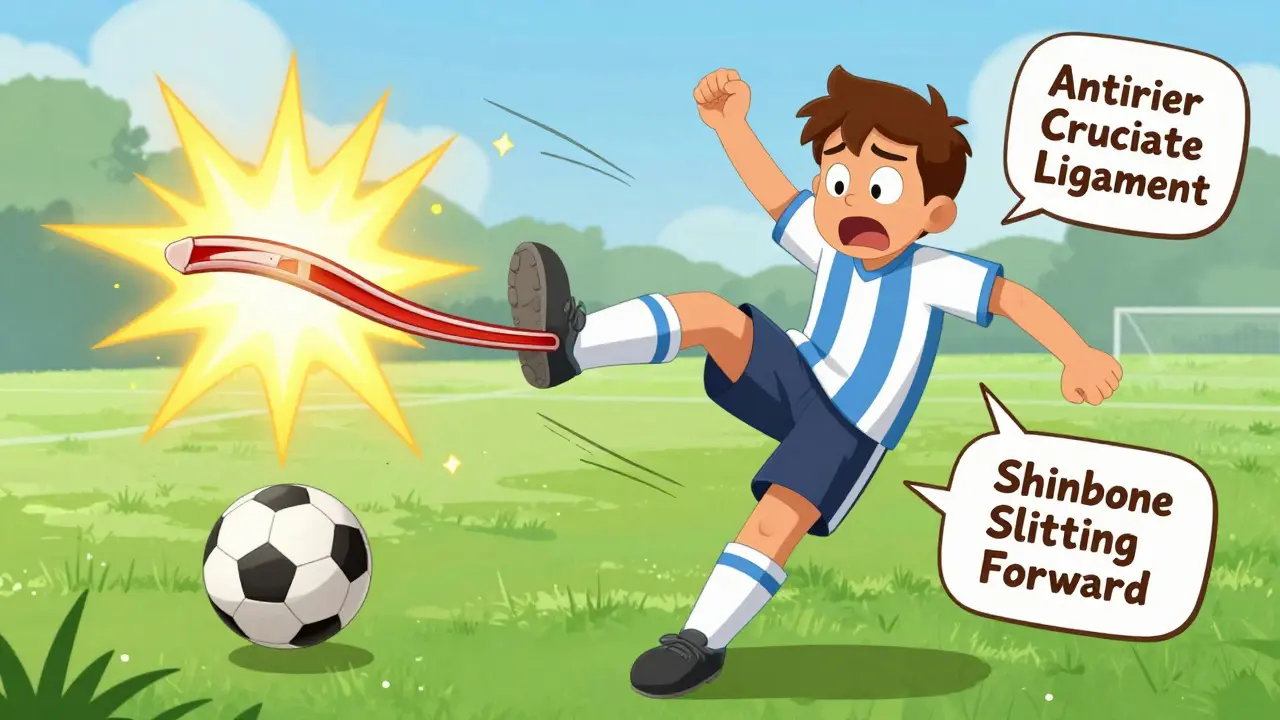
When your knee suddenly gives out during a soccer game, or you hear a loud pop while landing from a jump, it’s not just a bad feeling-it’s a signal your knee might be injured. Two of the most common and debilitating knee injuries involve the ACL and the meniscus. They’re often mentioned together because they’re both critical to knee function, but they’re completely different in structure, how they get hurt, and how they’re treated. Knowing the difference isn’t just medical trivia-it can change whether you need surgery, how long you’ll be off your feet, and even whether you’ll have arthritis in your 40s.
What Exactly Is the ACL and the Meniscus?
The ACL, or anterior cruciate ligament, is a strong band of tissue that runs diagonally in the middle of your knee. It stops your shinbone from sliding too far forward under your thighbone and helps control rotation. Think of it like a seatbelt for your knee joint-it keeps things stable when you cut, pivot, or land from a jump. It’s about 32mm long and can handle up to 2,160 newtons of force before it snaps. That’s more than the weight of a small car.
The meniscus is different. There are two of them-one on the inside (medial) and one on the outside (lateral)-and they’re made of tough cartilage shaped like a C. They act as shock absorbers between your thigh bone and shinbone. About 70% of their structure is collagen, and they’re mostly water, which helps them cushion impact. But here’s the catch: the outer edge of the meniscus has blood flow (the "red-red" zone), so it can heal. The inner part doesn’t-this is the "white-white" zone-and once it’s torn, it rarely repairs itself.
How Do These Injuries Happen?
ACL tears usually happen without contact. About 70% of cases occur when you suddenly stop, change direction, or land awkwardly. You might feel a pop, your knee swells up within two hours, and you can’t put weight on it. The classic sign is the "pivot shift"-when your knee feels like it’s slipping sideways during movement. Around 90% of people with a complete ACL tear hear or feel that pop.
Meniscus tears are different. They often happen during twisting motions, especially if you’re squatting or kneeling. Older adults can tear theirs just by stepping wrong. The symptoms are more mechanical: your knee catches, locks, or feels like something’s stuck inside. Swelling comes slower-usually 6 to 24 hours later. You’ll also feel pain right along the joint line, where the meniscus sits. Unlike ACL tears, meniscus injuries don’t always make your knee feel unstable. Instead, they make it feel broken.
When Is Surgery Actually Needed?
This is where things get messy. For ACL injuries, the decision is clearer-if you’re under 40 and active, especially in sports like basketball, soccer, or skiing, surgery is almost always recommended. The MOON Knee Group found that 95% of active patients under 40 who skip ACL reconstruction end up with recurrent instability, secondary meniscus tears, or early arthritis. Reconstruction isn’t about fixing pain-it’s about preserving the knee long-term.
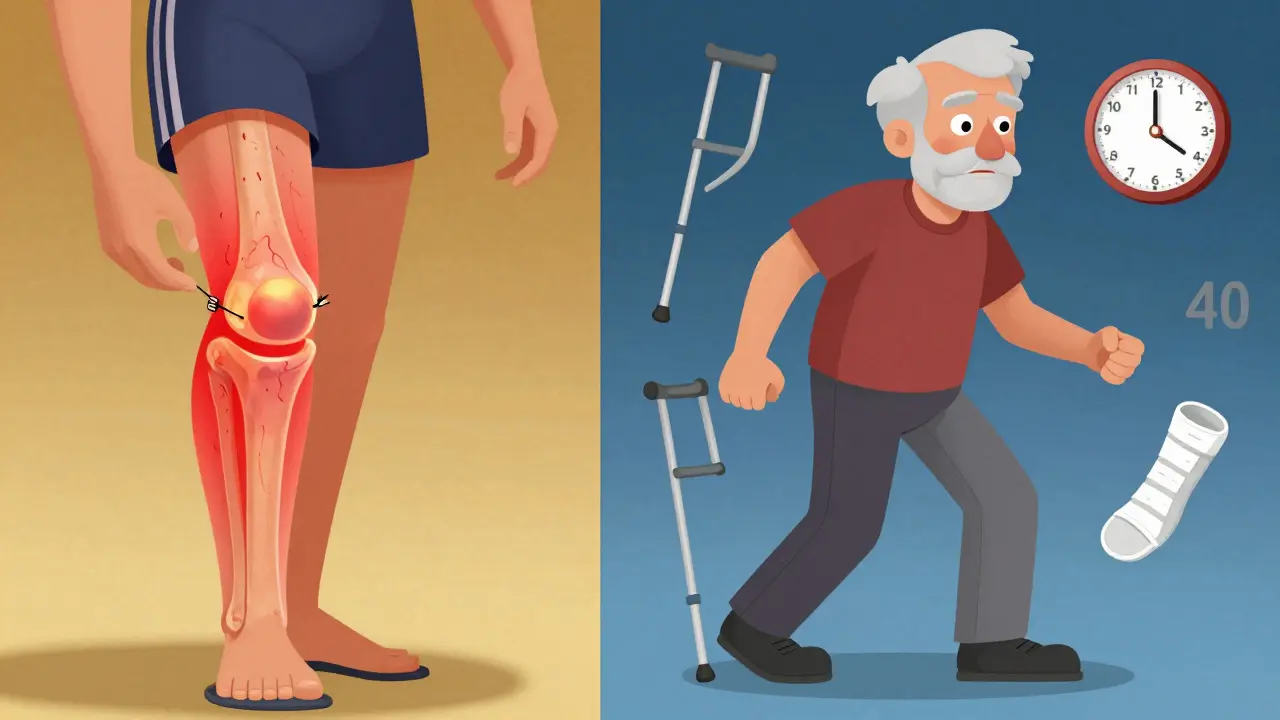
But for meniscus tears? Only 30-40% need surgery. The rest can be managed with physical therapy, activity modification, and time. Studies show that if you have a degenerative tear (common in people over 40) with no locking or catching, physical therapy works just as well as surgery. In fact, removing part of the meniscus (meniscectomy) increases your risk of osteoarthritis by 14% for every 10% of tissue removed. That’s why doctors now push hard to repair instead of remove-especially if the tear is in the red-red zone.
Surgical Options and Recovery Timelines
ACL reconstruction uses a graft to replace the torn ligament. The two most common options are your own hamstring tendon or the middle third of your patellar tendon. Hamstring grafts are less painful after surgery, but patellar tendon grafts are stronger-up to 2,900N of tensile strength. Allografts (donor tissue) heal faster initially but are more likely to fail in young athletes. Data from 2023 shows that under-25 patients using allografts have a 22% re-tear rate, compared to 7.7% with their own tissue.
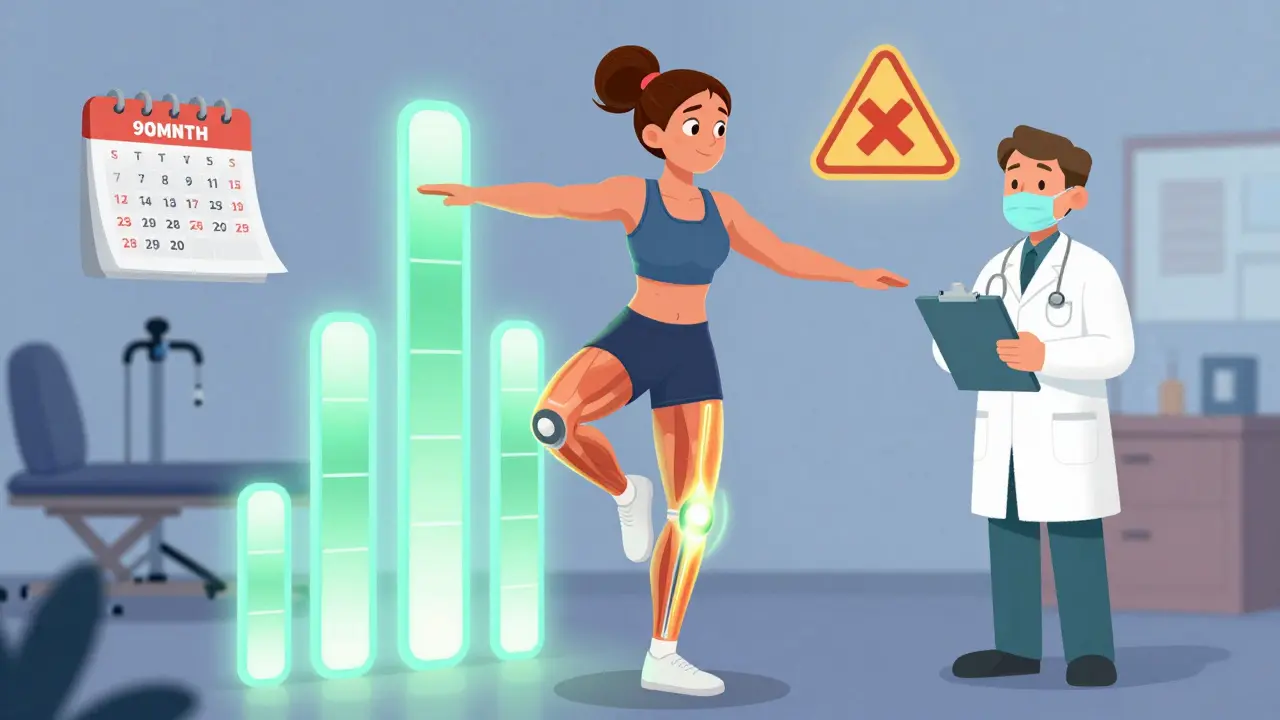
Recovery isn’t fast. Even with the best rehab, you need at least 9 months before returning to pivoting sports. Rushing back before 9 months increases re-injury risk by 5 times. The rehab is strict: weeks 0-2 focus on regaining full knee extension and 90 degrees of flexion. By week 6, you’re doing single-leg balance drills. Jogging starts around week 12. Sport-specific drills don’t begin until month 4. And even then, you need to hit 90% strength symmetry on isokinetic tests before clearing return-to-play.
Meniscus repair is trickier. If your tear is in the red-red zone and you get it fixed within 8 weeks, healing rates are 80-90%. But if you wait three months, the tissue degenerates, and repair success drops to 40-50%. After repair, you can’t put full weight on the leg for 6 weeks. You’ll wear a brace locked at 0-90 degrees. Walking with crutches is required. Full return to sports takes 5-6 months.
Meniscectomy? That’s the quick fix. You can walk the same day. Light activities? Back in 2-4 weeks. But you’re not truly recovered until 6-8 weeks. And even then, many people report ongoing pain or stiffness, especially when kneeling or squatting. Long-term, the risk of arthritis climbs.
Costs and Real-World Outcomes
ACL reconstruction costs between $15,000 and $25,000. Meniscus repair runs $9,000-$18,000. Meniscectomy is cheaper-$6,000-$12,000. But cost isn’t just about the surgery. It’s about rehab, time off work, and long-term consequences.
Patients who have ACL reconstruction report 82-92% satisfaction at 2 years. But 20-30% develop osteoarthritis within a decade. Meniscectomy has 85-90% short-term success, but every bit of tissue removed adds to arthritis risk. A 2020 study showed that removing just 20% of the meniscus doubles your chance of needing a knee replacement later.
Real people share their stories too. One Reddit user, after ACL surgery, said they had 15% less quad muscle mass even after 12 months. Another, who had a meniscus repair, ended up with 20 degrees of permanent extension loss because they couldn’t fully straighten the knee during early rehab. These aren’t rare cases-they’re common.
What Happens If You Don’t Do Anything?
Some people think, "I can live with it." But for ACL tears, that’s dangerous. Without a functioning ACL, your knee becomes unstable. That instability causes the meniscus to get crushed every time you move. Studies show that 50% of untreated ACL tears lead to a secondary meniscus tear within 5 years. And once you’ve lost both the ACL and meniscus, your risk of needing a knee replacement before age 50 jumps dramatically.
For meniscus tears, waiting too long reduces your options. Dr. Shah from Banner Health found that delaying treatment beyond 3 months cuts your chance of repair by 60%. What starts as a repairable tear becomes a degenerative mess that only a partial removal can fix.
What About Non-Surgical Options?
Physical therapy is powerful. For ACL injuries, prehab-strengthening your quads and hamstrings before surgery-can reduce post-op weakness from 22% to just 8%. For meniscus tears, a 12-week rehab program focusing on quad strength, hip stability, and controlled movement helps 60-70% of patients avoid surgery entirely.
Emerging options include platelet-rich plasma (PRP) injections during meniscus repair. A 2025 trial showed PRP boosted healing rates by 25% in red-white zone tears. Meniscus allografts (donor cartilage transplants) are also becoming more common for younger patients with large, irreparable tears. Five-year survival rates are now around 85%.
And prevention? The FIFA 11+ program-15 minutes of warm-up drills before training-has been shown to cut ACL injuries in half among soccer players. It’s simple: balance drills, strengthening, and proper landing techniques. It’s not magic. It’s science.
What Should You Do Next?
If you’ve had a knee injury:
- Get an MRI within 2 weeks. Delayed imaging means missed repair windows.
- Don’t assume surgery is the only option-especially for meniscus tears.
- If you’re active and under 40 with an ACL tear, don’t delay reconstruction.
- Find a surgeon who does at least 50 ACL reconstructions a year. Skill matters more than brand.
- Start physical therapy before surgery if you can. Even 3-4 weeks helps.
- Ask about graft options: hamstring vs. patellar tendon. Know the trade-offs.
- For meniscus tears, ask: "Is this repairable?" Not just, "Can you remove it?"
There’s no one-size-fits-all. But the longer you wait, the fewer choices you have. And the more you remove from your knee, the more you’re betting against your future mobility.
Can a meniscus tear heal without surgery?
Yes, about 60-70% of meniscus tears can be managed without surgery, especially if they’re degenerative, small, and don’t cause locking or catching. Physical therapy focusing on quad strength, hip control, and movement retraining helps most people regain function. But tears in the inner, blood-poor zone (white-white) won’t heal on their own-repair or removal becomes the only option.
How long does ACL recovery really take?
Full recovery takes 9-12 months, not 6. Most people feel okay at 6 months, but returning to sports before 9 months increases re-injury risk by 5 times. You need to pass strength tests (90% symmetry on isokinetic machines), hop tests, and agility drills before clearing return-to-play. Rushing it leads to another tear.
Is allograft or autograft better for ACL surgery?
For anyone under 25, autograft (your own tissue) is better. Allografts heal faster and cause less initial pain, but they’re twice as likely to fail in young, active people. Five-year data shows a 22% re-tear rate with allografts versus 7.7% with hamstring autografts. For older, less active patients, allografts are a reasonable option.
Can you still play sports after meniscus removal?
Yes, many people return to sports after meniscectomy. But the trade-off is long-term. Every 10% of meniscus removed increases your risk of osteoarthritis by 14%. Athletes often report stiffness, swelling after activity, and reduced endurance. You may need to switch from running to swimming or cycling. It’s not a "cure"-it’s damage control.
Why do some ACL surgeries fail?
Failure usually comes from returning to sport too early, poor graft placement, or inadequate rehab. The biggest risk? Returning before 9 months. Surgeons who do fewer than 50 ACL reconstructions a year also have higher failure rates. Arthrofibrosis (excessive scar tissue) is another cause-it locks the knee and requires manual manipulation under anesthesia.
Are meniscus repairs worth the long recovery?
If the tear is in the red-red zone and caught early, yes. Repairing the meniscus cuts your future arthritis risk by up to 50% compared to removal. The 6-week brace and slow rehab are tough, but preserving your natural cartilage is the best long-term strategy. For people under 30, repair is almost always the preferred choice-if it’s possible.




13 Comments
Jacob Milano
I used to think knee injuries were just 'bad luck' until I tore my ACL playing pickup basketball. The pop? Like a balloon bursting inside your joint. Then came the swelling, the fear, the endless PT sessions. But here's the thing no one tells you-prehab made all the difference. I did 4 weeks of quad strengthening before surgery, and honestly? My recovery felt like cheating. I was walking without crutches in 10 days. Don't skip the prep work. It's not optional-it's your secret weapon.
Cassie Tynan
Of course they want you to get surgery. Who do you think profits when you're stuck on crutches for six months? The ortho docs, the physical therapists, the brace companies... they're all on the same payroll. You ever wonder why they never mention that 40% of meniscus tears heal just fine with rest? Nah. Too messy for the corporate machine. They'd rather cut you open than admit they don't have all the answers.
Stephen Craig
The 9-month rule for ACL return is backed by data. Not opinion. Not hype. Data.
Peyton Feuer
i had a meniscus tear last year and went the PT route. 12 weeks later i was hiking again. no surgery. no meds. just patience and dumbass lunges. also, the FIFA 11+ thing? i started doing it before every workout. no injuries since. weird how simple stuff works best.
Connor Hale
It's funny how we treat knees like they're disposable. We run, jump, twist, and then act shocked when they break. But we'll spend thousands on the latest sneakers and never think about how we move. Maybe the real injury isn't the tear-it's the mindset that says 'fix it' instead of 'change how you live.'
John Wilmerding
As a sports medicine physical therapist with over 15 years in the field, I can confirm the data presented here is not only accurate but conservative. Patients who delay imaging beyond two weeks often lose the window for meniscus repair. And yes-autografts under age 25 remain the gold standard. I’ve seen too many allograft failures in Division I athletes to recommend otherwise. The key is not just the surgery, but the discipline in rehab. Nine months isn’t long-it’s the bare minimum.
Charlotte N
i read this whole thing and like... why does everyone assume surgery is the end goal? what if you just... stopped playing soccer? what if you just... walked more and lifted weights? why is the only solution to cut something open? i dont get it
Roshan Aryal
This is typical American medical overkill. In India, we treat knee injuries with Ayurveda, rest, and turmeric paste. No scalpel. No $20,000 bills. Just time and tradition. You people think surgery is progress? It's just capitalism wearing a white coat. My uncle tore his meniscus at 58-no surgery, just oil massage and yoga. He walks better now than most Americans half his age. Your system is broken.
Jack Wernet
I appreciate the thoroughness of this post. The distinction between ACL and meniscus pathology is often conflated, even among medical professionals. The emphasis on biomechanical function over symptom suppression is clinically sound. I particularly commend the inclusion of the MOON Knee Group data and the emphasis on prehabilitation. This is the kind of evidence-based narrative that should be standard in patient education materials.
Siobhan Goggin
I had both tears at 27. Did the ACL surgery, skipped the meniscus. Regret it. Now I have arthritis at 35. I wish I’d listened to the guy who said, 'Repair if you can.' Not remove. I’m not bitter. Just... wiser. And slower.
Jacob Milano
I just read your comment about the meniscus removal. That’s the exact reason I pushed for a repair instead of a trim. Six weeks on crutches sucked. But I’m 31 now, and I still run 5Ks without pain. My surgeon said I was lucky-my tear was in the red zone. If you’ve got a chance to save the meniscus, take it. Even if it’s hard. Your future self will thank you.
Vikram Sujay
The cultural lens through which we approach injury is profound. In many Eastern traditions, the body is viewed as a vessel of balance rather than a machine to be repaired. While Western medicine excels in intervention, it often neglects the holistic restoration of function. A 12-week physical therapy regimen, grounded in mindfulness and movement re-education, aligns more closely with ancient principles of healing than a scalpel ever could. We must integrate, not oppose.
Catherine HARDY
They don’t want you to know this, but the 'pop' you hear? It’s not your ACL tearing. It’s the implant company’s contract being signed. They’ve been planting those '70% of ACL tears need surgery' stats for 20 years. The real truth? The FDA approved the first ACL graft in 1982. That’s the same year the insurance industry started denying coverage for physical therapy beyond 6 visits. Coincidence? I think not.