
Breastfeeding Medication Timing Calculator
Recommended timing: Wait 2-3 hours before next feed
Expected infant exposure: 15-25% of maternal dose
Risk level: Low Risk
Safe practice: Take your medication right after breastfeeding to allow your body time to clear the drug before the next feeding.
Warning: Avoid this medication if your baby is less than 6 months old or if you're taking other sedating medications.
How It Works
This calculator determines the optimal timing for taking medication based on the drug's half-life and your baby's feeding schedule.
Drug Safety Rating
Important Notes
• Timing can reduce infant exposure by up to 75% for many drugs • The Relative Infant Dose (RID) is the standard safety measure • Always use the lowest effective dose • Check LactMed database for the most current information
Why Timing Matters When You’re Breastfeeding and Taking Medication
If you’re breastfeeding and need to take medicine, you’re not alone. Millions of mothers do it every day. But here’s the thing: when you take that pill can make a big difference in how much medicine your baby gets through your breast milk. It’s not about avoiding meds altogether-it’s about timing them right so your baby stays safe and you stay healthy.
Many moms worry that any medication will harm their baby. The truth? Most drugs pass into breast milk in tiny amounts. But for some, even small amounts can matter-especially with opioids, benzodiazepines, or certain antidepressants. That’s where timing comes in. By syncing your medication schedule with your baby’s feeding routine, you can cut infant exposure by up to 75% for many drugs, according to the Academy of Breastfeeding Medicine (2022).
How Medication Gets Into Breast Milk
Drugs don’t magically appear in your milk. They move from your bloodstream into your breast tissue. The amount your baby gets depends on how much is in your blood when you nurse. That’s why peak drug levels matter.
Take morphine, for example. After you swallow it, levels in your blood rise quickly-peaking in about 30 to 60 minutes. If you breastfeed right after taking it, your baby gets the highest dose possible. But if you wait until the drug has started to clear-say, 2 to 3 hours later-you’re giving your body time to break it down. The same principle applies to codeine, oxycodone, and even common pain relievers like ibuprofen.
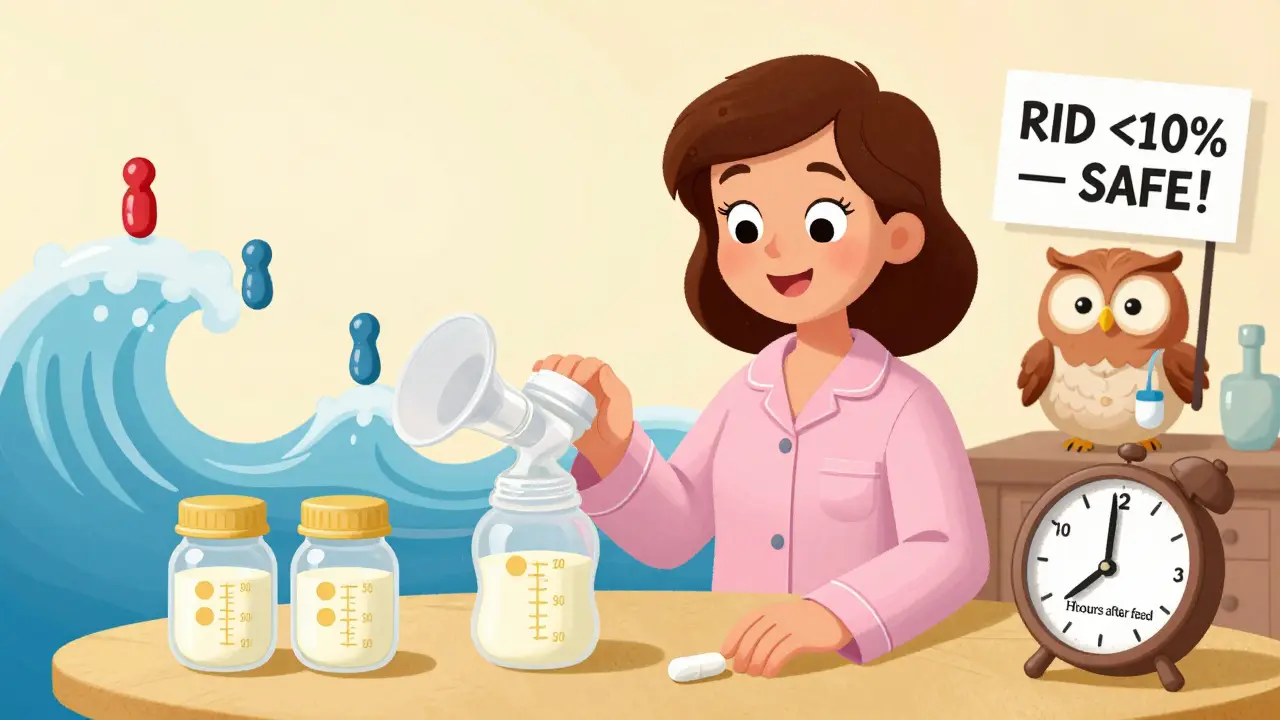
There’s a number doctors use to measure safety: the Relative Infant Dose, or RID. It’s the percentage of your dose that ends up in your baby’s system. Anything under 10% is generally considered safe. Codeine has an RID of 0.6-8.1%, while morphine can hit 9-35%. That’s why timing is critical for morphine-it’s more likely to cross into milk, so you need to be more careful.
Best Times to Take Medication While Breastfeeding
Here’s the simple rule for most short-acting medications: breastfeed right before you take your dose. This gives you the longest gap before the next feeding, letting your body clear the drug before your baby nurses again.
For example:
- If you take an opioid like hydrocodone or oxycodone, nurse your baby, then wait 1-2 hours before taking the pill. The next feeding should be at least 3-4 hours later.
- For immediate-release painkillers like acetaminophen or ibuprofen, timing matters less-they’re already low-risk, with RIDs under 1%. But if you want to be extra cautious, take them right after a feed.
- For anxiety meds like alprazolam (Xanax), which peak in 1-2 hours and last about 11 hours, take it after the longest stretch of sleep-usually right after the nighttime feed.
Some medications don’t need timing tricks. Ibuprofen and acetaminophen are safe at any time. The American Academy of Family Physicians (2022) recommends them as first-line options for pain during breastfeeding because they barely show up in milk.
Drugs That Need Extra Caution
Not all meds are created equal. Some have serious risks-even with perfect timing.
Codeine and tramadol are banned for breastfeeding by the FDA. Why? Some people metabolize them too fast, turning them into morphine-like compounds that can cause dangerous breathing problems in babies. No timing strategy fixes this. If you’re prescribed one of these, ask for an alternative.
Diazepam (Valium) is another tricky one. It has a half-life of nearly 2 days. That means it builds up in your system over time. Even if you time it perfectly, it’s still hanging around. For long-term use, doctors often recommend switching to a shorter-acting option like lorazepam.
Buprenorphine, used for opioid use disorder, is safer. The 2022 ABM protocol recommends taking it right after breastfeeding and waiting at least 3 hours before the next feed. This reduces infant exposure while keeping moms stable.
Antidepressants like sertraline and paroxetine are often preferred for breastfeeding moms because they have low milk transfer and minimal side effects in babies. Timing helps, but even without it, they’re considered low-risk.
What About Pumping and Dumping?
You’ve probably heard the advice: “Pump and dump after taking meds.” But that’s usually not necessary-and it can hurt your milk supply.
Here’s the reality: pumping and dumping doesn’t speed up how fast your body clears the drug. It just removes milk that’s already there. If you pump right after taking a pill, you’re just replacing the milk your body will make anyway. The drug is still circulating in your blood. The next batch of milk will still contain it.
The only time pumping and dumping makes sense is if you’re taking a medication you know is unsafe and you need to maintain supply while you wait for it to clear. For example, if you accidentally took codeine, you might pump and discard for 24 hours while switching to a safer drug. But this should be done under medical supervision.
Instead of dumping, plan ahead. If you know you’ll need a medication that requires timing, pump and store milk before you take it. That way, you can feed your baby stored milk during the window when your milk has the highest drug levels.
What to Do in the First Few Days After Birth
Newborns don’t drink much in the first 3-4 days. Your milk supply is low, and your baby’s stomach is the size of a marble. That means even if a drug passes into your milk, the total amount your baby gets is tiny.
According to Mayo Clinic (2023), medication exposure during this early stage is usually negligible. That’s good news if you need pain relief after delivery. You can take ibuprofen or acetaminophen without stress. Timing isn’t as critical right after birth.
But don’t assume it’s safe forever. Once your milk supply ramps up-usually by day 5-your baby starts drinking more. That’s when timing becomes important.
How to Talk to Your Doctor About This
Many moms don’t bring up breastfeeding when they’re prescribed meds. Others are told, “It’s fine,” without any details. That’s not enough.
Ask your doctor these questions:
- Is this drug safe for breastfeeding?
- What’s the peak time and half-life?
- What’s the recommended timing for breastfeeding?
- Is there a safer alternative?
Don’t be afraid to ask for the LactMed database reference-it’s the gold standard for breastfeeding and medication info, maintained by the U.S. National Library of Medicine. If your doctor doesn’t know, ask for a lactation consultant. They’re trained in this stuff.
Also, tell your pharmacist, midwife, or health visitor you’re breastfeeding. They can check for interactions and help you time doses correctly.

Real-Life Scenarios
Scenario 1: New mom with a C-section
She’s on morphine for pain. She nurses right after surgery, then waits 4 hours before the next feed. She takes her next dose right after that feed. She pumps and stores milk before her first dose so she has safe milk for the next feeding. She switches to ibuprofen after 48 hours.
Scenario 2: Mom with anxiety on alprazolam
She takes her daily dose right after her baby’s 10 p.m. feed. She waits 4 hours before the next feeding-meaning the baby gets her morning feed with minimal drug levels. She avoids nighttime feeds during peak concentration.
Scenario 3: Mom on buprenorphine for opioid use disorder
She takes her dose right after the 6 a.m. feed. She waits 3 hours before the next feed. She uses stored milk for any feeds in between. Her baby’s RID is under 5%-well within safe limits.
What Doesn’t Work
Timing won’t help if:
- The drug has a long half-life (like diazepam or fluoxetine).
- You’re taking extended-release or slow-release versions (like OxyContin or Effexor XR).
- The drug is known to be unsafe regardless of timing (like codeine or tramadol).
And timing doesn’t replace dose control. Always use the lowest effective dose. More isn’t better-it just means more drug in your milk.
What’s Changing Now
More doctors are catching on. As of 2023, 27 U.S. states now include medication timing in Medicaid-covered breastfeeding support. The LactMed database has updated its recommendations for 87% of commonly prescribed drugs-up from 62% in 2018.
Future tools might include genetic testing. Some people metabolize drugs differently because of their genes. For example, CYP2D6 gene variants can turn codeine into dangerous levels of morphine. In the next few years, we may see doctors testing moms for these variants before prescribing.
For now, the best tool you have is knowledge. And timing. Together, they let you keep doing what matters most: feeding your baby, while taking care of yourself.
Can I take ibuprofen while breastfeeding?
Yes, ibuprofen is one of the safest pain relievers for breastfeeding moms. It passes into breast milk in very small amounts-less than 1% of your dose-and has no known side effects in babies. You can take it at any time, with or without timing. It’s often recommended as a first choice over opioids or other stronger meds.
Is it safe to take antidepressants while breastfeeding?
Many antidepressants are safe, but timing matters. Sertraline and paroxetine are preferred because they transfer minimally into milk and rarely affect babies. Fluoxetine has a long half-life and can build up, so it’s less ideal. If you’re on an SSRI, work with your doctor to pick one with the lowest milk transfer and consider taking it right after a feed to reduce exposure.
What if I accidentally take codeine while breastfeeding?
Stop taking codeine immediately. It can cause life-threatening breathing problems in babies, especially if they’re ultra-rapid metabolizers. Pump and discard milk for 24 hours, then switch to a safer painkiller like ibuprofen or acetaminophen. Contact your pediatrician or a lactation consultant right away. Don’t wait for symptoms-they can appear quickly.
Should I pump and dump after every dose?
No, pumping and dumping doesn’t remove the drug from your system-it only removes milk already made. The drug is still in your blood, so your next milk will still contain it. Only pump and dump if you’ve taken a medication that’s unsafe and need to clear it while maintaining supply. Otherwise, timing your dose around feeds is far more effective and less disruptive.
How do I know if my baby is reacting to medication in my milk?
Watch for unusual sleepiness, trouble feeding, irritability, or breathing problems-especially if you started a new medication. These are rare, but serious. If you notice any of these, stop the medication and contact your pediatrician. Keep a log of when you take meds and when symptoms appear. This helps your doctor spot patterns.
Can I breastfeed if I’m on opioids for chronic pain?
Yes, but carefully. Hydrocodone and morphine are preferred over oxycodone, which carries a higher risk of infant sedation. Take the lowest effective dose, use immediate-release forms, and time doses after feeds. Wait 3-4 hours before the next nursing session. Work with a pain specialist and lactation consultant to create a safe plan. Avoid tramadol and codeine entirely.
Is it safe to take allergy or cold medicine while breastfeeding?
Most single-ingredient antihistamines like loratadine or cetirizine are safe. Avoid decongestants like pseudoephedrine-they can reduce milk supply. Check labels: multi-symptom formulas often contain alcohol or antihistamines that aren’t ideal. Stick to the simplest option and take it right after a feed. Always check LactMed or ask your pharmacist.





8 Comments
Sami Sahil
bro i was so scared to take ibuprofen after my c-section but this post saved me. i took it right after feeding and my baby slept like a angel. no more panic. you guys are legends.
franklin hillary
timing is everything. not just for meds but for life. i used to pump and dump like a maniac until i learned the science. now i take my anxiety meds after the 10pm feed and sleep like a baby. literally. the body knows what to do if you just give it a chance. stop fighting it. trust the rhythm.
Bob Cohen
so let me get this straight. we’re now treating breastfeeding like a timed drug delivery system? i mean… i guess it makes sense. but also… is this really what motherhood has come to? calculating every feed like a chemistry experiment? i’m just glad i’m not the one doing it.
Ed Di Cristofaro
pumping and dumping is for people who dont read. if you took codeine you deserve what happens. no one forced you. your baby suffers because you were lazy. learn or stop breastfeeding.
Deep Rank
i read this whole thing and honestly? i think you’re all missing the point. my cousin’s friend’s sister took ibuprofen and her baby got a rash and then cried for 14 hours straight. and now the kid has anxiety. and you’re talking about timing? what about the long term? what about the emotional toll? what if your baby grows up and blames you for this? you’re not just giving meds, you’re giving trauma. and no one talks about that.
Bryan Coleman
this is the most practical guide i’ve seen. took my first dose of sertraline after the 2am feed. waited 4 hours. baby slept through it. no fuss. no drama. just science. thank you for not sugarcoating it. also, lactmed is a godsend. bookmarked.
Ishmael brown
so… if i take my oxycodone right after feeding… does that mean my baby gets the *leftovers*? 🤔🤨😮💨
Aditya Gupta
took the advice. took my pain pill after the 8pm feed. waited 3 hrs. baby slept 6 hrs straight. no more 2am panic. you dont need to be perfect. just be smart. you got this.