
When you pick up a prescription, you might not realize the pharmacist is making a legal decision before handing you the bottle. That decision-whether to give you the brand-name drug your doctor wrote on the script or a cheaper generic version-isn’t up to them alone. It’s controlled by pharmacy substitution laws, which vary from state to state. These rules exist to save money, protect safety, and give patients some control. But they’re confusing. One state might force substitution; another might require your signature. One might let you swap a biosimilar like it’s aspirin; another demands your doctor’s OK first.
What Exactly Is Pharmacy Substitution?
Pharmacy substitution means a pharmacist replaces a brand-name drug with a generic version-or a biosimilar for biologic medications-without going back to your doctor. It’s legal in every U.S. state and Washington, D.C. But the rules? They’re a patchwork.For small-molecule drugs (like blood pressure pills or antibiotics), generics are chemically identical to brand names. The FDA says they work the same way. They cost 80-85% less. That’s why states encourage substitution: it saves billions. In 2023, generics accounted for 90% of all prescriptions filled but only 23% of total drug spending, saving the system $313 billion.
But biologics are different. These are complex drugs made from living cells-like insulin, rheumatoid arthritis treatments, or cancer therapies. Biosimilars are highly similar, but not identical. Only 10 out of 38 approved biosimilars have been labeled “interchangeable” by the FDA as of late 2023. That means they’ve passed extra tests to prove they can be swapped without risk. Even then, state laws often add extra layers.
How Your State Handles Substitution
States fall into three main categories for small-molecule drugs:- Mandatory substitution (19 states): Pharmacists must substitute unless the doctor says “dispense as written.” States like California, New York, and Texas are in this group.
- Permissive substitution (31 states + DC): Pharmacists can substitute, but aren’t required to. They might still choose the brand if they think it’s better for you.
- Restrictive rules (none outright, but some have hidden limits): Some states ban substitution for certain drugs-like epilepsy meds (Hawaii), blood thinners (Kentucky), or thyroid meds-because tiny differences in formulation could cause harm.
For biosimilars, the rules are even more layered. Forty-five states (90%) treat them differently than generics. Many require:
- Notification to your doctor within 24-72 hours after substitution
- Written or electronic documentation in your pharmacy record
- Proof that the biosimilar costs less than the brand
For example, Florida and Illinois require both you and your doctor to be notified within 72 hours. Alabama and Mississippi? They only require the pharmacist to log the swap. No patient or doctor alert needed.
Do You Have to Be Told?
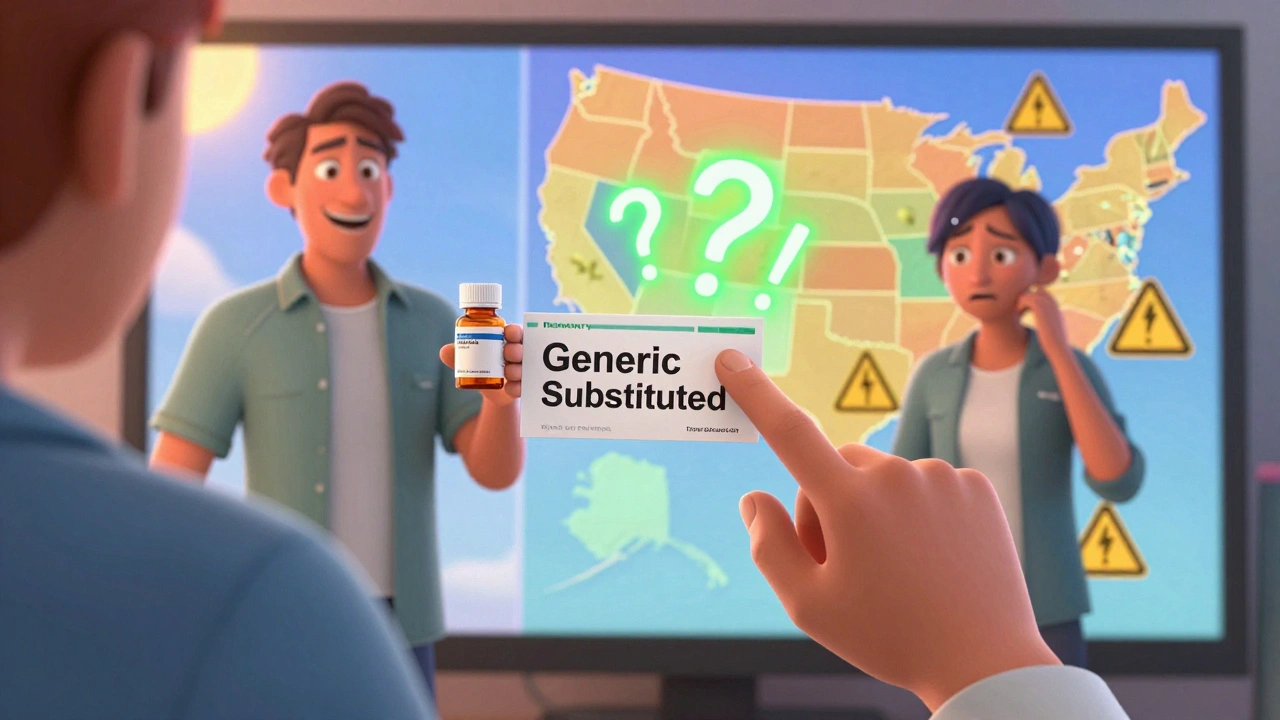
This is where things get personal. In 7 states and DC, pharmacists must get your explicit consent before swapping your medication. That means they ask you, you say yes or no, and they record it.In 31 states and DC, they only need to notify you after the fact-usually by labeling the bottle or giving you a paper slip. You might not even know until you get home and check the box.
And in 19 states? There’s no legal requirement to tell you at all. You could be on a new drug without realizing it. The American Medical Association calls this a problem, especially for people on multiple medications or with chronic conditions.
Can You Say No?
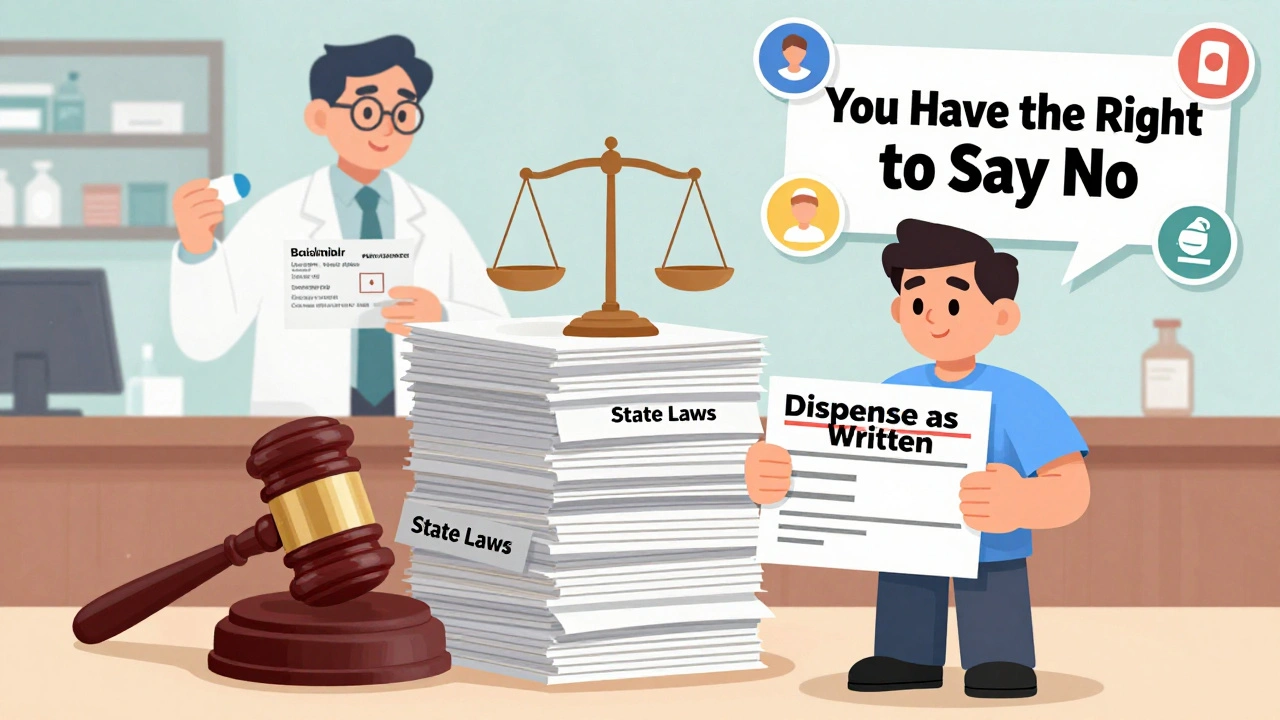
Yes. In every state, you can refuse a substitution-even if the law allows it. But here’s the catch: 24 states don’t require pharmacists to tell you that right. You might assume you have no choice. You do. Always ask: “Is this a generic? Can I get the brand instead?”If your doctor wrote “dispense as written” or “do not substitute” on the prescription, the pharmacist can’t switch it. That’s federal law. But in 28 states, doctors need to explain why they’re blocking substitution. That’s why you might get a form asking for a reason when your doctor refuses to allow generics.
What About Biosimilars? It’s More Complicated
Biosimilars aren’t like generics. You can’t swap them like you swap aspirin. Only 10 have been approved as “interchangeable” by the FDA. That’s a big deal. It means they’ve been tested to show they won’t cause unexpected side effects when switched back and forth.But even then, state rules can block substitution. Fifteen states say: “No substitution if the biosimilar costs more than the brand.” That doesn’t make sense if your insurance covers the biosimilar and not the brand. You could end up paying more out of pocket because of a state law.
And 37 states require pharmacists to notify your doctor within a few days. If your doctor doesn’t know you were switched, they might think your condition is worsening-and change your treatment unnecessarily.
How to Protect Yourself
You don’t need to be a lawyer to navigate this. Here’s what to do:- Check your bottle. Look for the label. If it says “generic” or “substituted,” you were switched. If it’s the brand name, you weren’t.
- Ask the pharmacist. “Was this changed from what my doctor ordered?” They’re required to answer.
- Know your state’s rules. Go to your state board of pharmacy website. Search for “drug substitution law” or “generic substitution.”
- Ask your doctor to write “dispense as written” if you’ve had bad reactions to generics before, or if you’re on a narrow therapeutic index drug like warfarin, levothyroxine, or phenytoin.
- Keep a list. Write down every medication you take, brand or generic. Bring it to every appointment. That way, if you’re switched without knowing, you can catch it.
Why This Matters for You
The goal of these laws is simple: save money without hurting health. And for most people, it works. Generic drugs are safe, effective, and save billions. But for a small group-people with epilepsy, thyroid disease, or those on biologics for autoimmune conditions-the stakes are higher.A 2018 study found states with rules banning substitution for narrow therapeutic index drugs had 18% fewer adverse events. That’s not a small number. It means real people avoided hospital visits, overdoses, or dangerous side effects.
On the flip side, states with mandatory substitution saw 25% higher generic use. That’s billions saved. But if you’re one of the people who reacts badly to a slight formulation change, those savings come at a cost.
What’s Changing Now?
The system is slowly becoming more consistent. In 2023, California passed AB1881, which strengthened patient notification for biosimilars. New York expanded pharmacist authority for certain biosimilars. The National Association of Boards of Pharmacy is pushing a model law that 22 states have already started using. It standardizes notification times and recordkeeping.More biosimilars are getting “interchangeable” status every year. By 2030, experts predict biosimilars could make up 70% of the biologics market-if states simplify their rules.
But until then, you’re the last line of defense. Pharmacists are bound by state law. Doctors are busy. Insurance companies want the cheapest option. You’re the only one who knows how your body reacts.
What to Do Next
Start today. Go to your state’s board of pharmacy website. Look up your state’s substitution law. Print it out. Or take a screenshot. Bring it to your next pharmacy visit. Ask: “Does your pharmacy follow the state’s rules for substitution?”If you’re on a biologic, ask your doctor: “Is there a biosimilar that’s interchangeable for my drug?” Then ask your pharmacist: “Is the one you’re giving me interchangeable?”
Don’t assume anything. Don’t accept silence. Your health isn’t a cost-saving metric. It’s yours.
Can a pharmacist substitute my brand-name drug without telling me?
In 19 states, yes-pharmacists aren’t legally required to notify you before substituting a generic drug. In 31 states and DC, they must notify you after the fact, usually via the label or a printed notice. Only 7 states and DC require your explicit consent before substitution. Always check your prescription label and ask if you’re unsure.
Can I refuse a generic drug even if my state allows substitution?
Yes. You can refuse any substitution in every state. You don’t need a reason. If the pharmacist tries to give you a generic, just say, “I’d like the brand-name drug instead.” The pharmacist must honor your request. If they refuse, contact your state board of pharmacy.
What’s the difference between a biosimilar and an interchangeable biologic?
A biosimilar is highly similar to the original biologic drug but may have minor differences. An interchangeable biologic has passed additional FDA testing proving it can be swapped with the brand drug without increasing risk or reducing effectiveness. Only 10 of the 38 approved biosimilars in the U.S. have interchangeable status as of late 2023.
Which drugs are too risky to substitute?
Drugs with a narrow therapeutic index (NTI) are most risky. These include warfarin (blood thinner), levothyroxine (thyroid), phenytoin (seizure), and cyclosporine (transplant). Even tiny differences in absorption can cause serious harm. Many states ban substitution for these drugs. Always ask if your medication is on a restricted list.
Why does my doctor have to write “dispense as written”?
In all 50 states and DC, doctors can prevent substitution by writing “dispense as written” or “do not substitute” on the prescription. In 28 states, they must also give a reason-like past side effects, allergy, or clinical instability. This adds paperwork but gives doctors control over high-risk cases.
How do I find out my state’s specific substitution rules?
Visit your state’s board of pharmacy website. Search for “drug product selection law,” “generic substitution,” or “pharmacy substitution.” Most states have downloadable PDFs or interactive maps. You can also call the board directly. They’re required to answer public questions.





8 Comments
Erin Nemo
Just got my levothyroxine switched last week and didn’t notice until my heart started racing. Never again. Always check the bottle.
James Allen
Oh sweet baby jesus, another one of these ‘you’re being robbed by big pharma’ rants? Let me guess - you’re one of those people who thinks generics are ‘fake medicine’? Wake up. The FDA doesn’t let junk through. I’ve been on generics since 2010 and I’m still alive. Stop being dramatic.
ariel nicholas
Wait-so you’re telling me, in 19 states, the state can literally swap your life-sustaining medication… without your consent… and call it ‘cost-saving’? That’s not policy-that’s bio-paternalism wrapped in a spreadsheet. And yet, we’re told ‘freedom’ is the American ideal? Where’s the liberty in being chemically altered without a signature? The Constitution didn’t foresee this. The Framers didn’t anticipate a pharmacist holding your fate in a pill bottle labeled ‘substituted.’ This isn’t capitalism. This is pharmacological feudalism.
Rachel Stanton
For anyone new to this: if you're on a narrow therapeutic index drug (like warfarin, levothyroxine, or phenytoin), ALWAYS ask your pharmacist to confirm whether it’s the same formulation as last time. Even small bioavailability differences can trigger serious adverse events. Also-request a printed summary of your med history from your pharmacy; it’s your right. And if your doctor doesn’t know you’ve been switched, that’s a communication gap, not a legal gray area. Advocate for yourself-it’s not nagging, it’s clinical safety.
Amber-Lynn Quinata
I’m so mad right now 😤 I just found out my insurance switched my Humira biosimilar without telling me. My doctor didn’t know. My husband didn’t know. I had a flare-up and thought I was dying. This is UNACCEPTABLE. Someone needs to get fired. I’m calling my state board. And no, I don’t care if it’s cheaper-I’m not a lab rat. 🚫💊
Scotia Corley
While the intent of substitution laws is fiscally prudent, the implementation remains dangerously inconsistent across jurisdictions. The absence of uniform notification protocols constitutes a systemic failure in patient-centered care. Pharmacists, as licensed professionals, are ethically bound to ensure therapeutic continuity-not to act as cost arbiters under statutory mandate. The current regulatory patchwork is not merely inconvenient-it is clinically untenable.
amit kuamr
i live in india we dont have this problem here all generics are same no one cares what brand it is just take the pill and move on
elizabeth muzichuk
So you’re saying it’s okay for pharmacies to swap my meds without telling me? That’s not just wrong-it’s evil. People die from this. I’ve seen it. My cousin went into seizures because they switched her phenytoin and no one said a word. And now you want to normalize this? You’re not saving money-you’re sacrificing lives. And you call yourself an American? Shame.