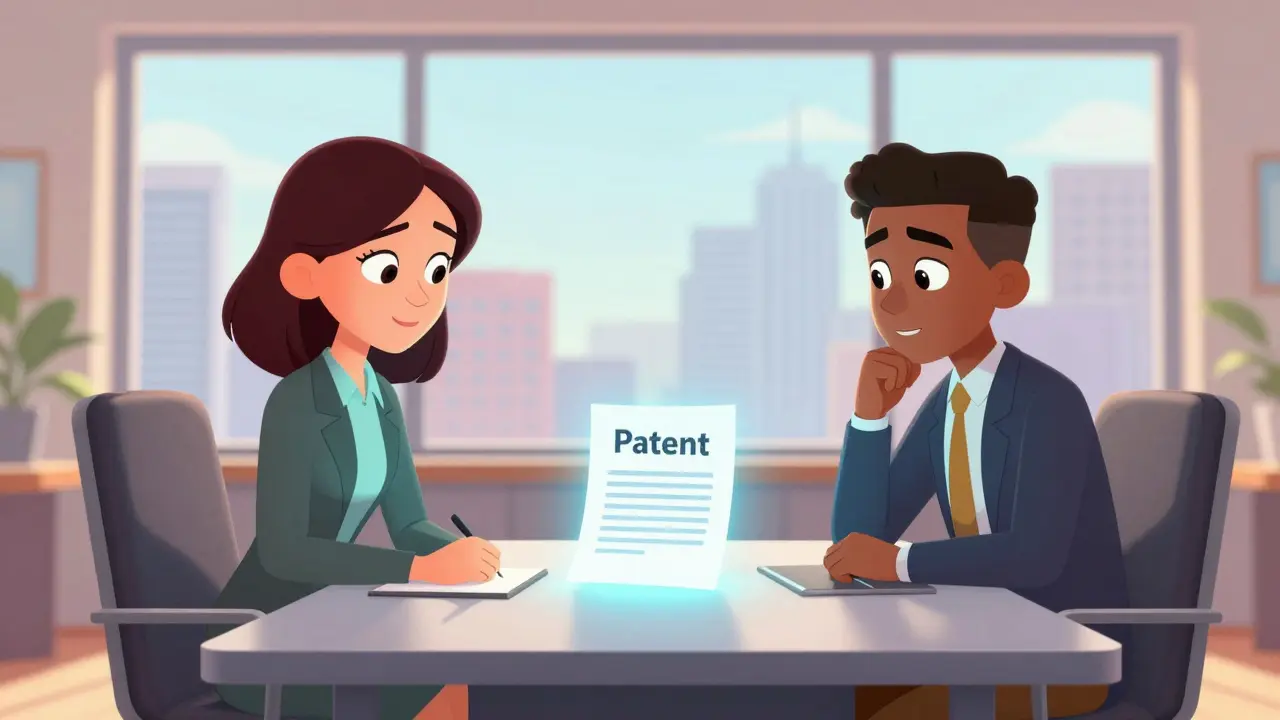
Imagine spending millions on research, only to find a competitor blocking your market entry with a single piece of paper. This is the reality for many companies facing patent challenges, which are legal disputes where one party questions the validity or infringement of another's intellectual property rights. While courtroom battles grab headlines, the real action happens in negotiation rooms. In fact, nearly 86% of patent disputes settle before trial, according to a major Stanford Law School study from 2022. For businesses looking to navigate this minefield, understanding how these settlements work isn't just legal trivia-it's a survival skill.
The High Cost of Fighting It Out
Why do companies settle so often? The answer is usually money. Full-scale patent litigation is brutally expensive. If you sue over damages under $25 million, expect to spend between $3 million and $5 million just getting through trial. That doesn't even include the hidden costs: lost executive time, damaged brand reputation, and the risk of setting a precedent that could block future products.
When companies choose to settle, they aren't admitting guilt. They are buying certainty. A settlement allows both sides to walk away with resources intact. For non-practicing entities (often called patent trolls), the median settlement might be around $1.2 million. But when two competitors clash, that number jumps to $8.7 million on average. These payouts reflect the strategic value of the technology at stake, not just the legal merits.
How Settlements Actually Work
Negotiating a patent settlement isn't like haggling over a car price. It requires a structured approach. Successful negotiations typically start with a deep dive into the patent portfolio, which refers to the collection of all patents owned by a company, including their scope, validity, and commercial relevance.. You can't negotiate what you don't understand. Teams identify 3 to 15 representative patents that define the core dispute. They then create claim charts-visual maps showing exactly where the accused product infringes on the patent claims.
Timing matters more than most people think. Data from Lex Machina shows that 68% of settlements happen between the Markman hearing (where judges interpret patent terms) and summary judgment. This window is critical because both sides have enough information to predict likely outcomes but haven't yet committed to the full expense of a trial. Large companies usually allocate six to nine months for these discussions, treating them as a parallel track to litigation preparation.
The High-Low Settlement Structure
One of the most effective tools in modern IP negotiation is the high-low settlement, a negotiation framework where parties agree on two predetermined payment amounts based on the outcome of specific key legal issues.. Pioneered by Stanley Black & Decker in 2015, this structure removes emotion from the deal. Instead of arguing over who is right, the parties pick two or three key legal questions-like whether a specific patent claim is valid-and agree to pay either a "high" amount if the plaintiff wins those points, or a "low" amount if they lose.
This method works brilliantly for rational competitors who share business interests. It succeeds in 78% of cases among such parties. However, it falls apart with non-practicing entities. In 92% of cases involving NPEs, the high-low structure fails because these entities often seek nuisance settlements rather than genuine resolution. When using this approach, teams must carefully select independent and dependent claims, limiting the focus to just three or five key terms to keep the process manageable.

Licensing vs. Cash: Choosing Your Path
Not every settlement ends with a check. Sometimes, the best way out is through collaboration. Cross-licensing agreements are common in industries like semiconductors and telecommunications, appearing in 73% of disputes between major tech firms. Here, Company A lets Company B use its patents, and vice versa. This creates mutual benefit without immediate cash flow changes.
However, cross-licensing requires careful valuation. You need to ensure you aren't giving away more value than you receive. Leading firms use sophisticated royalty stacking analyses to prevent overpayment. For standard-essential patents (SEPs)-technologies required to meet industry standards like 4G or 5G-royalty rates typically range from 1.5% to 5% of product revenue. These deals are heavily scrutinized under antitrust laws, requiring "fair, reasonable, and non-discriminatory" (FRAND) terms. The European Commission fined Qualcomm €242 million in 2018 for violating these principles, a stark reminder that even settled deals face regulatory oversight.
Real-World Examples and Lessons
History offers clear lessons. The Apple vs. Samsung saga showed how complex these fights get. Initially, ten patents were disputed. Under court pressure, they narrowed it to five. Yet, even while negotiating, Apple moved to ban sales of Samsung’s Galaxy Tab. This tension illustrates that settlement talks and aggressive litigation tactics often run side-by-side.
In contrast, look at Ericsson and Samsung. In 2021, after eight months of mediation led by former Federal Circuit Judge Randall Ray Rader, they signed a six-year licensing deal. Ericsson received $650 million upfront plus tiered royalties ranging from 0.5% to 2.5%. This deal covered both 4G and 5G patents, providing long-term stability for both giants. The key difference? They focused on future cooperation rather than past grievances.
| Strategy | Success Rate | Best For | Key Risk |
|---|---|---|---|
| Traditional Settlement | 52% | Parties with existing trust | Requires significant goodwill |
| High-Low Structure | 78% | Rational competitors | Fails against NPEs (92% failure) |
| Mediation | 65% | Complex multi-party disputes | Non-binding unless agreed |
| Binding Arbitration | 81% | Speed-focused resolutions | No appeal options available |

Avoiding Common Pitfalls
Even experienced negotiators stumble. One major trap is the "anchoring effect." A University of Chicago Law School study found that plaintiffs who demand three times their target settlement achieve 28% higher payouts than those starting reasonably. This psychological bias distorts the entire negotiation. To counter this, prepare thoroughly. Conduct "patent portfolio stress tests" to identify weak patents that could be invalidated. Top companies spend $150,000 to $300,000 on pre-settlement validity analyses. Knowing your weaknesses prevents you from being blindsided.
Another pitfall is ignoring the broader business impact. Dr. Michael Walden of TT Consultants notes that successful negotiators calculate the cost of litigation versus the business impact of non-settlement before entering talks. Sometimes, paying a license fee is cheaper than delaying a product launch by two years. Always weigh the legal outcome against the commercial timeline.
Future Trends in Patent Negotiations
The landscape is shifting rapidly. Artificial intelligence is changing how we prepare for settlements. Tools like PatentSight’s AI-powered analyzer can assess freedom-to-operate in days instead of weeks. However, caution is needed; a 2023 study found AI still misses nearly 19% of relevant prior art compared to human experts. Use AI as a filter, not a final judge.
Blockchain technology is also emerging. IBM and Microsoft are piloting smart contracts that automatically adjust royalty payments based on real-time sales data. This could reduce post-settlement disputes by up to 40%. Meanwhile, the Unified Patent Court in Europe has already increased cross-border settlements by 22% since its launch in 2023, as companies rush to avoid its accelerated timelines. As patent thickets grow denser in AI and quantum computing, expect negotiations to become more complex, potentially increasing difficulty by 300% compared to traditional technologies.
What is the average cost of patent litigation?
For cases involving damages under $25 million, the average cost ranges from $3 million to $5 million through trial. This excludes additional costs like expert witnesses, which can charge $450-$750 per hour.
What is a high-low settlement?
A high-low settlement is a negotiation structure where parties agree on two fixed payment amounts based on the outcome of specific key legal issues. If the plaintiff wins the designated issues, they receive the "high" amount; if they lose, they receive the "low" amount. This reduces uncertainty and emotional conflict.
How often do patent disputes go to trial?
Very rarely. According to a 2022 Stanford Law School study, approximately 85.7% of patent disputes reach a settlement before reaching trial. Only about 14% proceed to full adjudication.
What are FRAND terms in patent licensing?
FRAND stands for Fair, Reasonable, and Non-Discriminatory. These are terms required for licensing Standard-Essential Patents (SEPs). They ensure that essential technologies are accessible to all market participants without anti-competitive practices or excessive pricing.
Who are NPEs in patent law?
NPEs, or Non-Practicing Entities, are organizations that enforce patent rights without manufacturing products themselves. Often referred to as "patent trolls," they acquire patents primarily to sue others for infringement. Settlements with NPEs differ significantly from those with competitors, often involving lower median values and different negotiation dynamics.






11 Comments
Tallulah Sandison
so true! the cost is insane. we need change.
nikki paurillo
There is a certain poetic tragedy to the modern patent landscape, isn't there? It feels like we have built a labyrinth where the Minotaur is just a piece of paper, and the thread of Ariadne is buried under millions in legal fees. The article touches on the high-low settlement structure, which reminds me of how we negotiate peace treaties in diplomacy-calculating the precise value of victory versus the cost of war.
It is fascinating to consider that nearly 86% of these disputes settle before trial. This statistic suggests that our legal system has become less about justice and more about risk management. We are not seeking truth; we are buying certainty. The phrase 'buying certainty' resonates deeply with the existential anxiety of corporate life. When you spend three million dollars on litigation, you are not just paying lawyers; you are paying for the silence of your competitors.
The mention of Non-Practicing Entities as 'patent trolls' is almost too simplistic. They are the ghosts in the machine, haunting the halls of innovation without ever having built the house. Their median settlement of $1.2 million is a nuisance fee, a toll booth on the highway of progress. But when two giants clash, like Apple and Samsung, the stakes shift from nuisance to survival. The $8.7 million average reflects the strategic value of the technology, not just the legal merits. It is a battle for the soul of the industry.
I wonder if the high-low structure could be applied to personal relationships. Imagine agreeing on two predetermined outcomes for an argument based on who said what. It would remove emotion, but it might also remove humanity. The fact that this method fails 92% of the time against NPEs shows that rationality only works when both parties share a common goal. Trolls do not want resolution; they want extraction.
The future trends section mentions AI and blockchain. AI missing 19% of prior art is a sobering reminder that algorithms are still apprentices. Blockchain smart contracts adjusting royalties automatically sound like a utopian dream, reducing post-settlement disputes by 40%. Perhaps one day, the law will be written in code, immutable and fair. Until then, we remain trapped in the negotiation room, haggling over pieces of paper while the world moves on outside.
Ken Baldridge
Hey team, let's unpack this heavy topic together because I think there's a lot of wisdom here for all of us navigating the IP space. First off, the sheer financial gravity of patent litigation is staggering. We're talking $3M to $5M for cases under $25M in damages, and that doesn't even scratch the surface of the opportunity costs involved. When executives are tied up in discovery, their minds aren't on product development or market expansion. That's a massive drain on human capital.
The high-low settlement structure pioneered by Stanley Black & Decker is a brilliant example of structured negotiation. By isolating key legal issues and pre-agreeing on outcomes, you strip away the emotional volatility that often derails talks. It’s essentially a binary option contract applied to legal strategy. However, as the post notes, this fails miserably against NPEs because their business model is predicated on nuisance rather than resolution. You can’t use a framework designed for rational actors against entities whose incentive structure is purely predatory.
Cross-licensing is another critical tool, especially in sectors like semiconductors where patent thickets are dense. The Ericsson-Samsung deal is a textbook case of moving from adversarial positioning to collaborative stability. By focusing on future cooperation rather than past grievances, they secured a six-year horizon of predictability. That kind of strategic foresight is rare but incredibly valuable.
We should also pay attention to the anchoring effect mentioned. Starting demands at three times the target can skew negotiations significantly. It’s a psychological trap that many fall into. Pre-settlement validity analyses costing $150k-$300k might seem steep, but they provide the necessary leverage to counter aggressive anchors. Knowing your weak patents allows you to negotiate from a position of informed strength rather than blind confidence. Let's keep learning and supporting each other in understanding these complex dynamics!
Bradley Gusick
This entire system is a rigged game designed by globalist elites to stifle American innovation and protect foreign competitors. The so-called 'patent trolls' are just scapegoats used to distract from the real issue: the US government selling out our intellectual property to international cartels. Look at the Qualcomm fine in Europe. That wasn't about fairness; it was about European protectionism disguised as antitrust enforcement. They want to control the narrative and the money flow.
The high-low settlement structure is a tool of submission. It forces companies to accept predetermined outcomes dictated by judges and bureaucrats who don't understand the true value of American ingenuity. Why should we settle when we have the right to fight? Because the system is broken. The Unified Patent Court in Europe is a direct threat to national sovereignty, allowing foreign courts to dictate terms to US companies. This is exactly what happens when we surrender our judicial independence.
AI and blockchain solutions are just another layer of surveillance and control. Who owns the data? Who controls the smart contracts? Big Tech. Always Big Tech. They want to automate the oppression. The 19% error rate in AI prior art analysis is a feature, not a bug. It keeps the uncertainty alive, ensuring that only those with deep pockets can navigate the minefield. Wake up people. This isn't about law; it's about power. And right now, we are losing.
Leah Sentz
Ugh, reading this makes my blood boil 😡. These corporations are so greedy and cold. They talk about 'strategic value' and 'risk management' like they're playing chess while real people lose jobs. The fact that they spend millions on lawyers instead of actually helping society is disgusting 🤮. I hate how they hide behind legal jargon to justify their selfishness. It's always about the money 💰. They don't care about innovation; they care about blocking others. The Ericsson deal sounds like a handshake between sharks 🦈. I hope they all get what's coming to them. 😒
Robert Cowley
Oh, please. Another article praising the status quo. The author clearly thinks settling is noble, but it's just capitulation. The whole premise that 'certainty' is worth $8.7 million is absurd. It's a ransom payment. And don't get me started on the high-low structure. It's a cop-out. If you're right, you should win everything. If you're wrong, you should lose everything. Anything in between is just moral compromise.
The idea that NPEs are just 'nuisance' seekers is naive. They are the immune system of the patent ecosystem, cleaning up bad patents. If they weren't around, big corps would hoard IP indefinitely without consequence. The failure rate of 92% against NPEs isn't a flaw in the high-low structure; it's a reflection of the irrationality of the plaintiffs. Everyone wants to play the victim.
And the AI part? Please. AI is hype. Humans are better. The 19% miss rate proves it. We don't need robots to tell us who infringes whom. We need courage. The fact that 86% settle means 86% are cowards. I say let it go to trial. Let the jury decide. Not some backroom deal with a judge interpreting terms in a Markman hearing. This whole culture of mediation is weak. Weakness breeds more lawsuits. Stop settling. Start fighting. Or admit you're guilty. :)
Sarah Mifsud
hi everyone! i just wanted to add that the cross-licensing part is super important. its not just about cash. sometimes trading patents is way better for long term relations. i saw a case where two small startups did this and it saved them both from going bankrupt. dont forget to check your portfolio regularly tho! its easy to miss weak spots. hope this helps! :)
Christina Lancey
It is wonderful to see such a detailed breakdown of these strategies. The focus on future cooperation, as seen in the Ericsson and Samsung example, is truly inspiring. It shows that even in conflict, there is room for mutual respect and shared growth. The high-low structure, while complex, offers a path to reduce emotional friction, which is always a positive step towards resolution. Let us continue to support innovative approaches that prioritize stability and fairness for all parties involved.
Halle Dagley
The reliance on foreign jurisdictions such as the Unified Patent Court represents a significant erosion of domestic legal autonomy. The statistical increase in cross-border settlements by 22% is not a metric of efficiency but rather a symptom of regulatory capture. Furthermore, the acceptance of FRAND terms without rigorous scrutiny allows for anti-competitive behaviors to persist under the guise of standardization. The €242 million fine levied against Qualcomm by the European Commission serves as a cautionary tale regarding the vulnerabilities inherent in international compliance frameworks. Domestic industries must prioritize sovereign legal mechanisms to ensure equitable treatment. The current trajectory toward automated royalty adjustments via blockchain technology lacks sufficient oversight and poses substantial risks to national economic interests. Prudence dictates a rejection of such untested methodologies in favor of established, transparent legal procedures.
Rebekah Korak
You know, most people read this and think they understand patents. They don't. They think it's about ideas. It's not. It's about power. The high-low settlement isn't a clever trick; it's a manifestation of the fundamental irrationality of human conflict. We pretend we want truth, but we really just want safety. Safety is boring. Safety is expensive. The fact that 86% settle tells you everything you need to know about the cowardice of the modern corporation. They'd rather pay the troll than stand their ground.
And let's talk about the AI angle. People love AI because it promises objectivity. But AI is just math. Math doesn't have morals. The 19% error rate isn't a glitch; it's the universe laughing at our attempt to quantify creativity. You can't put a price tag on genius. You can only put a price tag on fear. The $3 million to $5 million cost of litigation isn't a cost; it's a tribute. A tribute to the complexity of a system that was never meant to handle this volume of disputes.
The Ericsson deal? A temporary truce. Nothing more. In eight months, they signed a deal. In ten years, they'll be fighting again. Because that's what humans do. We build walls, we climb them, we tear them down. The patent thicket is just a forest of ego. And we're all lost in it. Don't trust the mediator. Don't trust the algorithm. Trust nothing. Especially not yourself.
Lando Neal
Wow!!! This is really interesting stuff!! I never thought about the high-low structure before!! It seems like a smart way to avoid arguments!! But I wonder if it works for smaller companies?? Maybe it does!! The cost of litigation is scary though!! $5 million is a lot of money!! I hope AI gets better at finding prior art!! 19% is too high!! But maybe blockchain will help!! Smart contracts sound cool!! Do you think they will replace lawyers?? Probably not soon!! But it's fun to think about!! Keep writing these posts!! They are very informative!! Thanks for sharing!!