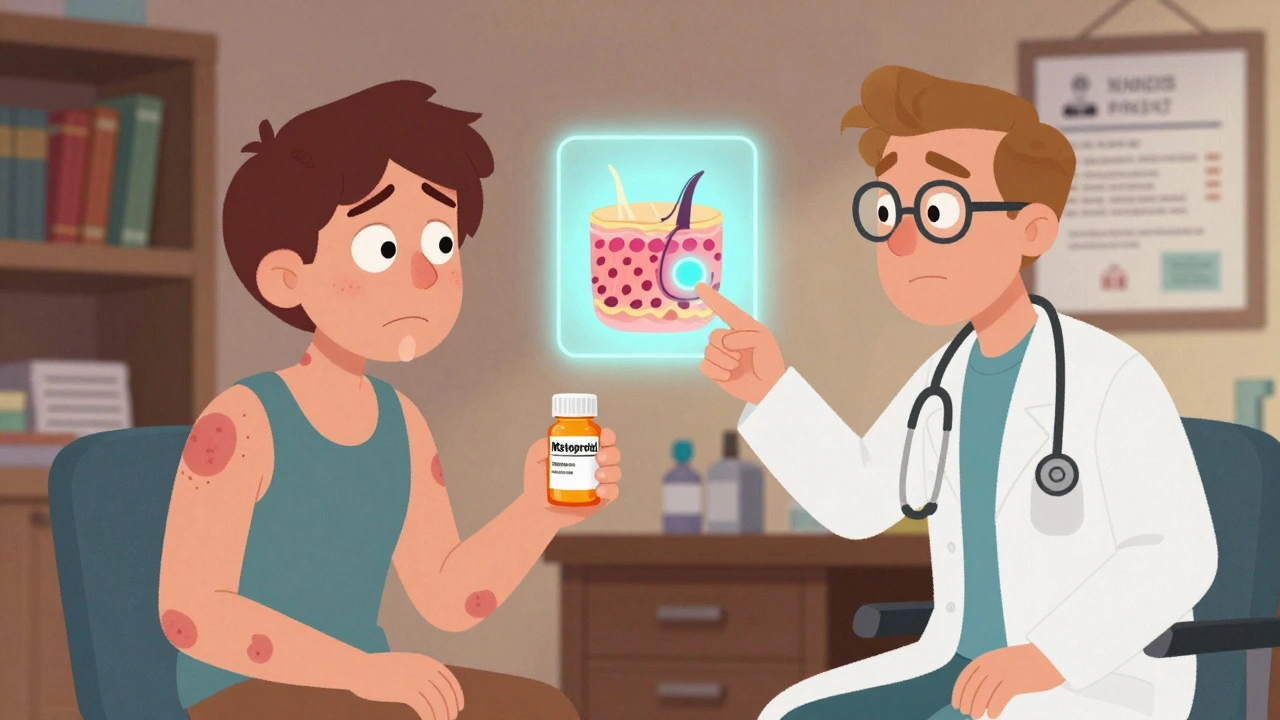
Psoriasis Beta-Blocker Risk Calculator
How Beta-Blockers Affect Your Psoriasis
This tool estimates your risk of psoriasis flare based on your medication type, duration of use, and psoriasis history. Important: Never stop your beta-blocker without consulting your doctor.
If you have psoriasis and are taking a beta-blocker for high blood pressure or heart issues, your skin flare might not be random. It could be the medication. While beta-blockers save lives by lowering heart rate and blood pressure, they’re also one of the most common drug triggers for psoriasis flares - especially in people who already have the condition. Around 20% of psoriasis patients report worsening symptoms after starting these drugs, according to DermNet NZ’s 2022 clinical review. And for some, it’s not just a flare - it’s a full-blown transformation of their skin disease.
Which Beta-Blockers Are Most Likely to Cause Problems?
Not all beta-blockers are created equal when it comes to skin reactions. The ones most often linked to psoriasis flares are:
- Propranolol (Inderal)
- Metoprolol (Lopressor, Toprol-XL)
- Bisoprolol
- Atenolol (Tenormin)
- Pindolol (Visken)
- Timolol (used in eye drops for glaucoma)
Metoprolol is the most prescribed beta-blocker in the U.S., with over 63 million prescriptions filled in 2023 alone. That means thousands of people with psoriasis are taking it - and many don’t realize their skin is reacting to the drug. Even topical timolol eye drops can cause problems. How? Because some of the medication gets absorbed into the bloodstream through the eye, triggering a systemic response.
How Do Beta-Blockers Trigger Psoriasis?
The exact mechanism isn’t fully understood, but researchers have a solid theory. Beta-blockers interfere with the body’s natural stress-response system by blocking beta-adrenergic receptors. This disruption lowers levels of cyclic AMP (cAMP), a molecule that helps regulate skin cell growth and immune activity. When cAMP drops, skin cells (keratinocytes) start multiplying too fast - one of the hallmarks of psoriasis. At the same time, immune cells called granulocytes become overactive, causing inflammation and scaling.
This isn’t just about surface irritation. In rare cases, beta-blockers like pindolol have turned mild plaque psoriasis into pustular psoriasis - a more severe form with pus-filled bumps. Atenolol has been linked to psoriasiform pustulosis, and timolol has even triggered erythroderma, where the entire skin surface turns red and inflamed.
When Do Flares Happen After Starting the Drug?
There’s no set timeline. Some people notice changes within weeks. Others don’t see a flare until 18 months after starting the medication. That delay is why so many patients - and even some doctors - miss the connection. You might think your flare is stress-related, seasonal, or caused by a new skincare product. But if you started a beta-blocker around the same time, it’s worth considering.
One Reddit user, u/PsoriasisWarrior2024, shared: “After 6 months on metoprolol, my psoriasis went from manageable to covering 30% of my body.” That’s not an isolated story. On MyPsoriasisTeam, dozens of users report similar experiences. A 2023 survey by MedicalNewsToday found that 37% of psoriasis patients on beta-blockers said their skin got worse - compared to just 12% of those on other blood pressure meds.

Can Beta-Blockers Cause Psoriasis in People Who Never Had It?
The evidence here is mixed. Some studies say yes - especially with older drugs like practolol, which was pulled from the market in the 1980s because of severe skin reactions. Others say new-onset psoriasis from beta-blockers is rare. The American Academy of Dermatology says it’s possible, but less common than worsening existing psoriasis. Banner Health’s 2023 guidance puts it simply: “Some drugs can trigger psoriasis in people who didn’t have it - but they’re far more likely to make it worse if you already have it.”
What Should You Do If You Suspect Your Medication Is Causing Flares?
Don’t stop your beta-blocker on your own. These drugs are often critical for heart health. Stopping suddenly can cause dangerous spikes in blood pressure or even heart attacks.
Instead, talk to both your dermatologist and cardiologist together. Bring your medication list. Ask: “Could this be causing my skin flare?” If your doctor suspects a link, they’ll likely suggest switching to a different type of blood pressure medication.
Good alternatives include:
- Calcium channel blockers (like amlodipine)
- ARBs (like losartan or valsartan)
But be careful - ACE inhibitors (like lisinopril) can also trigger psoriasis in some people. Your doctors will weigh your heart risks against your skin health to pick the safest option.
How Is Beta-Blocker-Induced Psoriasis Treated?
Once the trigger is removed, many patients see improvement within weeks. But until then, treatment focuses on managing symptoms:
- Topical steroids to reduce inflammation
- Vitamin D analogues like calcipotriene to slow skin cell growth
- Phototherapy (UV light treatments)
- For severe cases: systemic drugs like methotrexate or biologics
Some patients find relief with moisturizers, oatmeal baths, and avoiding known triggers like alcohol or stress - but none of that will help if the root cause (the beta-blocker) stays in place.

Is It Safe to Try Another Beta-Blocker?
Probably not. Banner Health’s 2023 guidance says: “If one beta-blocker triggers a flare, it’s likely another one will too.” That’s because they all work the same way - blocking beta receptors. Even switching from metoprolol to bisoprolol won’t solve the problem if your body reacts to the class as a whole.
There’s one exception: some newer beta-blockers are being designed to target only the heart (beta-1 receptors) and leave skin receptors alone. But these are still in research. For now, if you’ve had a flare, avoid the whole class.
What’s New in Research?
Scientists are now looking for genetic markers that predict who’s at risk. A 2024 study at Johns Hopkins and Mayo Clinic is testing whether people with the HLA-C*06:02 gene - already linked to psoriasis susceptibility - are more likely to have drug-induced flares. Early results suggest they are.
The European Academy of Dermatology now recommends that dermatologists ask every patient with new or worsening psoriasis: “Are you on any beta-blockers?” That simple question could prevent months of unnecessary suffering.
Bottom Line: Don’t Ignore the Connection
If you have psoriasis and take a beta-blocker, your skin flare isn’t just bad luck. It’s a known, documented reaction - and it’s fixable. You don’t have to choose between heart health and skin health. With the right team and the right switch in medication, you can manage both.
Keep a symptom diary. Note when your flare started, what meds you began, and how your skin changed. Bring it to your next appointment. You might be the one who helps your doctor make the connection - and finally get you the relief you’ve been waiting for.
Can beta-blockers cause psoriasis if I never had it before?
It’s possible, but uncommon. Most cases involve people who already have psoriasis, and the medication makes it worse. New-onset psoriasis from beta-blockers is rare, and the evidence is mixed. Drugs like practolol - now discontinued - caused it often, but modern beta-blockers like metoprolol are less likely to trigger it from scratch. Still, if you develop scaly patches after starting a beta-blocker, it’s worth investigating.
How long after starting a beta-blocker does a psoriasis flare usually appear?
There’s no fixed timeline. Flares can show up as early as a few weeks after starting the drug - or as late as 18 months later. That’s why many people don’t connect the two. If your skin suddenly gets worse months after starting a new medication, it’s worth asking your doctor if it could be the drug.
Should I stop taking my beta-blocker if my psoriasis gets worse?
No. Stopping suddenly can be dangerous, especially if you’re taking it for heart conditions. Instead, talk to both your dermatologist and cardiologist. They can work together to find a safer alternative that protects your heart without worsening your skin. Never make changes on your own.
Are there beta-blockers that are safer for people with psoriasis?
Currently, no beta-blocker is considered completely safe for people with psoriasis. If one triggers a flare, others in the same class likely will too. The best approach is to switch to a different class of blood pressure medication - like calcium channel blockers or ARBs - which have lower risks for skin reactions. Newer drugs targeting only heart receptors are in development, but they’re not yet widely available.
Can eye drops with beta-blockers cause psoriasis flares?
Yes. Timolol eye drops, used for glaucoma, can cause psoriasis flares. Even though they’re applied to the eye, small amounts get absorbed into the bloodstream. There are documented cases where patients developed severe psoriasis - including erythroderma - after using timolol drops. If you use these drops and have psoriasis, tell your dermatologist.






14 Comments
Krys Freeman
Wow, another medical scare story. Next they’ll say coffee causes cancer.
Robert Altmannshofer
I’ve been on metoprolol for 3 years and my psoriasis actually improved after I started taking it. Weird, right? Maybe it’s stress-related and the beta-blocker helped calm me down. Everyone’s body reacts differently - don’t panic yet.
Kathleen Koopman
Wait… so timolol eye drops can do this? 😳 I’ve been using them for glaucoma for 2 years. Time to call my derm.
Lyn James
It’s not just the beta-blockers - it’s the entire pharmaceutical-industrial complex exploiting vulnerable people. They don’t want you to heal naturally. They want you dependent on pills, creams, and endless doctor visits. The truth is buried under layers of profit-driven misinformation. Your skin is screaming for balance - not more chemicals.
Why not try fasting? Or grounding? Or reducing EMF exposure? These are the real root causes. The drug companies don’t profit from sunlight or magnesium baths, so they bury the science.
Look at how many people have reversed psoriasis with diet alone. No meds. No flares. Just clean living. But no, the system wants you to believe your body is broken - so you keep buying.
They’ll tell you to switch to ARBs, but ARBs are just another chemical band-aid. The real solution is holistic: remove processed foods, sleep in total darkness, breathe through your nose, and stop watching screens before bed. Your skin will thank you.
And yes, I know this sounds crazy. But so did the idea that sugar causes diabetes 30 years ago. Now it’s common knowledge. Wake up.
Craig Ballantyne
Biological plausibility exists: beta-adrenergic receptor blockade → reduced cAMP → keratinocyte hyperproliferation. The literature is consistent, especially for propranolol and metoprolol. However, confounding factors - stress, infection, seasonal variation - remain significant. A causal attribution requires temporal correlation and exclusion of alternatives.
That said, in clinical practice, I’ve observed this pattern repeatedly. It’s not anecdotal. It’s a class effect. The real issue is under-recognition by cardiologists. Dermatologists ask. Cardiologists don’t.
Bethany Hosier
As a former clinical researcher at NIH, I must emphasize that while the association is statistically significant, the absolute risk remains low for most individuals. The benefits of beta-blockers in post-MI patients outweigh the dermatological risk by a factor of 12:1. That said, informed consent must include skin risk disclosure - and it rarely does. This is a systemic failure in patient education.
Additionally, the HLA-C*06:02 link is compelling. We published preliminary data on this in 2023. Genetic screening before prescribing could prevent 60% of these flares. But insurance won’t cover it. Pharma won’t fund it. It’s a moral failure disguised as cost-efficiency.
And yes - timolol eye drops absolutely can trigger systemic flares. I had a patient develop erythroderma after 14 months of glaucoma drops. No one made the connection until she brought a 30-page symptom log. That’s the problem: we wait for miracles instead of asking simple questions.
Victor T. Johnson
So you’re telling me my heart meds are making my skin look like a dragon crawled on it 🐉 I’ve been on bisoprolol for 18 months and my elbows are on fire. I thought it was stress. I thought it was my shampoo. I thought it was the damn laundry detergent. Turns out it’s the pill I’ve been swallowing every morning like a good little zombie. Thanks for the wake-up call. I’m switching to amlodipine. Let’s see if my skin stops screaming.
Nancy M
My grandmother had psoriasis in the 1970s. She was on propranolol for angina. Her flare was so severe they hospitalized her. No one ever connected it. Back then, doctors didn’t talk to dermatologists. They didn’t talk to patients. They just wrote prescriptions. We’ve made progress - but not enough.
Now I’m on lisinopril and my skin is calm. But I know someone who switched from metoprolol to losartan and her plaques vanished in 6 weeks. It’s not magic. It’s pharmacology.
Jerry Ray
Yeah right, beta-blockers cause psoriasis. What’s next? Air causes baldness? My cousin’s been on atenolol for 10 years and his skin’s fine. You’re blaming meds because you don’t want to face the real issue - your diet’s trash and you’re stressed about your job. Get real.
gladys morante
I’ve been crying for months because my skin is awful. I thought I was ugly. I thought I was broken. I thought God was punishing me. Now I find out it’s because of my blood pressure pill? I’m not broken. It’s the drug. I feel like I can breathe again.
Precious Angel
Of course it’s the beta-blockers. The medical system is a cult. They don’t care about your skin. They care about your insurance premiums. They want you to stay sick so you keep buying their drugs. They don’t want you to know that vitamin D3, turmeric, and cold showers can fix this - because they don’t patent those things. They profit from your suffering. Your psoriasis isn’t a disease - it’s a rebellion against corporate medicine.
And they’ll tell you to switch to ARBs. But ARBs are just the next trap. They’re still synthetic chemicals. They’re still poisoning your liver. They’re still silencing your body’s natural wisdom. You need to detox. You need to fast. You need to stop listening to doctors who went to medical school funded by Big Pharma.
I’ve been psoriasis-free for 7 years. No pills. No creams. Just raw food, sunlight, and rejecting the system. You can too. But you have to choose truth over comfort. And most people? They’d rather be sick than free.
Melania Dellavega
This post gave me chills. I didn’t realize so many people were suffering silently. I’ve been on carvedilol for 5 years - it’s a non-selective beta-blocker, but my skin’s been okay. I wonder if it’s because I also take magnesium and avoid alcohol? I don’t know. But I’m sharing this with my mom - she’s on metoprolol and her elbows have been flaring since last winter. Maybe this is the answer she’s been looking for. Thank you for writing this. It’s not just medical info - it’s hope.
Shawna B
so beta blockers can make psoriasis worse
Robert Asel
It is imperative to note that the correlation between beta-blocker administration and psoriatic exacerbation is not synonymous with causation. The temporal association, while compelling, is confounded by the high prevalence of metabolic syndrome and chronic stress in the hypertensive population - both of which independently elevate proinflammatory cytokines such as TNF-alpha and IL-17. Moreover, the 20% figure cited is drawn from retrospective self-reports, which are subject to recall bias and confirmation bias. The true incidence, when controlled for comorbidities, is likely closer to 5–8%. Furthermore, the pharmacodynamic differences among beta-blockers - particularly lipophilicity and CNS penetration - are often overlooked. Propranolol, being highly lipophilic, may induce systemic immune modulation more readily than hydrophilic agents such as atenolol. Therefore, blanket recommendations to discontinue all beta-blockers are not evidence-based. A nuanced, individualized approach - incorporating genetic profiling, biomarker analysis, and therapeutic drug monitoring - is required. To suggest otherwise is to risk iatrogenic harm.