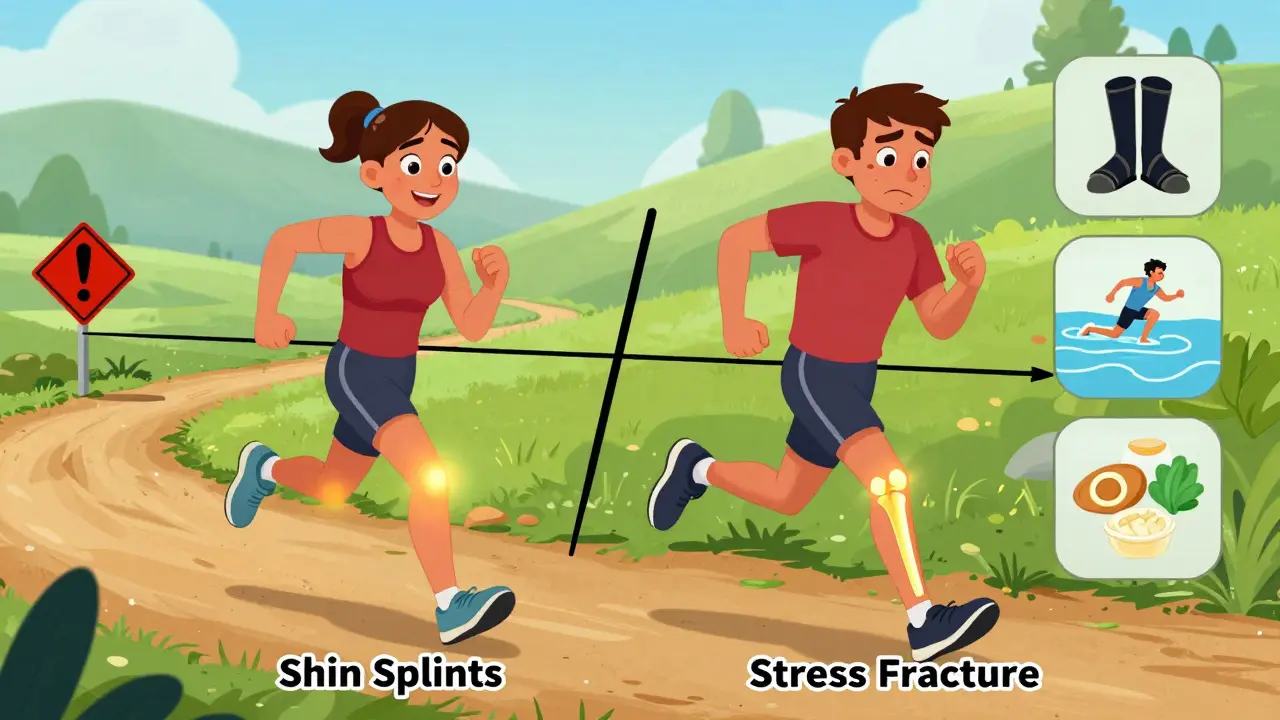
Two runners, same symptoms: sharp pain along the shin. One has shin splints. The other has a stress fracture. Both think they’re the same thing. Both get told to rest for two weeks and then try running again. One goes back and re-injures herself in three weeks. The other takes eight weeks and runs her first marathon six months later. What’s the difference? Protocol.
Shin Splints and Stress Fractures Are Not the Same
Shin splints - or medial tibial stress syndrome (MTSS) - are a soft tissue issue. The pain comes from inflammation in the muscles, tendons, and bone lining along the inner edge of your tibia. It’s common, affecting up to 20% of all running injuries. The pain is usually diffuse, feels better after warming up, and fades with rest.
Stress fractures - or bone stress injuries (BSIs) - are actual micro-cracks in the bone. These aren’t tiny breaks you can ignore. They’re warnings from your skeleton that it’s been overloaded. Pain is sharp, localized, and often worse at night. Walking hurts. Pressing on the spot hurts. If you keep running, it can turn into a full fracture.
Here’s the hard truth: most runners can’t tell the difference on their own. MRI is the only reliable way to confirm a stress fracture. But you don’t need an MRI to start acting smart. If your pain is worse in the morning, stays sharp after you stop running, or gets worse over days instead of better - you’re probably dealing with a bone injury, not just sore muscles.
Why the 10% Rule Doesn’t Work for Bone Injuries
You’ve heard it a thousand times: “Don’t increase your mileage by more than 10% per week.” It sounds reasonable. But here’s what the research says: 68% of runners with stress fractures got hurt because they followed that rule. Why? Because bone doesn’t adapt on a weekly schedule. It needs 90 to 120 days to fully remodel.
Shin splints? You might be back in four weeks. Stress fractures? Minimum six weeks - often longer. Rushing back is the number one reason people end up with the same injury again. Studies show recurrence rates hit 19-32% when protocols aren’t followed. That’s not bad luck. That’s bad timing.
The real key isn’t distance. It’s load tolerance. Can you walk without pain? Can you do single-leg heel raises without your shin screaming? That’s what matters - not how many miles you logged last month.
Phase-Based Recovery: The Only System That Works
Successful rehab isn’t about waiting. It’s about progressing in stages - each with clear rules. Here’s how it breaks down:
Phase 1: Pain-Free Walking (3-10 Days)
Stop running. Stop jumping. Stop anything that hurts. But don’t stop moving. Walk as much as you can - as long as it’s pain-free. If you feel even a 2/10 ache during or after walking, you’re pushing too hard. This phase isn’t about rest. It’s about letting the bone calm down. For stress fractures, this takes longer - often 4-6 weeks. For shin splints, maybe 3-7 days.
Phase 2: Gentle Loading (Starts After Pain-Free Walking)
Time to rebuild strength - slowly. Start with double-leg heel raises. Stand flat, rise onto your toes, lower slowly. Do 3 sets of 15-20 reps, once a day. No pain allowed. Zero. If your shin twinges, go back to walking only. This builds the calf’s ability to absorb force. For shin splints, you can start this within a week. For stress fractures, wait until you’ve had at least 7 straight days of zero pain while walking.
Phase 3: Full Range Strength (Weeks 2-4)
Now add step-ups. Stand on a low step or book, rise up on one foot, hold for two seconds, lower slowly. Do 3 sets of 10-15 reps per leg. Focus on control, not speed. This trains your ankle and shin to handle uneven terrain - exactly what you’ll face when you start running again. Add hip bridges and clamshells. Weak glutes are behind 57% of recurring shin injuries.
Phase 4: Explosive Strength (Weeks 4-6)
Time to get your tendons ready for impact. Start with double-leg hops - small, controlled bounces on the spot. 2 sets of 10-15. No pain. Then progress to single-leg hops. Then side-to-side hops. This phase takes 2-4 weeks. If you’re doing this before you can do 20 single-leg heel raises pain-free, you’re risking another injury.
Phase 5: Run-Walk Progression (Weeks 6-12)
This is where most people fail. Don’t jump into a 5K. Don’t even think about a 1-mile run yet.
For low-risk stress fractures (back of the shin), use this exact plan:
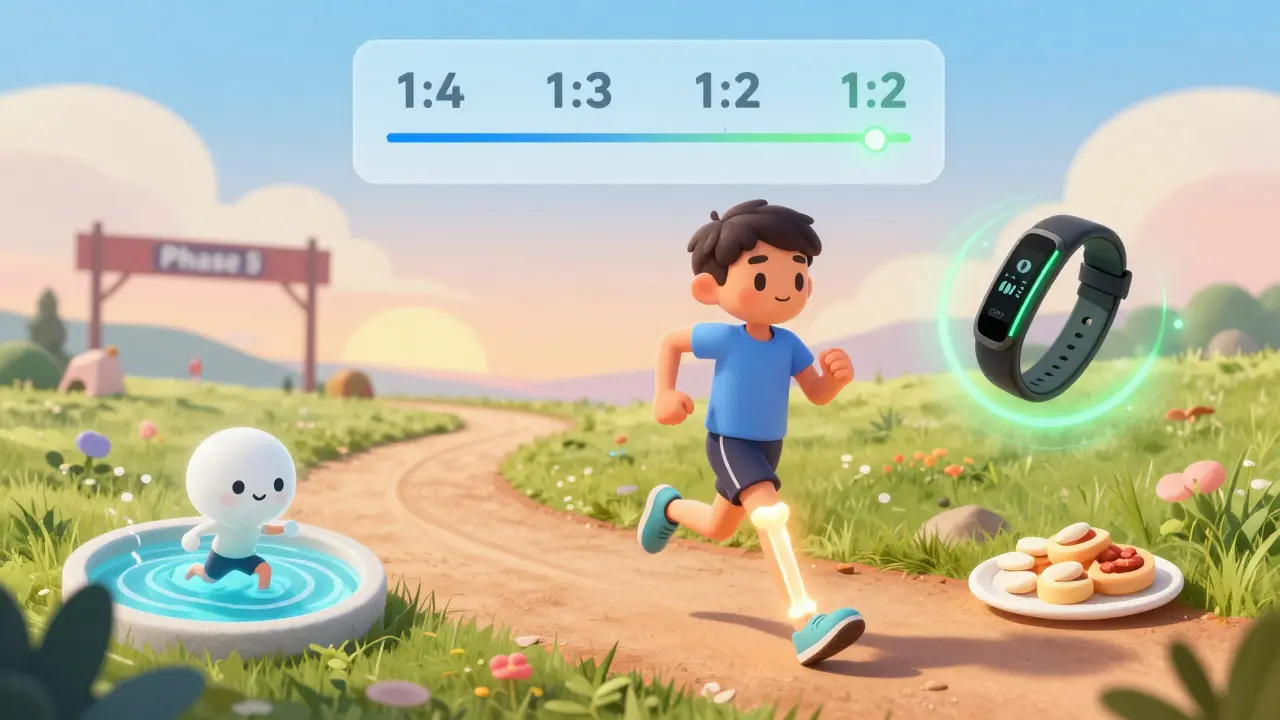
- Week 1-2: 1 minute run, 4 minutes walk. Total: 20 minutes. Do this 3x/week.
- Week 3: 1 minute run, 3 minutes walk. Total: 25 minutes.
- Week 4: 1 minute run, 2 minutes walk. Total: 30 minutes.
- Week 5: 1 minute run, 1 minute walk. Total: 35 minutes.
- Week 6: 3 minutes run, 1 minute walk. Total: 40 minutes.
For high-risk sites - front of the shin, foot bones, hip - double the time. That’s 8-12 weeks minimum. And if you feel any pain during the run intervals? Go back to the last pain-free stage. No exceptions.
What No One Tells You: Nutrition and Hormones Matter
Here’s the hidden cause behind so many recurring injuries: energy deficiency. If you’re not eating enough - even if you think you’re “eating healthy” - your bones can’t heal. Female runners are especially at risk. One in three women with stress fractures have undiagnosed Relative Energy Deficiency in Sport (RED-S).
It’s not about calories alone. It’s about protein, calcium, vitamin D, and enough fat to support hormone production. Low estrogen? Slowed bone repair. Low iron? Poor oxygen delivery to healing tissue. A 2023 IOC statement says every competitive athlete with a stress fracture should be screened for RED-S. If you’re a woman with recurring injuries, get your hormones and iron checked. Don’t wait.
What Works Better Than Heel Lifts or Orthotics
Most runners buy cushioned shoes, arch supports, heel lifts. They cost money. They don’t fix the problem.
Dr. Casey Kerrigan’s research shows heel lifts reduce tibial strain by only 12-15%. Gait retraining - learning to land softer, shorter, quicker - reduces it by 38%. That’s not a small difference. That’s the difference between healing and re-injury.
Try this: Run barefoot on grass for 5 minutes. Feel how your foot lands? Light. Quick. No slamming. Now try to mimic that with shoes on. Shorter strides. Higher cadence. Less heel strike. It’s not about shoes. It’s about how you move.
Tools That Actually Help (And What to Skip)
Some gadgets work. Most don’t.
- Do use: A pain scale (0-10) every day. Write it down. If your pain is above 2/10 during rehab, you’re pushing too hard.
- Do use: Cross-training. Pool running, cycling, elliptical - keep your heart strong while your bone heals. Pool running is especially good - it mimics running without impact.
- Do use: WHOOP or Oura ring. The new bone strain algorithms can detect abnormal loading patterns before you feel pain.
- Don’t use: Foam rolling the shin. It won’t fix a bone injury. It might make it worse.
- Don’t use: “Just run through it.” That’s not toughness. That’s ignorance.
Real Stories: What Happens When People Follow the Plan
u/TrailRunner2023 on Reddit: “I had a stress fracture. My PT gave me the 1:4 run-walk plan. I thought it was too slow. But after two weeks, I felt like I was still running - not just waiting. I finished my marathon six months later. No re-injury.”
u/ShinSplat: “I skipped weeks. Did 1:1 after two pain-free days. Ran 3 miles. Pain came back. Had to start over. Took 14 weeks total. Stupid.”
Strava data shows athletes who followed a physical therapist’s plan returned to their pre-injury mileage 22 days faster than those who guessed. Why? Structure. Accountability. No guesswork.
When to See a Professional
You can do most of this yourself - if you’re honest. But you need a pro if:
- Pain lasts more than two weeks despite rest
- You’ve had more than one stress fracture
- You’re a woman with irregular periods or low energy
- You’re not improving after 4 weeks of following the plan
Get a DXA scan if you’ve had two or more stress fractures. One in four runners with recurring injuries have low bone density. That’s not normal. That’s treatable.
How Long Does It Really Take?
Shin splints? 4-6 weeks if you stop running and do the rehab.
Stress fracture? 8-12 weeks. Maybe longer if you’re a female athlete, under-fueled, or have a high-risk injury site.
There’s no shortcut. But there is a safe path. And it’s not about how fast you get back. It’s about how long you stay running.
Can I still cross-train while recovering from shin splints or a stress fracture?
Yes - and you should. Pool running, cycling, and using an elliptical are excellent. They keep your cardiovascular fitness up without loading your shin. Avoid high-impact activities like jumping rope or stair climbers. Pool running is especially effective - it mimics running form with near-zero impact. Many athletes use anti-gravity treadmills (like AlterG) to maintain running mechanics while reducing weight load by 40-60%. This can cut recovery time by almost a month.
How do I know if it’s a stress fracture and not just shin splints?
Shin splints cause a dull, widespread ache along the inner shin that improves as you warm up. A stress fracture causes sharp, pinpoint pain that gets worse over time, hurts at night, and feels tender when you press on the bone. If you can’t walk without pain after a few days of rest, or if the pain is localized to one spot, it’s likely a bone injury. An MRI is the only way to be 100% sure - but don’t wait for one to start treating it. If pain persists beyond a week with rest, assume it’s a stress fracture and act accordingly.
Why do I keep re-injuring myself even after resting?
Most runners return too soon - often because they confuse pain-free walking with being ready to run. Bone takes 90-120 days to fully remodel. If you jump back into running before your bone is strong enough, you’ll re-injure it. Another big reason is weak hips and glutes. Studies show 57% of runners who skip glute exercises re-injure within three months. Also, low energy availability - not eating enough to support training - prevents healing. Female athletes with irregular periods are at especially high risk.
Should I use orthotics or heel lifts for shin pain?
Heel lifts and orthotics might offer temporary relief, but they don’t fix the root cause. Research shows heel lifts reduce tibial strain by only 12-15%. Gait retraining - learning to land with shorter, quicker steps and less heel strike - reduces strain by 38%. Instead of buying new shoes or inserts, focus on improving your running form. Try running barefoot on grass for 5 minutes to feel a lighter foot strike, then try to replicate that with shoes on.
Is it safe to run through mild shin pain?
No. Any pain above a 2/10 during activity is a red flag. Shin splints can turn into stress fractures if you keep running. Stress fractures can turn into full breaks. Pain is your body’s signal - not a challenge to overcome. The most successful runners aren’t the ones who push through pain. They’re the ones who listen to it, adjust, and come back stronger.
How long should I wait before returning to running after a stress fracture?
For low-risk stress fractures (like the back of the shin), a minimum of 6 weeks is needed - with 4-6 weeks of non-weight-bearing rest before even starting the run-walk plan. For high-risk sites (front of the shin, foot, or hip), expect 8-12 weeks. You should be completely pain-free during daily walking for at least 7 consecutive days before starting any running. Even then, start with the 1:4 run-walk ratio and progress slowly. Rushing increases your risk of re-injury by up to 70%.
Can I prevent shin splints and stress fractures from coming back?
Yes - but it requires consistency. Strength training (especially calves and glutes) is non-negotiable. Do heel raises and hip bridges 3-4 times a week, even after you’re back running. Increase mileage slowly - not by 10% per week, but by listening to your body. Track your pain daily. Get your nutrition and hormones checked if you’re a female runner with recurring injuries. And never skip rest days. Protocols that include at least one full rest day between running sessions cut recurrence rates by 34%.



15 Comments
Jarrod Flesch
This is the best rundown I've seen on shin injuries. I used the 1:4 run-walk plan after my stress fracture and it saved me. No more re-injuries. I'm running 50 miles a week now. 🙌
MARILYN ONEILL
I mean... honestly if you're not doing daily foam rolling and wearing those $200 orthotics you're just asking for trouble. I've been doing this for 12 years and I know better than this basic stuff.
Steve Hesketh
Brother, I was in the same spot last year. Pain every step. Thought I was done running forever. But I followed this plan to the letter - even the heel raises. Now I’m training for my first marathon. You got this. Don’t give up.
shubham rathee
you know what they dont tell you the government is hiding the real cause of shin pain its all about 5g radiation from cell towers messing with bone density i saw a video on youtube and now im convinced
Kevin Narvaes
i mean like... what even is healing? like if your body is just a meat machine and pain is just signals... then why are we so scared of pain? maybe we should just run through it and let the universe decide if we're worthy to run again
Dee Monroe
It’s funny how we treat our bodies like machines that need tuning, when really they’re living ecosystems. Bone isn’t just tissue - it’s memory. It remembers every mile, every stumble, every time you ignored the whisper before it became a scream. Healing isn’t about time. It’s about listening. And most of us haven’t learned how to be quiet long enough to hear it.
Melanie Pearson
The protocol outlined here is dangerously simplistic. In the United States, we have a culture of instant gratification that undermines long-term health outcomes. This approach would be considered negligent in any regulated athletic program in Europe or Japan.
Jerry Rodrigues
Solid breakdown. I skipped phase 2 once and paid for it. Took me 10 extra weeks. Lesson learned: don't rush the quiet stuff.
Barbara Mahone
I'm from Japan and we have a similar approach here called 'kizuna rehab' - focus on gradual, silent progress. No loud goals. Just consistency. This matches what we teach. Good work.
Stephen Rock
Everyone here is acting like this is some sacred text but I know three people who did this and still got stress fractures. It's all luck. The system doesn't work. You're just playing Russian roulette with your bones.
Amber Lane
This saved me.
Malvina Tomja
If you're a woman and you're still running with low iron, you're just being selfish. Your body is screaming. Stop pretending you're tough. Get your labs done. Now.
Samuel Mendoza
10% rule is a myth. The real rule is: if you're not bleeding, you're not trying.
Glenda Marínez Granados
So... we're supposed to believe that a 1:4 run-walk ratio is the secret sauce? 😏 I've seen more recovery plans than my therapist has coffee mugs. This is just a fancy list with a pretty font.
Rod Wheatley
YES YES YES - this is exactly what I tell my clients! The heel raises are NON-NEGOTIABLE! And the RED-S screening? EVERYONE needs it! If you're a woman and you're skipping meals because you're ‘watching your weight’ - you’re not being healthy, you’re being dangerous. I’ve seen too many runners crash. Don’t be one of them. You’re worth more than a PR. You’re worth healing.