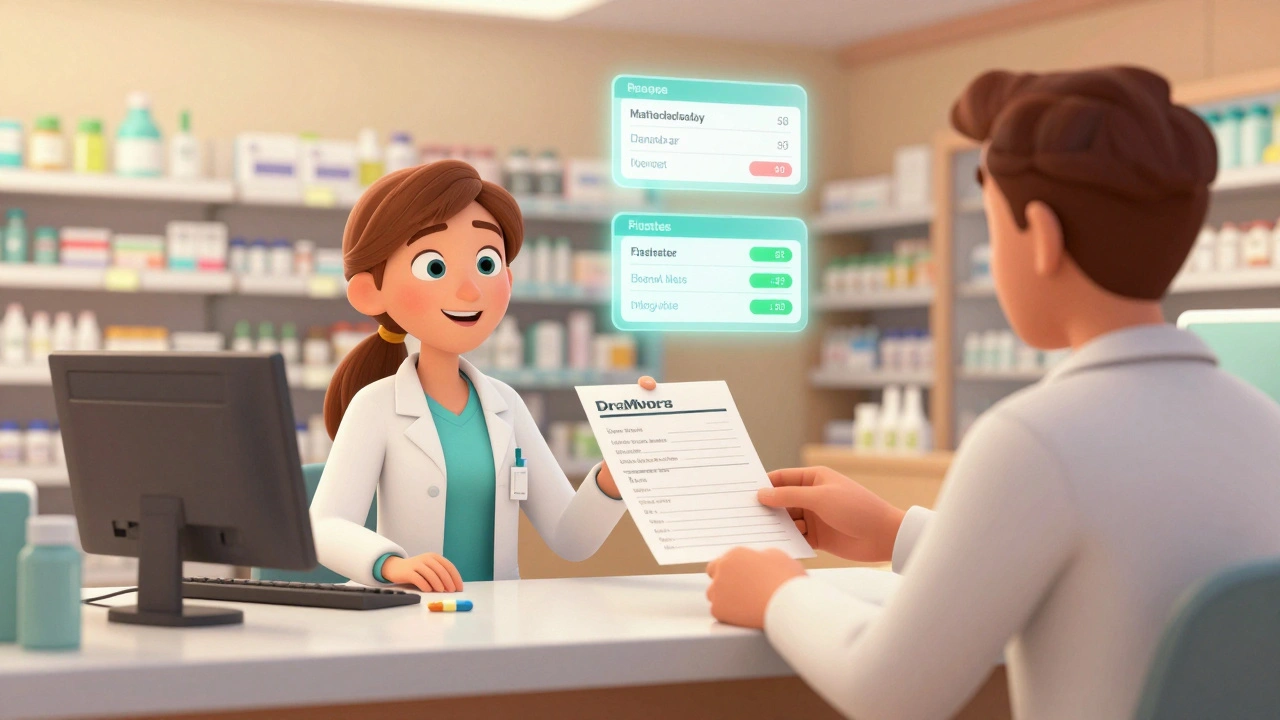
Prescription Transfer Eligibility Checker
Check Transfer Eligibility
When you switch pharmacies, it’s not just about picking a new location or a better price. It’s about making sure your medications move safely and legally from one pharmacy to the next. If you’re taking any controlled substances-like painkillers, ADHD meds, or anxiety medications-the rules are strict. And if you’re not careful, your prescription could get stuck, delayed, or even denied. This isn’t theory. It’s real. In 2023, the DEA changed how electronic prescriptions for controlled substances are transferred. Now, patients can request these transfers directly, but only once per prescription. That means if you’re switching from your old pharmacy to a new one, you need to know exactly what to give them-and what not to expect.
What You Must Give the New Pharmacy
The new pharmacy needs more than just your name and a list of meds. They need precise, complete information to comply with federal law. For every prescription you want to transfer, you’ll need to provide:- Your full legal name (as it appears on your ID)
- Your date of birth
- Your current residential address
- The name of the medication (brand or generic)
- The dosage and form (e.g., 10mg tablet, 30ml liquid)
- The name of the prescribing doctor
- The original prescription number
- The number of refills remaining
That’s the baseline. But here’s where it gets tricky: if any of your medications are controlled substances, the rules change.
Controlled Substances: One-Time Only Transfer
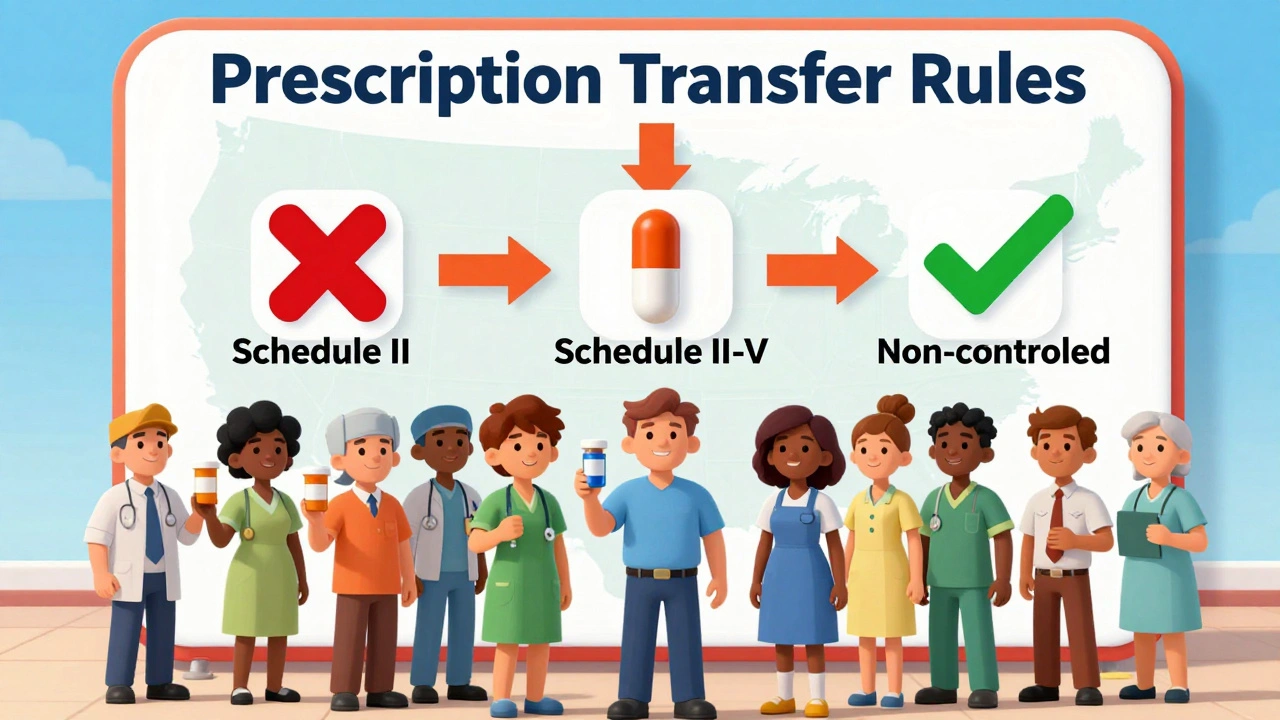
Not all prescriptions can be moved freely. The DEA’s August 2023 Final Rule limits transfers of electronic prescriptions for controlled substances (Schedules III, IV, and V) to one time only. That means if you transfer your Adderall prescription from Pharmacy A to Pharmacy B, you can’t later move it again to Pharmacy C-even if you move cities or switch insurance.Here’s what you need to know:
- Schedule II drugs (like oxycodone, fentanyl, or Adderall in higher doses) cannot be transferred at all. If you’re on these, you must get a new prescription from your doctor. No exceptions.
- Schedule III-V drugs (like tramadol, Xanax, or Vyvanse) can be transferred once, electronically, between two DEA-registered pharmacies. No paper copies. No screenshots. No phone calls from you to the old pharmacy.
- The transfer must happen directly between pharmacists using secure electronic systems, fax, or phone-but the prescription record itself must remain unchanged and digital.
Many patients don’t realize this. They assume all prescriptions work the same. But if you’re on a Schedule III-V medication and you’ve already transferred it once, your new pharmacy will tell you: “We can’t refill that. You need to see your doctor.” And they’re not being difficult. They’re following federal law.
What Happens to Your Old Prescription?
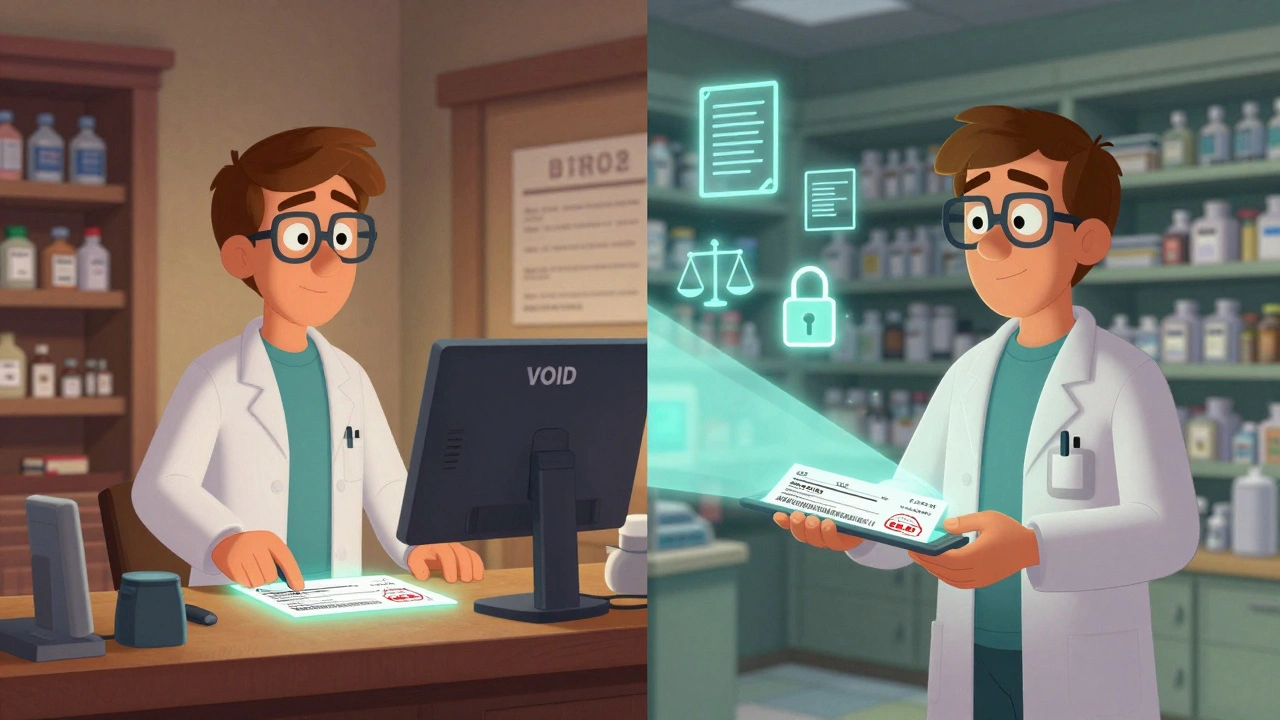
Once a controlled substance prescription is transferred, the old pharmacy must mark it as “VOID” in their system. They also have to record:- The name and DEA number of the receiving pharmacy
- The date and time of the transfer
- The full name of the pharmacist who processed the transfer
This isn’t just paperwork. It’s a legal audit trail. The DEA requires these records to be kept for at least two years. If a pharmacy fails to document this correctly, they risk fines or losing their DEA registration.
That’s why transfers can take 24 to 48 hours. Pharmacists aren’t dragging their feet-they’re double-checking every field. If the transferring pharmacy didn’t include the correct DEA number or the original prescription number, the receiving pharmacy can’t accept it. And if they accept it anyway, they’re breaking the law.
Non-Controlled Medications: Easier, But Still Not Automatic
If you’re only switching over things like blood pressure pills, statins, or thyroid meds, the process is simpler. These prescriptions can be transferred multiple times, as long as refills remain. But that doesn’t mean it’s instant.Pharmacies still need your full name, DOB, address, and prescription details. If you just say, “I need my lisinopril transferred,” they won’t know which one. There are 5mg, 10mg, 20mg versions. Is it from Dr. Lee or Dr. Patel? Did you get it last month or six months ago?
Pro tip: If you have a list of all your meds-preferably printed or saved on your phone-hand it to the new pharmacy. It saves time. It reduces errors. And it means you’re less likely to get stuck waiting because they had to call your old pharmacy twice.
State Laws Can Block You-Even If Federal Rules Allow It
The DEA rule sets the floor, not the ceiling. Some states have stricter rules. For example:- California requires written consent from the patient before any controlled substance transfer.
- New York mandates that the transferring pharmacist must verbally confirm the transfer with the receiving pharmacist, even if it’s electronic.
- Some states don’t allow transfers between pharmacies owned by different companies, even if both are DEA-registered.
That’s why a transfer that works in Florida might fail in Oregon. The new pharmacy will check your state’s rules before proceeding. If they say “We can’t do it,” ask for the specific reason. They’re required to give you one.
What If Your Prescription Has No Refills Left?
You can’t transfer a prescription with zero refills-controlled or not. That’s not a loophole. It’s a legal requirement. The prescription must have at least one refill remaining to be eligible for transfer.If you’re out of refills, you need a new prescription from your doctor. Don’t wait until your last pill is gone. Call your provider a week before you run out. Some doctors now offer electronic refill requests through patient portals, which can cut down on delays.
How Long Does It Take?
For non-controlled meds: 1-2 business days, if the old pharmacy responds quickly. For controlled substances: 2-4 business days, because of extra verification steps. If you’re transferring multiple prescriptions, add a day per script.Delays usually happen because:
- The old pharmacy didn’t mark the script as transferred.
- The new pharmacy didn’t get the DEA number or original prescription number.
- The transfer was requested on a Friday, and the old pharmacy doesn’t process transfers over the weekend.
Call the new pharmacy on day three if you haven’t heard anything. Don’t wait until you’re out of meds.
What to Do If the Transfer Is Denied
If your transfer is refused, don’t accept a vague answer like “We can’t do it.” Ask for:- The specific regulation or law they’re citing
- Whether it’s a federal or state rule
- Whether the issue is with the prescription, your info, or the pharmacy’s system
Pharmacies are required to provide this information. If they refuse, ask to speak to the pharmacist-in-charge. If they still won’t explain, you can file a complaint with your state’s Board of Pharmacy. Most have online forms.
What’s Changing Soon?
The DEA is required to review the one-time transfer rule by Q3 2024. Early data suggests patients are using the rule correctly-there’s been no spike in misuse. Industry analysts predict the rule may be expanded to allow multiple transfers for controlled substances within the next two years.But for now, the rule is clear: one transfer, per prescription, only.
Before You Switch: Checklist
Before you walk into a new pharmacy, do this:- Know which of your meds are controlled substances (ask your doctor or check your prescription label-Schedules III-V will say so).
- Check how many refills remain on each script. No refills? Call your doctor now.
- Write down the exact name, dosage, prescriber, and prescription number for each med.
- Call the new pharmacy and ask: “Do you accept electronic transfers of controlled substances under the DEA’s 2023 rule?”
- Don’t assume your old pharmacy will initiate the transfer. You have to ask the new one to do it.
- Confirm the transfer was completed. Call the new pharmacy after 48 hours.
Switching pharmacies doesn’t have to be a headache. But it does require you to be informed. The system is designed to protect you-from errors, from diversion, from running out of meds. When you know the rules, you’re not just a patient. You’re an active participant in your own care.





11 Comments
Matt Dean
Yo I just switched pharmacies last week and nearly got my Adderall denied because I didn’t know about the one-time transfer rule. I thought it was like moving my Netflix password. Nope. My new pharmacist looked at me like I’d asked to transfer my kidney. Turned out my old pharmacy had already transferred it once before I even knew I was switching. Total chaos. Now I carry a printed list like a survivalist with ammo. Don’t be me.
Walker Alvey
So let me get this straight. The government trusts you to take a Schedule II drug daily but doesn’t trust you to change your pharmacy without a doctor’s permission. Brilliant. Next they’ll require a notarized letter to buy ibuprofen. We’re not criminals we’re patients. And yet here we are begging for the right to move our meds like adults.
Bee Floyd
Big thanks for laying this out so clearly. I’ve been through this twice now and it’s always a mess. The worst part isn’t the rules-it’s the pharmacists who act like they’re doing you a favor by even looking at your script. I always print my med list, double-check refills, and call ahead. It’s not hard, but nobody tells you this stuff until you’re out of pills at 2am. You’re not just a patient-you’re your own advocate now. And that’s okay.
Jeremy Butler
The regulatory architecture governing pharmaceutical transfers reflects a systemic prioritization of administrative compliance over patient autonomy. The DEA’s one-time transfer limitation, while ostensibly designed to mitigate diversion, inadvertently imposes undue burdens upon individuals who require mobility due to relocation, insurance changes, or provider transitions. This policy fails to account for the dynamic nature of contemporary healthcare logistics and constitutes a form of bureaucratic inertia masquerading as public safety.
Courtney Co
OMG I had this happen and I cried in the pharmacy parking lot. I was on Xanax and my old pharmacy was closed for a holiday and the new one said NO TRANSFER and I had like 3 pills left and I was shaking and my partner had to drive me to urgent care at midnight and they gave me a 3-day supply but now I have to see my shrink again and I hate that guy and I just wanted my meds to move with me like my socks and my toothbrush why is this so hard why do they treat us like criminals why why why
Shashank Vira
How quaint. In my homeland, we have a centralized e-pharmacy registry where your entire pharmacological history is accessible with biometric authentication. Here, you need to recite your prescription number like a medieval incantation. The American system is not broken-it is a cathedral of inefficiency, built by lawyers and funded by fear. One transfer? How primitive. We are not in the 1980s.
Adrian Barnes
Let’s be clear: the DEA’s rule is not overly restrictive. It is the bare minimum required to prevent abuse. Patients who complain about this system are either unaware of the opioid crisis or actively enabling it. The fact that you think transferring a controlled substance should be as easy as changing your Spotify playlist is symptomatic of a broader cultural delusion about pharmaceutical entitlement. This isn’t about inconvenience. It’s about survival.
Jaswinder Singh
Bro I just got back from India and I saw how they do it there. You show your ID, they scan your name, boom-your whole med history pops up. No forms, no calls, no waiting. Here? I spent 45 minutes on hold because they needed the original Rx number from 2022. We’re not in the Stone Age. Why are we still doing this?
Eric Vlach
Pro tip: write the name of your doctor and the Rx number on a sticky note and put it on your phone case. I did that after I got burned once. Now I just show it to the pharmacist and they go ohhh okay cool. Saves everyone time. Also if you’re on Vyvanse or anything Schedule III-don’t wait till Friday to transfer. They don’t do it over the weekend. Trust me.
Souvik Datta
This is actually a beautiful example of how systems can protect people without punishing them. The one-time transfer rule isn’t about control-it’s about safety. One mistake, one wrong script, one diverted pill-and someone could die. The system is slow because it’s careful. And yes, it’s frustrating. But think of it like a seatbelt. You don’t like it until you need it. Be patient. Be prepared. And if you’re unsure? Call your doctor. They’re your ally, not your obstacle.
Priyam Tomar
Wait so you’re telling me I can’t transfer my Xanax from CVS to Walgreens because they’re different companies? That’s not a rule that’s a corporate monopoly disguised as law. And you’re just gonna sit there and say it’s for safety? Bro I’ve seen the same script transferred 3 times in Florida. This is just Big Pharma protecting their pharmacy chains. Wake up.