Anticoagulant Reversal Agent Calculator
This tool helps clinicians determine the most appropriate reversal agent based on the patient's anticoagulant, bleeding severity, and available resources. Time is critical in bleeding emergencies.
Select options above to see recommendations
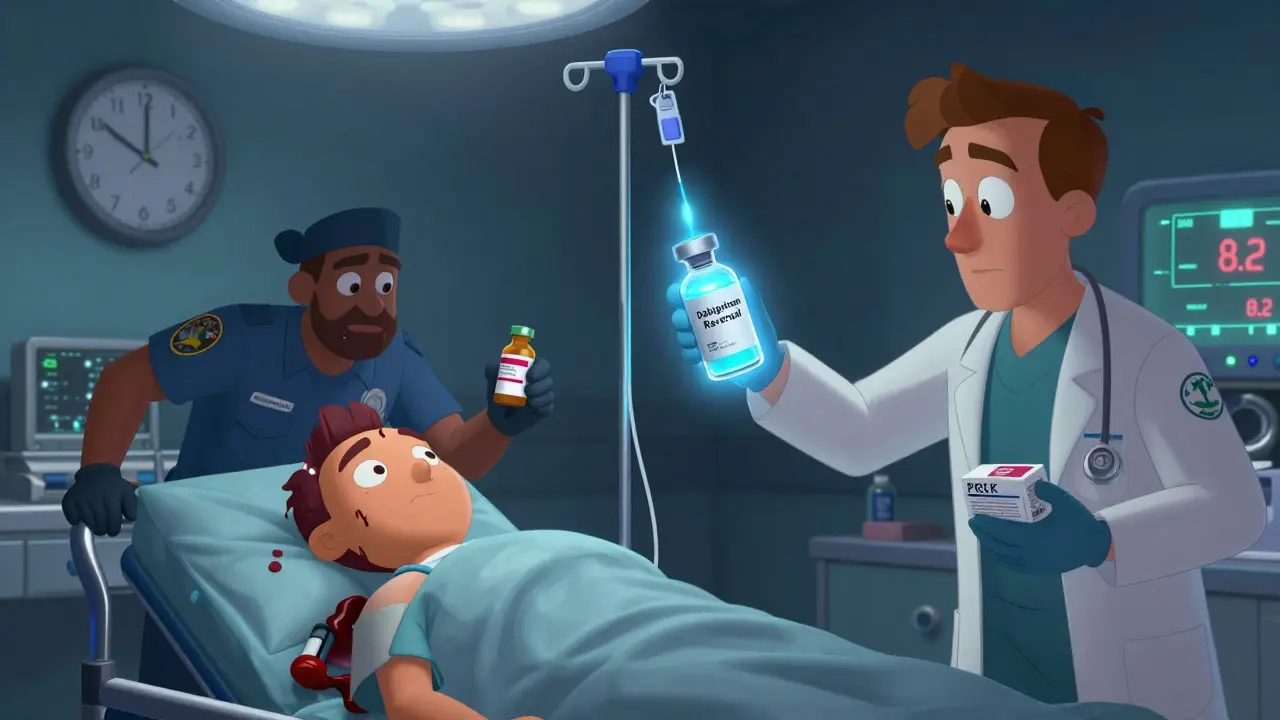
When someone on blood thinners suffers a serious bleed-like a fall that causes a brain hemorrhage-time isn’t just money. It’s life. That’s where anticoagulant reversal agents come in. These aren’t just backup plans. They’re emergency tools designed to stop bleeding fast. And not all of them work the same way. Some act in minutes. Others take hours. Some cost thousands. Others are cheap and everywhere. Understanding which one to use-and when-isn’t just medical knowledge. It’s survival.
Why Reversal Isn’t Optional
About 4 million Americans take anticoagulants every year. Most are on warfarin, dabigatran, rivaroxaban, or apixaban. These drugs prevent strokes and clots, but they also turn minor injuries into major crises. If a person on these medications has a head injury, their risk of dying from intracranial hemorrhage jumps to 30-50%. That’s why reversal isn’t about convenience. It’s about stopping death in its tracks.Vitamin K: The Old Workhorse
Vitamin K has been around since the 1940s. It reverses warfarin and other vitamin K antagonists (VKAs) by helping the liver rebuild clotting factors II, VII, IX, and X. Sounds simple, right? But here’s the catch: it takes 4 to 6 hours just to start working. Full reversal can take up to 24 hours. That’s too slow for a bleeding brain.That’s why vitamin K is never used alone in emergencies. It’s always paired with something faster-like PCC. Without vitamin K after PCC, the body quickly runs out of clotting factors again. That’s called rebound anticoagulation. It’s a hidden trap. Many doctors forget it. And when they do, patients bleed again.
Prothrombin Complex Concentrate (PCC): The Practical Choice
PCCs are concentrated mixes of clotting factors. Modern 4-factor PCC (4F-PCC) contains factors II, VII, IX, X, plus proteins C and S. It works fast-within 15 to 30 minutes. In one study, 92% of patients had their INR (a measure of blood clotting) drop below 1.5 in under 30 minutes. That’s far better than fresh frozen plasma, which only worked in 65% of cases.Dosing depends on how high the INR is:
- INR 2-4: 25-50 units/kg
- INR 4-6: 35-50 units/kg
- INR >6: 50 units/kg
It’s cheap too. A single dose costs $1,200 to $2,500. Most hospitals stock it. It’s the go-to for warfarin reversal. But here’s the twist: PCC doesn’t work well for newer drugs like rivaroxaban or dabigatran. It’s not designed for them. Still, in real-world emergencies-when the right drug isn’t available-doctors use it anyway. A 2022 survey of U.S. ERs found 63% of teams used PCC off-label for DOACs. It’s not ideal. But it’s better than nothing.

Idarucizumab: The Dabigatran Killer
Idarucizumab is a monoclonal antibody fragment. It binds to dabigatran like a magnet and pulls it out of the bloodstream. No guesswork. No waiting. The RE-VERSE AD trial showed reversal in under 5 minutes. That’s faster than most ambulances arrive.It’s simple: two IV bags, each 2.5 grams. Total dose: 5 grams. No need to weigh the patient. No complex math. Just give it. And it works. The same trial showed 82% of patients had successful hemostasis. Mortality? Only 11%. Thrombosis risk? Just 5%. That’s the lowest among all reversal agents.
It’s not perfect. It only works for dabigatran. If the patient is on apixaban or rivaroxaban? Useless. And it costs $3,500 per vial. But for the right patient? It’s a miracle.
Andexanet Alfa: Fast, But Risky
Andexanet alfa is a modified version of factor Xa. It acts like a decoy, soaking up rivaroxaban, apixaban, and edoxaban. It’s fast too-reversal in 2 to 5 minutes. The ANNEXA-4 trial showed 82% success in stopping bleeding.But here’s the problem: it comes with a warning label. The FDA added a boxed warning for thrombotic events. In trials, 14% of patients had clots-heart attacks, strokes, deep vein thrombosis. That’s double the rate of PCC. Why? Because andexanet alfa doesn’t just neutralize the drug. It floods the body with clotting potential. Too much. Too fast.
It’s also complicated. You need a 400mg IV bolus, then a 4mg/min infusion for 2 hours. That’s not something you can do in a busy ER without training. And it costs $13,500 per treatment. Only 65% of U.S. hospitals carry it. In New Zealand? Almost none. It’s the Ferrari of reversal agents-powerful, expensive, and dangerous if misused.

Cost, Access, and Real-World Choices
Let’s cut through the hype. In a perfect world, every hospital would stock idarucizumab and andexanet alfa. But we don’t live in that world. A 2023 American Hospital Association report found that 35% of U.S. hospitals don’t have andexanet alfa. Many rural centers can’t afford it. Even in cities, supply chains break. What do you do then?Here’s what actually happens:
- For warfarin: PCC + vitamin K. Always.
- For dabigatran: Idarucizumab if available. If not? PCC.
- For apixaban/rivaroxaban: Andexanet alfa if available. If not? PCC.
Cost matters. A single andexanet alfa dose could pay for 10 PCC treatments. In a system with limited budgets, that’s not just a number. It’s a life-or-death decision.
What’s Coming Next?
Ciraparantag is a new drug in Phase III trials. It’s a small molecule that reverses not just DOACs, but also heparin and low-molecular-weight heparin. One drug for everything. If approved in late 2025, it could change the game. No more choosing between agents. Just one vial. One protocol. One price.But until then? We work with what we have. And that means knowing your tools. Knowing your limits. Knowing when to use the fast, expensive option-and when to fall back on the old, reliable one.
Key Takeaways
- Vitamin K reverses warfarin-but slowly. Always pair it with PCC in emergencies.
- 4F-PCC works fast for warfarin and is the fallback for DOACs when specific agents aren’t available.
- Idarucizumab is the gold standard for dabigatran: fast, safe, simple.
- Andexanet alfa works for rivaroxaban and apixaban, but carries a high clotting risk and is rarely stocked.
- Cost and availability often dictate treatment more than guidelines do.
Can you reverse anticoagulants without special agents?
Yes, but it’s risky. For warfarin, PCC plus vitamin K is the standard. For DOACs like rivaroxaban or apixaban, PCC is often used off-label when specific reversal agents aren’t available. It’s less effective and slower, but it can still stop bleeding. In rural or under-resourced settings, this is common practice. The key is to never delay treatment while waiting for the "perfect" drug.
Why is vitamin K needed after PCC?
PCC gives you a quick boost of clotting factors, but those factors break down in 6-24 hours. If you don’t give vitamin K to rebuild them, the body can’t make new ones. That leads to rebound anticoagulation-meaning the patient starts bleeding again hours later. It’s why the 2022 ASH guidelines say: never give PCC without vitamin K for VKA reversal.
Is idarucizumab better than andexanet alfa?
For dabigatran, idarucizumab is the only option-and it’s safer. Studies show lower death and clotting rates. Andexanet alfa has higher rates of thrombosis (14% vs. 5%) and is far more expensive. But for rivaroxaban or apixaban, idarucizumab doesn’t work. So it’s not about which is better overall-it’s about matching the drug to the agent.
Do emergency rooms always have these reversal agents?
No. Vitamin K and PCC are widely available. Idarucizumab is in most urban hospitals. Andexanet alfa? Only in about 65% of U.S. hospitals. Many rural and international centers don’t carry it at all. That’s why protocols often include PCC as a backup. If you’re in a small ER, assume you’ll need to use PCC for DOACs. Train for it.
What’s the biggest mistake in anticoagulant reversal?
Delaying treatment while waiting for the "perfect" agent. The goal isn’t perfection-it’s stopping the bleed. Waiting 30 minutes for andexanet alfa when PCC is right there can cost a life. Second? Forgetting vitamin K after PCC. That mistake causes rebound bleeding, and it’s more common than you’d think.






8 Comments
Emma Nicolls
I've seen this play out in the ER and honestly? PCC + vitamin K is the unsung hero. No fancy names, no $13k bills. Just gets the job done. I've had patients walk out because of it. Don't sleep on the old school stuff.
Also side note: vitamin K after PCC? YES. I've seen two patients re-bleed because someone forgot. Not cool.
Jimmy V
Andexanet alfa is a glorified landmine. 14% clotting risk? That's not a feature, that's a bug wrapped in a patent. If you're using it without a neurologist, a hematologist, and a damn fortune, you're playing Russian roulette with a patient's brain. PCC works. It's cheap. It's there. Stop fetishizing the Ferrari.
Richard Harris
Interesting read. I work in a small hospital in Wales and we don't have idarucizumab or andexanet. We use PCC and vitamin K religiously. It's not glamorous but it saves lives. One time we had a guy fall off a ladder on warfarin... 48 hours later he was watching football. No miracles, just basics done right.
Kandace Bennett
OMG I LOVE THIS POST 💖💖💖
Like seriously?? Idarucizumab is like the superhero of reversal agents 😍✨ It's literally a magic wand for dabigatran! And PCC? Sooo basic. Like using a flip phone when you could have an iPhone 16. Andexanet? Yeah it's pricey but come on-it's the future!!! 💫
Also why are we still talking about vitamin K like it's a main character? It's the sidekick. The sidekick. 😅
Tim Schulz
Oh sweet mercy. We're still having this conversation in 2025? PCC for DOACs? Really? That's like using duct tape to fix a jet engine. And you call that 'practical'? Nah. That's just lazy. And yes, I'm the guy who screamed 'WHERE'S THE ANDEXANET?!' in the trauma bay while everyone was still Googling 'how does PCC even work'.
Also vitamin K after PCC? Only if you want to watch a patient bleed out 12 hours later. Welcome to medicine, folks. Where 'good enough' is a death sentence.
Jinesh Jain
This is very informative. I am from India and we rarely have access to idarucizumab or andexanet. PCC is sometimes available but expensive. We rely heavily on fresh frozen plasma and vitamin K. It's not ideal but we make do. The real issue is not the drugs-it's the system.
douglas martinez
Thank you for this well-structured and clinically accurate overview. The emphasis on evidence-based practice, cost-effectiveness, and real-world constraints is commendable. As a practicing clinician, I appreciate the nuanced discussion on rebound anticoagulation and off-label PCC use. These are critical considerations that are often overlooked in academic settings. Continued education on these protocols saves lives.
Devin Ersoy
You know what’s funny? Everyone’s acting like PCC is some kind of noble backup. Nah. It’s the medical equivalent of using a butter knife to cut through steel. And yet we’re all pretending it’s a real solution. Meanwhile, ciraparantag is in Phase III and we’re still arguing over whether to give 50 or 35 units of PCC. We’re not saving lives-we’re just delaying the inevitable while pretending we’re heroes. And don’t even get me started on the emoji queen who thinks idarucizumab is a ‘magic wand’. It’s a protein. Not a wand. 🤦♂️