Antihistamine Risk & Sedation Calculator
Select Your Profile Factors
Click the options below that apply to you to calculate your personalized risk profile.
Your Results
Adjust the settings on the left and click calculate to see your specific impairment risk and safety recommendations.
You take a pill for your itchy eyes or to help you sleep. An hour later, you feel like you’ve been hit by a truck. Your mouth is as dry as the desert, your vision blurs slightly, and trying to focus on a screen feels impossible. This isn’t just "being tired." It’s the specific, potent pharmacological profile of first-generation antihistamines, a class of drugs that includes household names like Benadryl (diphenhydramine) and Phenergan (promethazine). While these medications have been around since the 1940s and remain widely available over the counter, their side effect profile-specifically severe drowsiness and anticholinergic toxicity-is often underestimated by users who view them as harmless allergy relief.
The core issue lies in how these molecules interact with your body. Unlike newer alternatives, first-generation antihistamines do not stay where they are needed. They flood your central nervous system, causing profound sedation and disrupting basic bodily functions like digestion and bladder control. Understanding why this happens, who is most at risk, and when these drugs might still be appropriate can save you from dangerous accidents and long-term cognitive decline.
The Blood-Brain Barrier Breach: Why You Get So Sleepy
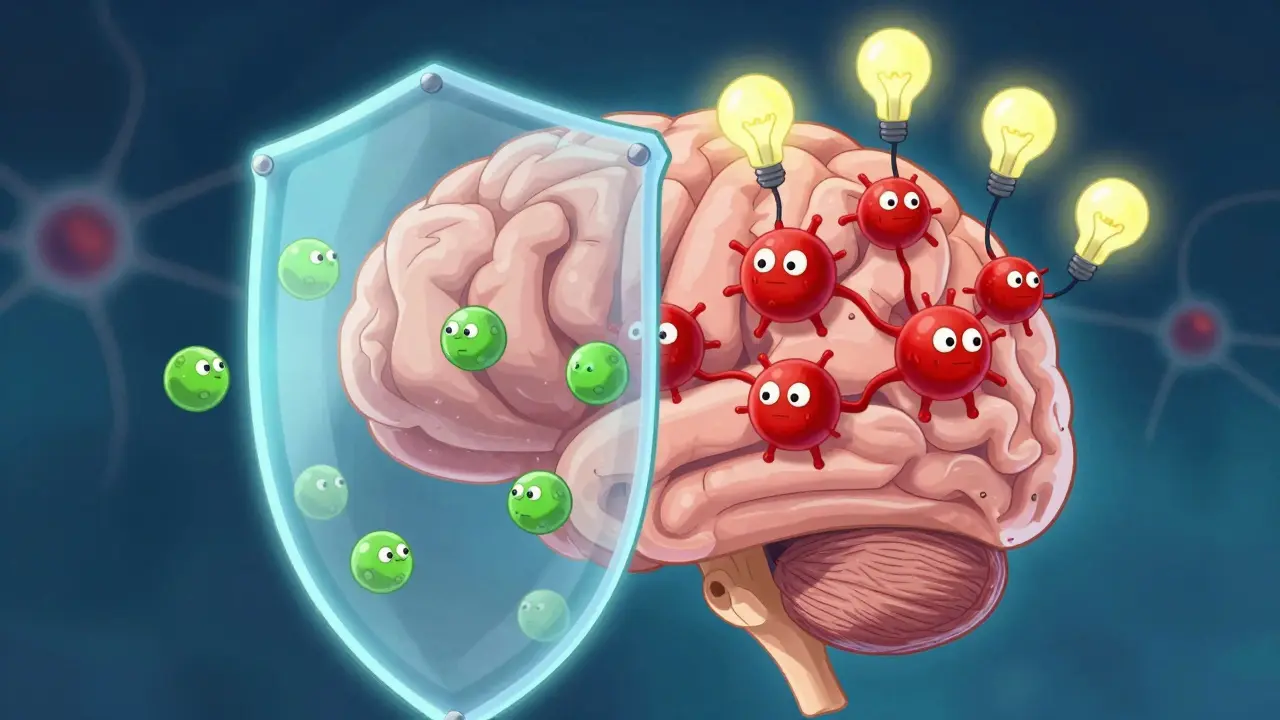
To understand the drowsiness, we have to look at chemistry. First-generation antihistamines are highly lipophilic, meaning they dissolve easily in fats. The blood-brain barrier is a selective semipermeable border that separates the circulating blood from the brain and extracellular fluid in the central nervous system (CNS). Because these older drugs are fat-soluble and small (molecular weights below 350 daltons), they slip right through this protective wall.
Once inside the brain, they bind to histamine H1 receptors. Histamine is a neurotransmitter that keeps you awake and alert. By blocking these receptors, the drug forces your brain into a state of unconsciousness. Studies show that after a standard dose of diphenhydramine, brain concentrations can reach 15-25 ng/mL within two hours. In contrast, second-generation antihistamines like cetirizine (Zyrtec) maintain brain levels below 1 ng/mL because they are pumped out of the brain by efflux transporters.
This isn't a subtle difference. Driving simulator tests measure impairment on a scale where 1.0 is maximum impairment. First-generation antihistamines typically score between 0.7 and 0.9. That is comparable to having a blood alcohol concentration near the legal limit in many jurisdictions. The sedation doesn't just stop when the drug wears off; residual cognitive fog can persist for up to 18 hours, leading to what users call the "hangover effect."
The Anticholinergic Burden: More Than Just Dry Mouth
If drowsiness is the headline, the anticholinergic effects are the fine print that causes serious health issues. These drugs don't just block histamine; they also block acetylcholine, a critical neurotransmitter involved in memory, muscle contraction, and glandular secretion. Muscarinic receptors, which respond to acetylcholine, share about 45% structural homology with H1 receptors, making them easy targets for these broad-spectrum blockers.
The consequences of blocking acetylcholine are widespread and uncomfortable:
- Dry mouth (Xerostomia): Saliva production drops significantly. For some, this requires artificial saliva products to eat or speak comfortably.
- Blurred vision: The pupils dilate, and the eye's ability to focus changes, making reading or driving hazardous.
- Urinary retention: The bladder muscles relax while the sphincter tightens, making it difficult to urinate. This is particularly dangerous for men with enlarged prostates.
- Constipation: Gut motility slows down, leading to digestive distress.
- Cognitive impairment: Acetylcholine is vital for learning and memory. Blocking it leads to confusion and short-term memory loss.
For older adults, this "anticholinergic burden" is not just an inconvenience-it is a medical crisis. The American Geriatrics Society Beers Criteria explicitly lists first-generation antihistamines as potentially inappropriate medications for patients over 65. Chronic use is associated with a 54% increased risk of cognitive decline and dementia. The mechanism is believed to be the cumulative disruption of cholinergic signaling in the hippocampus, the part of the brain responsible for forming new memories.
First vs. Second Generation: A Clear Comparison
Why would anyone take a drug that makes them so impaired? Cost, availability, and specific therapeutic needs. However, for general allergy relief, the data overwhelmingly favors second-generation options. Here is how they stack up against each other.
| Feature | First-Generation (e.g., Diphenhydramine) | Second-Generation (e.g., Cetirizine, Loratadine) |
|---|---|---|
| Blood-Brain Barrier Penetration | High (Lipophilic) | Low (Hydrophilic/Pumped out) |
| Sedation Risk | Severe (Sedation Index 0.7-0.9) | Mild to None (Sedation Index 0.1-0.3) |
| Anticholinergic Effects | Significant (Dry mouth, retention, confusion) | Negligible |
| Duration of Action | 4-6 Hours | 12-24 Hours |
| Primary Use Case | Insomnia, Motion Sickness, Acute Allergies | Chronic Allergies, Daytime Relief |
| Cost (OTC Average) | ~$5.00 per month | ~$15.00 per month |
Second-generation antihistamines were designed specifically to avoid the CNS side effects. They are larger molecules or are substrates for P-glycoprotein, a pump that ejects them from the brain before they can cause sedation. If your goal is simply to stop sneezing or itching without falling asleep, the second generation is objectively safer and more effective for daily living.
When Are First-Generation Antihistamines Still Useful?
Despite the risks, these drugs haven't disappeared. They have specific niches where their side effects are actually features.
1. Insomnia: Because they induce sleep so reliably, low-dose diphenhydramine is used as a short-term sleep aid. It reduces sleep onset latency by 30-40 minutes. However, tolerance builds quickly, and the quality of sleep is often poorer than natural sleep, with less REM activity.
2. Motion Sickness: The vestibular system in the inner ear uses both histamine and acetylcholine. First-generation antihistamines block both, making them 70-80% effective for motion sickness, compared to 40-50% for second-generation drugs. Promethazine is frequently prescribed for this reason.
3. Nausea and Vomiting: Drugs like promethazine and hydroxyzine have strong antiemetic properties, useful in post-operative care or chemotherapy support, though again, sedation is a major drawback.
4. Acute Allergic Reactions: In emergency settings, where rapid sedation might be acceptable or even desired (to calm a panicked patient), IM diphenhydramine is sometimes used alongside epinephrine for acute allergic reactions.
Risks for Specific Populations
Not everyone reacts the same way to these drugs. Genetics play a huge role. Your liver metabolizes these drugs using enzymes called Cytochrome P450, specifically CYP2D6 and CYP3A4. About 7-10% of the population are "poor metabolizers" due to genetic variations. For these individuals, the drug stays in the system much longer, leading to toxic buildup, extreme sedation, and prolonged anticholinergic symptoms even at standard doses.
Children are another vulnerable group. While parents often give Benadryl to kids for allergies, paradoxical excitation can occur. Instead of sleeping, children may become hyperactive, agitated, or hallucinate. The FDA has issued warnings about this, and pediatric emergency visits related to misuse have risen 27% between 2018 and 2022.
Elderly patients face the highest stakes. As mentioned, the link to dementia is strong. Additionally, the urinary retention caused by these drugs can lead to kidney damage or severe infections if ignored. Falls are another major risk; the combination of drowsiness, blurred vision, and orthostatic hypotension (a drop in blood pressure upon standing) makes falls likely, which can be catastrophic for older bones.

Harm Reduction: How to Use Them Safely
If you must use a first-generation antihistamine, follow these guidelines to minimize harm:
- Avoid Daytime Use: Never drive or operate machinery for at least 6-8 hours after taking the medication. The impairment lingers.
- Start Low: Try half the recommended dose first to assess your individual sensitivity.
- Never Mix with Alcohol: Alcohol increases the penetration of these drugs into the brain by 40-60%, drastically increasing the risk of respiratory depression and severe sedation.
- Limit Duration: Do not use them chronically for allergies. Switch to a second-generation alternative for long-term management.
- Check Other Meds: Many other common drugs (antidepressants, antipsychotics, bladder control meds) also have anticholinergic effects. Combining them creates a "stacking" effect that can lead to delirium.
The Future: Third-Generation Alternatives
Science is moving forward. Researchers have recently mapped the cryo-EM structure of the H1 receptor, identifying secondary binding sites. This allows for the design of "third-generation" antihistamines that bind tightly to peripheral receptors (in the skin and nose) but poorly to central receptors (in the brain). Candidates like EB-029 are currently in Phase II trials, showing 80% reduced CNS penetration while maintaining full efficacy. Until these become widely available and affordable, understanding the limitations of current OTC options is crucial for your health.
How long does diphenhydramine stay in your system?
The half-life of diphenhydramine is approximately 4-6 hours in healthy adults. However, it takes about 5 half-lives for a drug to be completely eliminated from your body. Therefore, it can take 24-30 hours for the drug to fully clear your system. Cognitive impairment and drowsiness can persist for up to 18 hours after ingestion, especially in older adults or poor metabolizers.
Can first-generation antihistamines cause permanent brain damage?
While a single dose will not cause permanent damage, chronic, long-term use of high-anticholinergic medications like first-generation antihistamines is strongly linked to an increased risk of dementia and cognitive decline in older adults. The American Geriatrics Society advises avoiding these drugs in patients over 65 due to this cumulative neurotoxic risk.
Is it safe to take Benadryl every night for sleep?
No, it is generally not recommended for long-term use. Tolerance to the sedative effects builds up quickly, meaning you need higher doses to achieve the same result, which increases side effects. Furthermore, it disrupts natural sleep architecture, reducing restorative REM sleep. Non-pharmacological sleep hygiene or prescription sleep aids with better safety profiles are preferred for chronic insomnia.
What should I do if I experience urinary retention after taking an antihistamine?
If you cannot urinate despite feeling the urge, seek medical attention immediately. Urinary retention can lead to bladder damage and kidney infection. This is a known anticholinergic side effect. Doctors may need to catheterize you temporarily until the drug wears off. Avoid taking further doses of this medication and discuss alternative allergy treatments with your provider.
Are there any non-drowsy antihistamines available?
Yes. Second-generation antihistamines such as cetirizine (Zyrtec), loratadine (Claritin), fexofenadine (Allegra), and desloratadine (Clarinex) are considered non-drowsy for most people. They do not cross the blood-brain barrier significantly and lack strong anticholinergic properties, making them safer for daytime use and for elderly patients.