
Pharmacogenetic Testing Decision Tool
Step 1: Your Current Situation
Your Personalized Recommendation
Step 2: Understand Your Metabolic Phenotype
Select your result (if known) or use this to understand what your doctor might find.
Poor Metabolizer
Body breaks down drugs very slowly.
- Risk: High side effects
- Action: Lower dose needed
Intermediate Metabolizer
Slower than average processing.
- Risk: Moderate side effects
- Action: Monitor closely
Normal Metabolizer
Average processing speed.
- Risk: Standard risk
- Action: Standard dosing
Rapid Metabolizer
Faster than average processing.
- Risk: Drug wears off too quickly
- Action: Higher dose may be needed
Ultrarapid Metabolizer
Very fast processing.
- Risk: Levels drop below effective range
- Action: Significant dose increase or different drug
Ever taken a prescription that worked wonders for your friend but made you feel like garbage? You aren't imagining it. Your body processes medications differently than almost everyone else's, and the reason is written in your DNA. Pharmacogenetic testing is a clinical diagnostic procedure that analyzes how an individual's genetic makeup affects their response to medications by examining genetic variations that influence drug metabolism, effectiveness, and safety. It’s not magic; it’s biology. But should you actually pay for it? The answer depends on what drugs you take and how badly you’ve suffered from side effects.
This isn't just a futuristic concept anymore. By 2026, major health systems are embedding these results directly into electronic health records. However, it’s still not a one-size-fits-all solution. For some people, it saves lives. For others, it’s an expensive curiosity with confusing results. Here’s how to figure out if it’s worth your money and time.
The Quick Answer: When Does It Make Sense?
You don’t need a genetic test for every pill you pop. The value of pharmacogenomics spikes when you are taking medications with a "narrow therapeutic index." These are drugs where the difference between a helpful dose and a toxic one is tiny. If you get the dose wrong, you either don’t get better, or you end up in the hospital.
Think of it like baking. With most recipes (like standard painkillers), adding a little extra flour doesn’t ruin the cake. But with a delicate soufflé (like blood thinners or certain cancer drugs), a small mistake causes it to collapse. Genetic testing helps you know exactly how much "flour" your body can handle.
- Blood Thinners: Warfarin and Clopidogrel. Small dosage errors can lead to bleeding or clots.
- Cancer Drugs: 5-Fluorouracil. Toxicity can be severe without proper dosing.
- HIV Medications: Abacavir. A specific gene variant can cause a life-threatening allergic reaction.
- Statin Cholesterol Drugs: If you hate statins, genetics might explain why and help find a better alternative.
If you’re only taking over-the-counter ibuprofen or basic antibiotics, skip the test. The evidence for those is weak. But if you’re on complex chronic therapy, especially in psychiatry or cardiology, it’s worth a conversation with your doctor.
How the Test Actually Works
Getting tested is less invasive than you might think. You usually provide a cheek swab or a small blood sample. No needles required for most panels. The lab looks at specific spots in your DNA called Single Nucleotide Polymorphisms (SNPs). They aren’t looking for diseases; they’re looking at how fast your liver breaks down drugs.
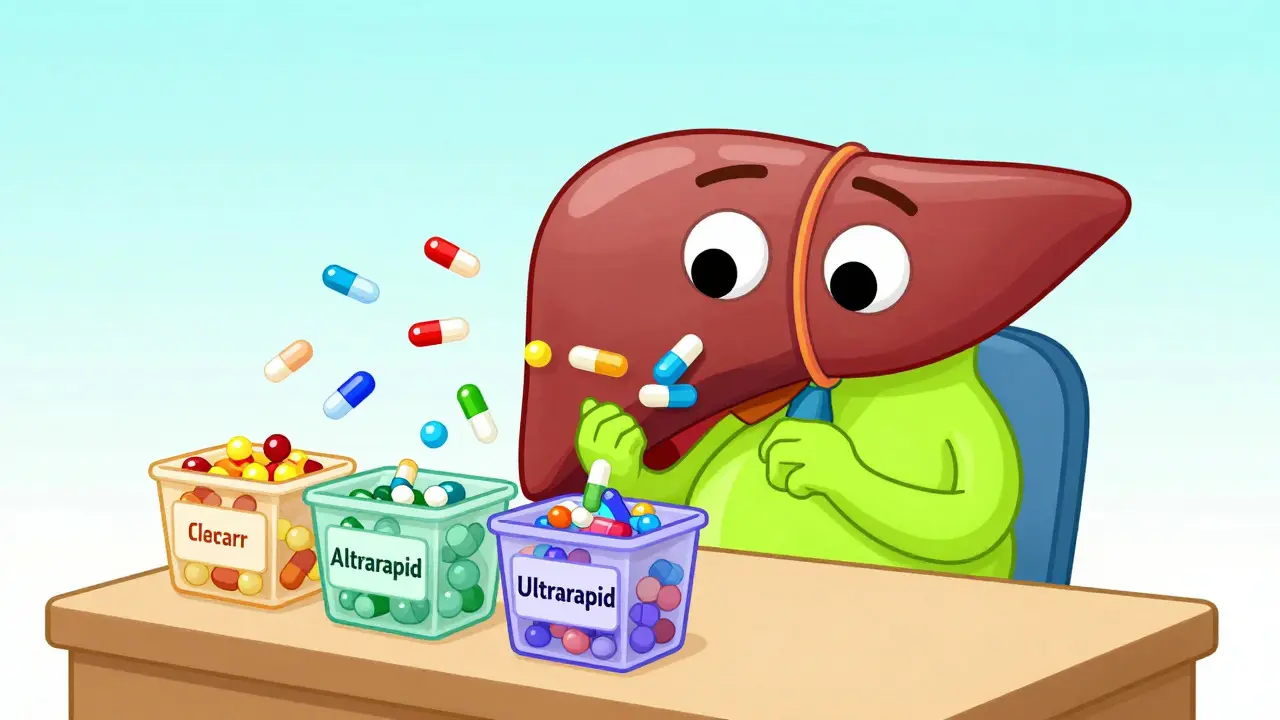
The main players here are the Cytochrome P450 enzymes, specifically CYP2D6 and CYP2C19. These enzymes are responsible for metabolizing about 25% of all commonly prescribed drugs. Your test will classify you into one of five metabolic phenotypes:
- Poor Metabolizer: Your body breaks down the drug very slowly. Risk: High side effects. Action: Lower dose.
- Intermediate Metabolizer: Slower than average. Risk: Moderate side effects. Action: Monitor closely.
- Normal Metabolizer: Average processing speed. Action: Standard dosing.
- Rapid Metabolizer: Faster than average. Risk: Drug wears off too quickly. Action: Higher dose may be needed.
- Ultrarapid Metabolizer: Very fast processing. Risk: Drug levels drop below effective range. Action: Significant dose increase or different drug.
Results typically come back in 3 to 14 days. Once received, your healthcare provider integrates this data into your chart. In advanced systems like those used by Mayo Clinic or Vanderbilt University Medical Center, the Electronic Health Record (EHR) now automatically flags potential interactions before a new prescription is written.
What the Evidence Says: Wins and Limits
Let’s look at the hard numbers, because the marketing often oversells the benefits. The biggest win in pharmacogenomics is preventing catastrophic reactions. Take the HIV drug Abacavir. Before genetic screening, 5-8% of patients developed a severe, potentially lethal hypersensitivity syndrome. Now, doctors test for the HLA-B*57:01 gene variant before prescribing. If you have the variant, you don’t take the drug. Result? The incidence of this reaction has dropped to near zero. That is a clear, proven benefit.
For cholesterol management, the story is more nuanced. Variants in the SLCO1B1 gene predict who will suffer muscle pain (myopathy) from statins. Patients with high-risk variants who were switched to a lower dose or different statin showed a 60% adherence rate in the first three months, compared to only 33% in control groups. If you quit statins because of aches, this test could bring them back into your life safely.
However, not everything is a success story. In mental health, a major 2022 study published in JAMA Network found that while pharmacogenomic testing reduced inappropriate prescriptions by 30%, it didn’t significantly improve depression remission rates at 24 weeks. Dr. Steven Lubitz of Harvard Medical School puts it bluntly: "Prediction isn't perfect." Some people with "high-risk" genes tolerate meds fine, while others without risk markers still have bad reactions. Genetics is a probability tool, not a crystal ball.
| Drug Category | Key Gene(s) | Clinical Utility | Main Benefit |
|---|---|---|---|
| Blood Thinners (Warfarin/Clopidogrel) | CYP2C19, VKORC1 | High | Reduces bleeding/clotting risk |
| HIV Antiretrovirals (Abacavir) | HLA-B*57:01 | Very High | Prevents life-threatening allergy |
| Statins | SLCO1B1 | Moderate-High | Reduces muscle pain, improves adherence |
| Antidepressants (SSRIs) | CYP2D6, CYP2C19 | Moderate | Faster trial-and-error reduction |
| Cancer Chemotherapy (5-FU) | DPYD | High | Prevents severe toxicity |
Cost, Insurance, and Access in 2026
Money is the biggest barrier. Out-of-pocket costs for comprehensive panels typically range from $250 to $500. Some specialized tests, like the single-gene HLA test, cost around $200. Is it worth it? If you prevent one hospitalization for a drug reaction, which can cost upwards of $37,000, the math works out in your favor. But insurance coverage is a patchwork.
In the U.S., only about 22% of Medicare Administrative Contractors cover pharmacogenetic testing broadly. Many plans require a "medical necessity" code. This means if you haven’t already had a bad reaction, getting approval can be a fight. In New Zealand and other countries with public healthcare, access is often tied to specialist referrals rather than direct patient purchase. Check with your insurer or GP before buying a kit online. Direct-to-consumer tests are convenient, but without a clinician to interpret the results, you might end up with a report full of acronyms and no clear action plan.

Who Should Skip the Test?
Not everyone needs this. You should probably hold off if:
- You’re healthy and taking few meds: If you only take occasional acetaminophen or seasonal antihistamines, the ROI is low.
- Your current regimen works perfectly: If you’ve been on the same antidepressant or blood thinner for years with no issues, changing things based on a genetic report might introduce unnecessary variables.
- You’re seeking a cure, not optimization: Pharmacogenomics tells you *how* to take a drug, not *if* the drug will work biologically for your specific disease mechanism. It optimizes delivery, not necessarily efficacy.
Also, be wary of "wellness" genetic tests that claim to tell you everything from caffeine tolerance to sleep patterns. Stick to clinically validated drug-metabolism panels if you decide to proceed.
Next Steps: How to Talk to Your Doctor
If you think you’re a candidate, don’t just ask, "Should I get a genetic test?" Ask specific questions. Doctors are more likely to prescribe when you frame it as a problem-solving tool.
- List your problems: "I’ve tried three SSRIs and had bad side effects each time."
- Mention the science: "I’ve read that CYP2D6 testing might help us choose the right SSRI faster."
- Ask about interpretation: "If we do this, who will review the results? Will you adjust my dose immediately?"
- Check coverage: "Does my insurance cover this under preventive care or does it need a prior authorization?"
Remember, the goal isn’t to replace your doctor with a lab report. It’s to give your doctor better data so they can stop guessing. For the right patients, it turns the frustrating process of trial-and-error prescribing into a targeted strategy. For the rest, it’s just another bill in the mail. Know where you stand before you spit in the tube.
Is pharmacogenetic testing the same as ancestry DNA testing?
No. Ancestry tests look at hundreds of thousands of markers to trace lineage. Pharmacogenetic tests look at a specific set of 10-50 genes related to drug metabolism. They serve completely different purposes, though the sample type (cheek swab/blood) is similar.
Can my genes change after I get tested?
Your core metabolic genotype (like being a CYP2D6 poor metabolizer) is generally fixed for life. However, environmental factors like age, liver health, and other medications can temporarily alter how you metabolize drugs. So, while the genetic baseline stays the same, your actual drug response can fluctuate with your overall health.
What if the result says "Variant of Uncertain Significance"?
This happens in about 15-20% of tests. It means scientists found a change in your DNA, but they don't yet know if it impacts drug metabolism. In these cases, doctors usually stick to standard clinical monitoring rather than making drastic dose changes based on that specific marker.
Do I need to retest every year?
Generally, no. Unless you are a child whose liver function is still developing, or you have undergone a major organ transplant, your genetic profile for drug metabolism remains stable. One test is usually sufficient for lifetime reference, stored in your medical record.
Are there risks to taking the test?
The physical risk is negligible (just a swab or blood draw). The main risk is psychological: anxiety over results that may not be actionable. There is also a minor privacy risk regarding genetic data storage, so ensure the lab uses HIPAA-compliant or equivalent secure storage methods.








12 Comments
Paul Coar
finally someone talking about this without the hype. i took a blood thinner for like two years and felt like crap every single day. turns out my liver was just slow to process it. got tested after switching doctors and they dropped my dose. life changer honestly
Vivek sharma
This is a fascinating intersection of biology and personalized medicine 🧬. In India, we often see patients struggling with standard dosages because our genetic makeup differs significantly from the Western populations on which most clinical trials are based. It’s not just about convenience; it’s about equity in healthcare outcomes. If we can map these metabolic pathways better for diverse populations, we stop treating everyone as if they have the same internal engine. The potential here is massive for reducing adverse events globally.
Garry Hedges
the insurance part is the real villain here. great science but useless if you cant afford the test or get it covered. i had to fight my provider for months to get a prior auth approved. by the time i got the results i had already switched meds and felt fine. wasted money imo. its all about access not just availability
Jamaal Johnson
One must consider the psychological burden of such data. Knowing one is an 'ultrarapid metabolizer' can induce a sense of biological inadequacy, as though one's body is fundamentally flawed in its processing capabilities. It transforms a medical variable into a personal identity trait. While the data is objective, the interpretation is often subjective and laden with anxiety. We must be cautious about how much agency we grant to a simple cheek swab in defining our health narratives.
Ankit Sinha
Let's be real, this is mostly marketing fluff for people who don't read studies. The CYP450 thing has been around for decades. Why is it only 'new' now? Because they found a way to sell it direct to consumer. I've seen plenty of 'poor metabolizers' do fine on standard doses and 'normal' ones crash hard. It's probabilistic at best. Don't let the fancy graphs fool you, your doctor should be adjusting doses based on how you feel, not a DNA report that costs $300.
Jw George John Warren
Oh please, another overhyped bio-hack trend 💀. You think knowing your genes fixes everything? I'm a 'rapid metabolizer' according to my last test and I still get headaches from caffeine. The data is garbage because it ignores epigenetics, diet, stress, sleep. It's a snake oil solution to a complex problem. Just take half a pill if it makes you sick, genius level advice right there. Stop spending your rent money on spit tubes.
Rachel Robinson Interiors
I completely agree with the point about insurance barriers. It is frustrating when the technology exists to help us, but the administrative hurdles make it inaccessible. For those who are interested, it is worth checking if your specific plan covers pharmacogenomics under preventive care rather than diagnostic testing, as the coding can differ significantly. It might save you a lot of headache later.
Jesse Barlau
While the skepticism regarding insurance coverage is certainly valid and well-founded, it is also important to recognize that the landscape is shifting slowly but surely. Many major hospital systems are beginning to integrate these panels into routine pre-admission screenings for cardiac patients, which suggests that the barrier to entry may lower over the next decade. However, until that happens, patient advocacy remains the primary driver for access, and understanding the specific language used in insurance codes is a crucial skill for any individual navigating the modern healthcare system effectively.
olatunde oluranti
they want your dna for sure. once you give them the sample who knows what they do with it. pharma companies love collecting data. why else would they push this so hard? its not about helping you its about building a database of who reacts to what so they can design drugs that fail less often in trials. big brother is watching your liver enzymes. wake up people.
teresa baldini
It is, however, quite ironic that while we worry about privacy, we willingly share our location, purchase history, and even our heart rate via smartwatches. The genetic data is arguably more static and less revealing of our daily habits than the metadata we generate every second. But yes, the consent forms are notoriously vague, so reading them is essential. One must remain vigilant, yet not paralytically fearful of progress.
Daniel Cook
sarcastic aside, the statin section hit home. quit them twice because of muscle pain. doctor finally suggested the genetic test after i complained for the third time. turned out i was a poor metabolizer for that specific enzyme. switched to a different statin and no issues since. weird how long it took them to suggest it though. maybe just ask directly instead of waiting for the doctor to guess
Michael Smith
solid post. the part about 'prediction isn't perfect' is key. too many people treat these tests like a magic bullet. its just one more tool in the toolbox. use it if you're stuck in trial and error hell, skip it if you're happy. simple as that. thanks for breaking down the cost stuff too, that's usually the missing piece in these articles