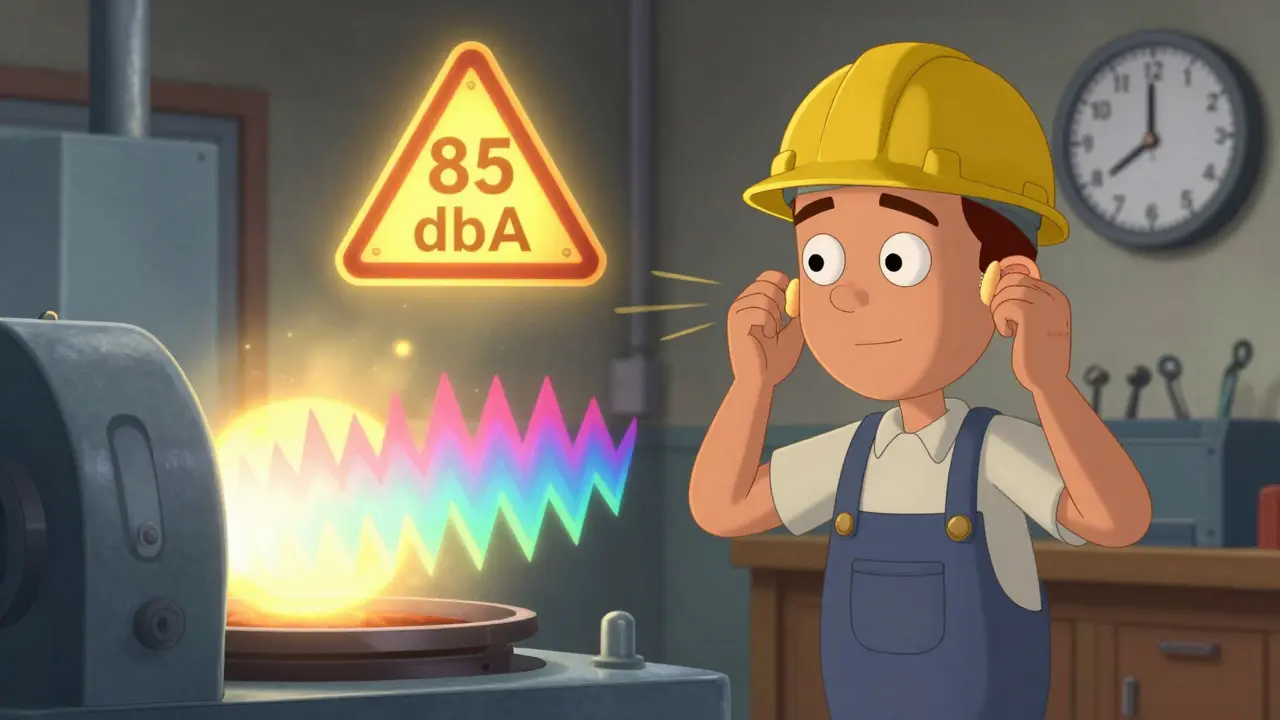
Every year, millions of people lose their hearing-not from aging, not from illness, but from something completely preventable: too much noise. Whether you’re working on a factory floor, operating a chainsaw, or standing in front of a speaker at a live concert, your ears are taking damage you can’t feel until it’s too late. The good news? We know exactly how loud is too loud, and we have the tools to stop it.
What Counts as Dangerous Noise?
Noise isn’t just about volume. It’s about time. A lawnmower at 90 decibels (dBA) might seem loud, but if you’re only mowing for 30 minutes, your risk is low. But if you’re exposed to that same noise for 8 hours straight, you’re in danger of permanent hearing loss. That’s why experts use a time-weighted average to measure exposure. The 85 dBA level is the critical line. That’s the sound of heavy city traffic, a blender on high, or a busy restaurant. The National Institute for Occupational Safety and Health (NIOSH) says anything at or above 85 dBA over an 8-hour day is hazardous. The Occupational Safety and Health Administration (OSHA) allows up to 90 dBA, but even OSHA requires employers to start protecting workers once noise hits 85 dBA. Why the difference? Because NIOSH’s standard is based on science, not politics. At 85 dBA, the risk of permanent hearing loss over a working lifetime is less than 8%. At 90 dBA, it jumps to about 25%. And here’s the kicker: noise doesn’t just add up-it multiplies. Every 3-decibel increase doubles the noise energy. That means if you’re exposed to 88 dBA, your safe exposure time drops to just 4 hours. At 91 dBA, it’s 2 hours. At 100 dBA? Only 15 minutes. This is called the 3-dB exchange rate, and it’s used by NIOSH, the European Union, and Australia. OSHA uses a looser 5-dB rate, which gives workers more time at high noise levels but ignores how quickly damage builds up.How Noise Damages Your Ears
Your inner ear is lined with tiny hair cells that convert sound waves into electrical signals your brain understands. These cells don’t grow back. Once they’re damaged by loud noise, the hearing loss is permanent. It doesn’t happen overnight. It’s slow. You might not notice it until you’re struggling to hear conversations in a crowded room or turning up the TV too loud. NIOSH studies show that workers exposed to 85-90 dBA for 20 years show clear, measurable hearing loss-especially in the 3,000 to 6,000 Hz range, where speech clarity lives. That’s why audiometric testing at work focuses on those frequencies. A shift of 10 dB or more at those points is a red flag. It means your ears are already paying the price. And it’s not just workers. Concerts, nightclubs, and even personal audio devices are major culprits. A rock concert can hit 110-120 dBA. At that level, damage can happen in under a minute. The World Health Organization recommends limiting personal audio use to 40 hours a week at 80 dBA. Most people blast their headphones at 90-100 dBA. That’s not just risky-it’s a guaranteed path to early hearing loss.Legal Limits at Work: NIOSH vs. OSHA vs. the EU
Different countries have different rules, but the science doesn’t lie. Here’s how they stack up:| Region | Action Level (dBA) | Exposure Limit (dBA) | Exchange Rate | Peak Limit (dBA) |
|---|---|---|---|---|
| NIOSH (Recommended) | 85 | 85 | 3-dB | 140 |
| OSHA (Legal) | 85 | 90 | 5-dB | 140 |
| European Union | 80 | 87 | 3-dB | 137 |
| Australia | 85 | 85 | 3-dB | 140 |
| UK | 80 | 87 | 3-dB | 137 |
NIOSH’s 85 dBA limit with a 3-dB exchange rate is the gold standard. It’s backed by decades of research showing that even small increases in noise level dramatically raise risk. OSHA’s 90 dBA limit is outdated. It’s based on 1970s data and ignores modern evidence. The EU and UK are closer to NIOSH’s standard, especially with their 87 dBA upper limit that accounts for hearing protection. California already follows NIOSH’s stricter rules-and it’s working. Hearing loss claims in the state have dropped.
What Employers Must Do
If your workplace hits 85 dBA, the law requires a hearing conservation program. That doesn’t mean handing out earplugs and calling it a day. It means a full system:- Engineering controls: Fix the source. Use quieter machines, install sound barriers, or isolate noisy equipment.
- Administrative controls: Rotate workers, limit time in noisy areas, schedule loud tasks for off-hours.
- Hearing protection: Provide earplugs or earmuffs that reduce noise by 15-30 dB. Fit matters. NIOSH found that workers who get hands-on training use protection correctly 85% of the time-up from 40% with just a pamphlet.
- Audiometric testing: Baseline hearing tests within 6 months of exposure, then yearly. Look for shifts at 2,000, 3,000, and 4,000 Hz.
- Training: Workers need to know why it matters, how to fit their gear, and how to tell if it’s working.
Manufacturing, construction, and mining are the worst offenders. In 2022, over 15,500 U.S. workers filed claims for hearing loss. The cost? Over $1 billion in workers’ compensation. That’s money spent on disability, lost productivity, and medical care-all preventable.
Concerts, Clubs, and Personal Audio
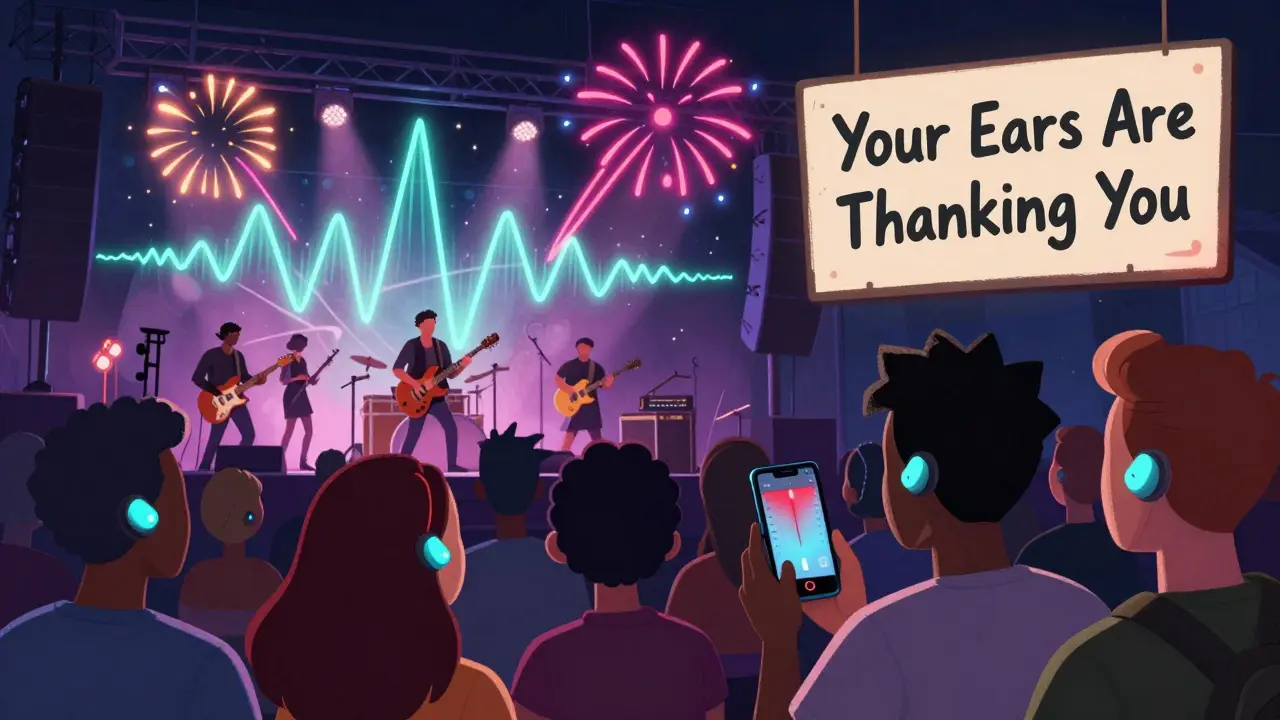
You don’t need a hard hat to lose your hearing. A 2022 survey found that 63% of professional musicians have some degree of hearing loss. Orchestral musicians face average exposures of 89-94 dBA during performances. That’s not a career hazard-it’s a public health crisis. Thankfully, change is coming. Festivals like Lifehouse now hand out free, high-fidelity earplugs-and 75% of attendees use them. Some venues have quiet zones where sound levels drop to 70-75 dBA, giving ears a break. Real-time sound displays are popping up, showing patrons how loud it is right now. Even your phone can help. Apple and Spotify now warn you when your headphone volume hits 85 dBA equivalent. And smartphone apps can now measure noise with 92% accuracy compared to professional meters. You don’t need a lab to know if you’re in danger.
What You Can Do Today
You don’t have to wait for your employer or a festival organizer to act. Here’s how to protect yourself:- Know the numbers: If it’s loud enough to make your ears ring or speech hard to understand at arm’s length, it’s too loud.
- Use earplugs: Foam ones cost a dollar. High-fidelity ones cost $20 and let you hear music clearly while cutting the damage.
- Take breaks: Every hour, step away from the noise for 5-10 minutes. Let your ears recover.
- Lower your headphones: If you can’t hear someone talking to you while wearing them, turn it down.
- Get tested: If you’re regularly exposed to loud noise, get a baseline hearing test. It’s free at many clinics.
Hearing loss is silent. It creeps up. By the time you notice, it’s permanent. But every time you put in earplugs at a concert or choose quieter tools at work, you’re not just protecting your ears-you’re protecting your future ability to hear your child’s laugh, your favorite song, or the quiet moments in between.
What’s Next?
Regulators are catching up. The European Commission is proposing new rules in 2024 to extend workplace-style protections to concert staff. NIOSH’s 2023 ‘Buy Quiet’ list now ranks 150 tools by noise level so employers can choose safer equipment. The National Institute on Deafness and Other Communication Disorders estimates that if everyone followed the 85 dBA standard, we could prevent 240,000 cases of hearing loss every year in the U.S. alone. This isn’t about regulation. It’s about choice. You can keep turning up the volume-or you can choose to hear for life.What noise level is considered dangerous for hearing?
Any noise at or above 85 decibels (dBA) over an 8-hour period is considered hazardous by NIOSH. For every 3-decibel increase, safe exposure time is cut in half. At 100 dBA, you should limit exposure to 15 minutes or less. Even short bursts above 120 dBA can cause immediate damage.
Is OSHA’s noise limit enough to protect hearing?
No. OSHA’s legal limit of 90 dBA is outdated and less protective than the science supports. NIOSH recommends 85 dBA as the safe threshold, with a 3-dB exchange rate. OSHA’s 5-dB rate allows workers to be exposed to much higher noise levels for longer, increasing the risk of permanent hearing loss by up to 700% at higher volumes, according to the American College of Occupational and Environmental Medicine.
Can earplugs really protect me at concerts?
Yes-especially high-fidelity earplugs. They reduce volume evenly across frequencies so music still sounds natural, but at safer levels. Studies show they can lower exposure by 15-25 dB. Many festivals now offer them for free, and uptake rates exceed 75% when they’re easily available.
How do I know if my hearing is already damaged?
Early signs include ringing in the ears after noise exposure, difficulty understanding speech in noisy places, or needing to turn up the TV. A hearing test can detect early damage by measuring shifts in hearing thresholds at 2,000, 3,000, and 4,000 Hz-frequencies most affected by noise. If you’re regularly exposed to loud noise, get tested yearly.
Are smartphone apps accurate for measuring noise?
Yes. Research published in JAMA Otolaryngology in 2023 found that smartphone apps can measure environmental noise with 92% accuracy compared to professional sound meters. Apps like NIOSH’s Sound Level Meter are free and reliable for personal use. They’re not lab-grade, but they’re good enough to tell you if you’re in a dangerous noise zone.
Can hearing loss from noise be reversed?
No. Once the hair cells in your inner ear are damaged by loud noise, they don’t regenerate. Hearing loss from noise is permanent. That’s why prevention is the only effective treatment. Using protection, limiting exposure, and getting regular hearing checks are your only tools to avoid it.



12 Comments
Ryan Riesterer
Per NIOSH guidelines, 85 dBA TWA-8 is the threshold for administrative controls. The 3-dB exchange rate is non-negotiable in occupational audiology - OSHA’s 5-dB model is a relic of industrial-era cost-benefit analysis, not evidence-based practice. Any employer using the latter is essentially gambling with neurosensory integrity.
Mike P
Yeah right, let’s all just wear earplugs at concerts like we’re at a library. Meanwhile, the Chinese are building factories with 100 dB ambient noise and calling it ‘economic growth.’ You think some fancy EU regulation is gonna fix that? Wake up. America’s got better things to worry about than your ears.
Sarvesh CK
It is a profound irony that while humanity has achieved unprecedented technological advancement, we remain indifferent to the preservation of one of our most fundamental sensory gifts - hearing. The erosion of auditory perception, silent and irreversible, mirrors our collective neglect of intangible values in favor of transient stimuli. Perhaps the true cost of noise is not measured in decibels, but in the quieting of human connection.
Daphne Mallari - Tolentino
How utterly pedestrian. One cannot help but observe the crass commodification of ‘hearing protection’ - as if a $20 pair of ‘high-fidelity’ earplugs somehow redeems the cultural decay of listening to music at 100 dBA through tinny AirPods. The real issue is not the decibel level, but the aesthetic bankruptcy of modern sonic consumption.
Neil Ellis
Man, I used to think my ears were fine until I went to a metal show and came out feeling like I’d been punched in the head by silence. Then I got those musician’s earplugs - mind blown. Music still hits hard, but now I can actually hear the bassline without my ears screaming for mercy. Seriously, try it. Your future self will high-five you.
Rob Sims
Oh look, another guilt-trip article for people who can’t handle the volume. You know what’s worse than loud music? Being told you’re a bad person for enjoying it. Next they’ll ban bass boosters and call it ‘hearing justice.’ Grow a pair - or at least, grow a pair of earplugs and stop whining.
arun mehta
Dear friends, let us not forget: hearing is not merely a physiological function - it is the bridge to empathy, to music, to the laughter of loved ones. 🌿 The 3-dB rule is not a suggestion; it is a covenant with our own humanity. Let us act with wisdom, not convenience. 🙏
Lauren Wall
My boss gave me earplugs and called it a day. That’s not a program - that’s negligence dressed up as compliance.
Kenji Gaerlan
who even cares? i mean like, my headphones are fine and i dont hear no ringing… unless its the beat
Tatiana Bandurina
Interesting how the article cites NIOSH and EU standards as ‘scientific’ while dismissing OSHA as ‘political.’ But the same logic would suggest that if a regulatory body’s standards are politically motivated, then their data is too. You can’t cherry-pick science when it suits you.
Philip House
Let’s be real - this isn’t about hearing. It’s about control. They want you to wear earplugs, use apps, get tested… all so they can track your exposure, monetize your data, and sell you ‘premium auditory wellness’ subscriptions. The real enemy isn’t noise - it’s surveillance capitalism.
Akriti Jain
They say 'wear earplugs'... but what if the earplugs are just a distraction so they can slip in subliminal frequency weapons? 🤔 The WHO’s 40-hour limit? Total scam. They don’t want you to hear - they want you to be numb. 🎧💣