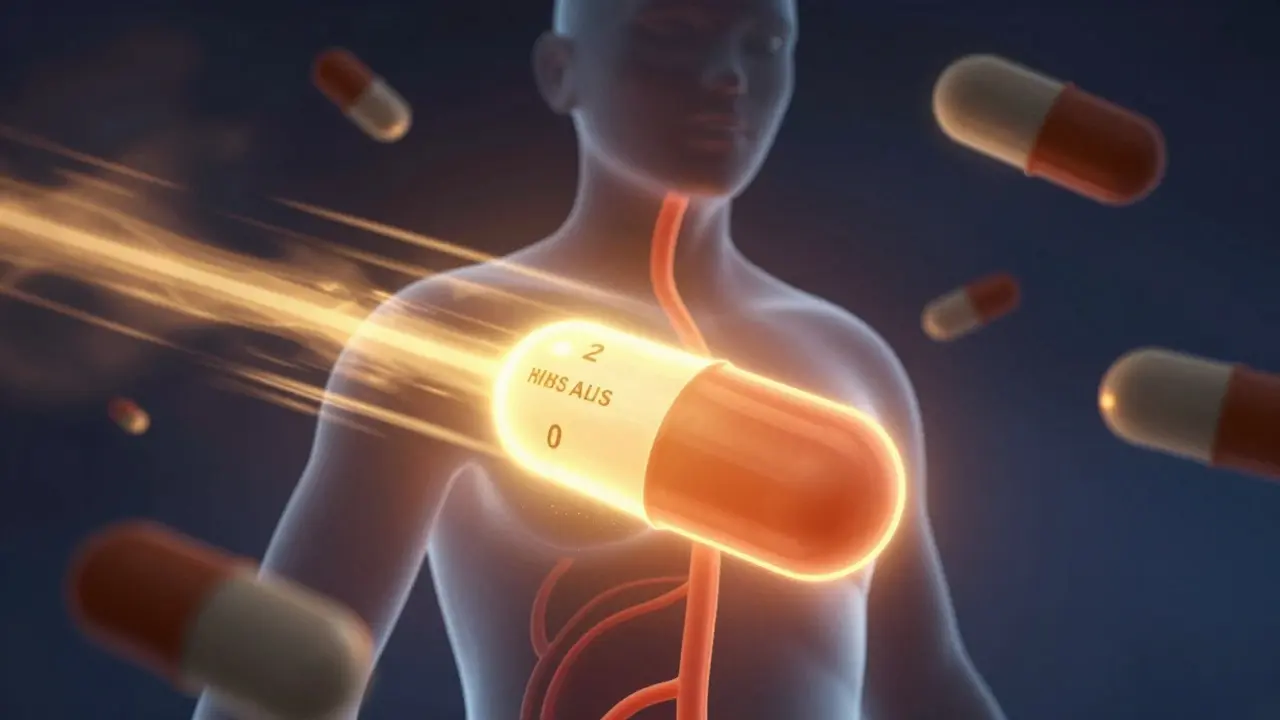
When a generic drug hits the market, it doesn’t just need to contain the same active ingredient as the brand-name version. It needs to behave the same way in your body. That’s where partial AUC comes in - a sophisticated tool used to make sure that even complex drug formulations deliver consistent, safe, and effective results. Unlike older methods that only looked at the total exposure or peak concentration, partial AUC zooms in on the most important part of the drug’s journey: the early absorption phase. This is critical for drugs where timing matters - like painkillers that need to kick in fast, or extended-release opioids that must resist abuse.
Why Traditional Metrics Fall Short
For decades, bioequivalence was judged using two simple numbers: Cmax (the highest concentration in the blood) and total AUC (the area under the entire concentration-time curve). These worked fine for simple, immediate-release pills. But when you’re dealing with extended-release capsules, abuse-deterrent tablets, or mixed-release formulas, these metrics start to miss the point. Imagine two painkillers that both reach the same peak level and have the same total exposure. One releases its drug slowly over 12 hours. The other dumps half its dose in the first hour, then tapers off. To your body, these aren’t the same. The first gives steady relief. The second might cause a spike in side effects or, worse, be easier to crush and abuse. Traditional AUC and Cmax can’t tell that difference. That’s why regulators started looking for better tools.What Is Partial AUC?
Partial AUC, or pAUC, measures drug exposure only during a specific time window - not the whole curve. This window is chosen based on clinical relevance. For example, if a drug needs to reach effective levels within 30 minutes to treat acute pain, the pAUC might cover the first 60 minutes after dosing. Or, if the goal is to prevent abuse by limiting early release, the pAUC might focus on the first 2 hours when most of the drug would be released if tampered with. The key idea is simple: focus on the part of the curve that matters most. The FDA calls this an “improved metric” because it’s sensitive to differences in absorption rates where they count - and ignores noise in later phases where the drug is just being cleared. This makes pAUC especially useful for products where timing affects safety or effectiveness.How Is It Calculated?
There’s no single way to define the time window for pAUC. The FDA allows several approaches:- Time until the reference product reaches its peak (Tmax)
- A fixed percentage of Cmax (like 50%)
- A concentration threshold (e.g., time above 10% of Cmax)
Regulatory Shifts: FDA and EMA Lead the Way
The European Medicines Agency (EMA) was the first to formally recognize pAUC’s value in 2013, specifically for extended-release formulations. They realized that many products passed traditional tests but still had different absorption profiles - a hidden risk. The FDA followed suit. By 2018, its Center for Drug Evaluation and Research launched a company-wide push to standardize pAUC use. Today, over 127 specific drug products have FDA guidance that requires pAUC analysis. That number keeps growing - in 2023, the FDA proposed adding 41 more products to the list. The most common applications? Central nervous system drugs (like ADHD meds), pain medications (especially opioids), and cardiovascular agents. For abuse-deterrent opioids, pAUC is now mandatory. Why? Because if a generic version releases too much drug too quickly when crushed, it defeats the whole purpose of the abuse-deterrent design. pAUC catches that.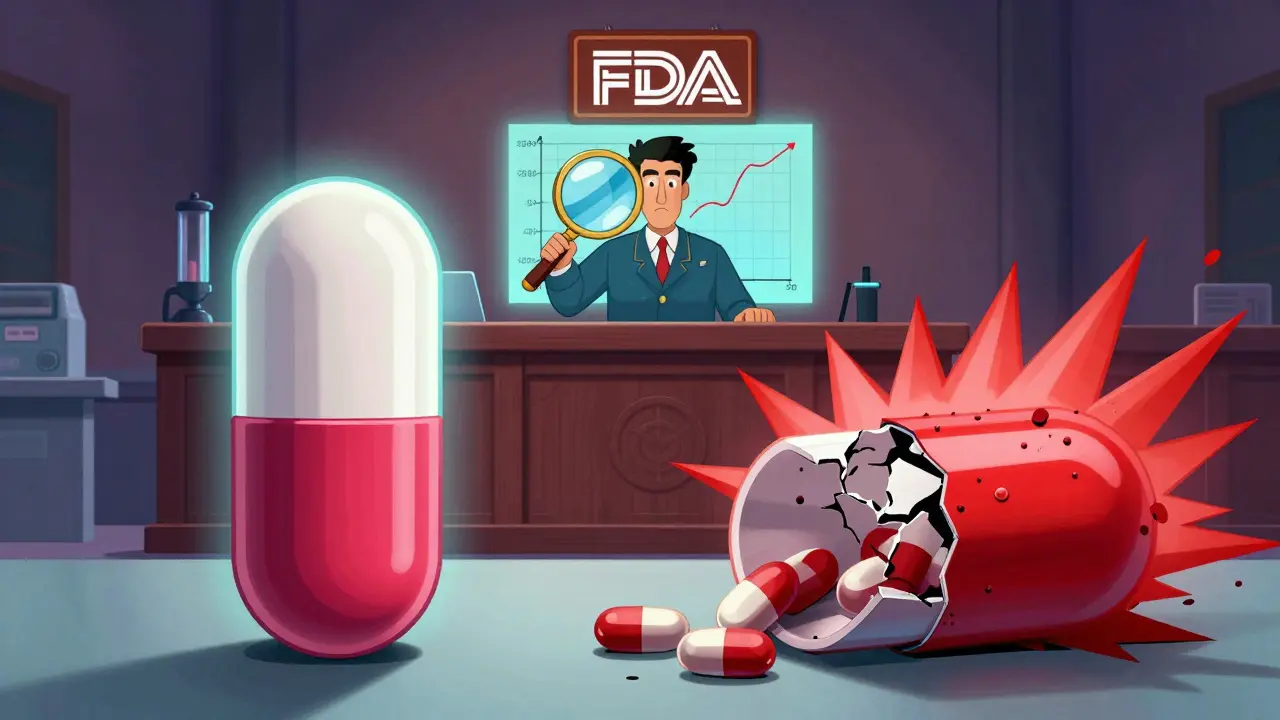
Real-World Impact: Successes and Stumbles
In 2021, a case study presented at the American Association of Pharmaceutical Scientists showed how pAUC prevented a dangerous generic from reaching patients. The test product met all traditional bioequivalence criteria - same Cmax, same total AUC. But pAUC revealed a 22% lower exposure in the first two hours. That difference meant the drug wouldn’t work fast enough for acute symptoms. It was pulled before approval. On the flip side, companies have paid a price for underestimating pAUC. In 2022, the FDA rejected 17 ANDA submissions - nearly 9% of all bioequivalence-related deficiencies - because the time window for pAUC was poorly defined. One company used a 0-4 hour window, but the reference product’s Tmax varied widely between subjects. The result? Unreliable data. Another company picked a fixed concentration cutoff without validating it across populations. Both were sent back for redesign. A senior biostatistician at Teva told the ACPAC forum that adding pAUC to their extended-release opioid study increased their budget by $350,000 and raised their sample size from 36 to 50 subjects. But they avoided a costly clinical failure down the line.Who Uses It and Why It’s Becoming Essential
pAUC isn’t used by small labs or startups. It’s a tool for large pharmaceutical companies and specialized contract research organizations (CROs). About 92% of pAUC studies are run by firms with over 500 employees. Smaller companies often outsource it because the expertise is rare. Biostatisticians now need specialized training. Industry surveys show it takes 3-6 months of focused learning to become proficient. Job postings for bioequivalence roles increasingly list pAUC as a required skill - 87% of them in 2023, up from under 20% in 2018. The global bioequivalence testing market is growing fast. In 2022, 35% of new generic drug applications included pAUC - up from just 5% in 2015. Evaluate Pharma predicts that by 2027, over half of all generic approvals will need it.Challenges and the Road Ahead
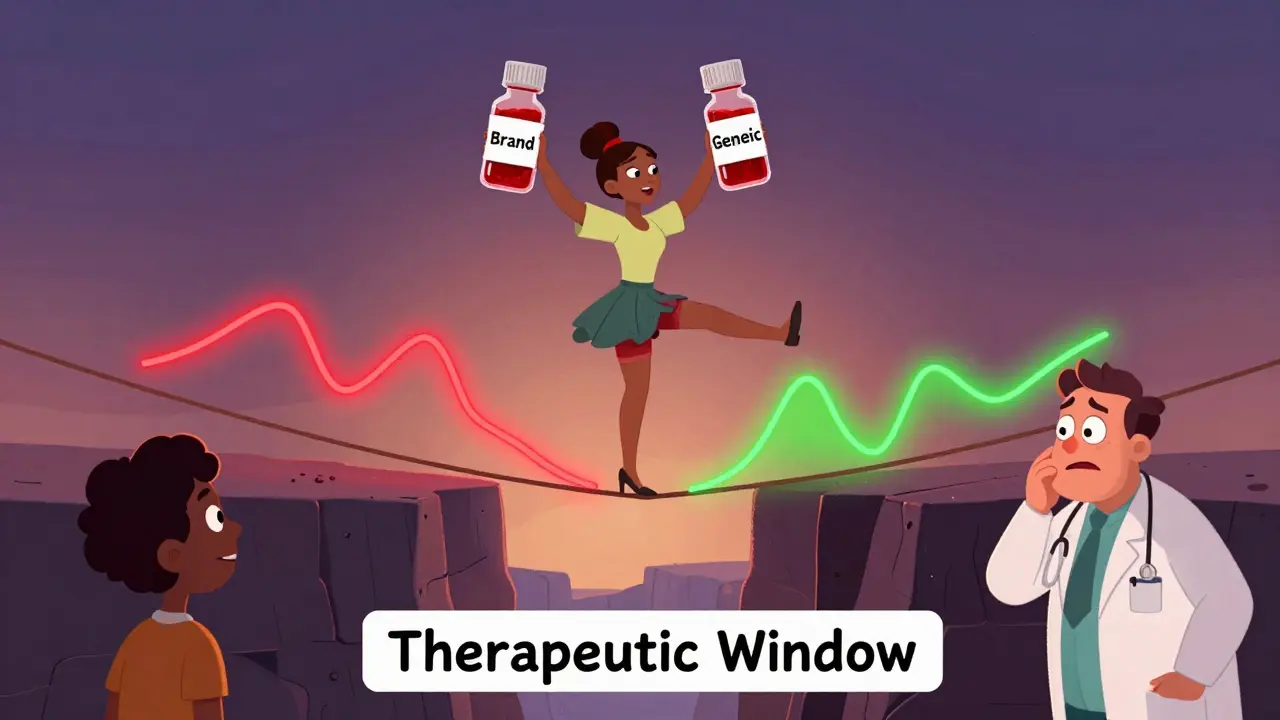
Despite its value, pAUC has big problems. The biggest? Inconsistency. The FDA’s product-specific guidances vary wildly in how they define the time window. Only 42% of them give clear instructions. That creates confusion. One company designing a generic for the U.S. market might use a 0-2 hour window. The same drug in Europe might require 0-3 hours. That adds 12-18 months to global development timelines, according to the IQ Consortium. There’s also a statistical hurdle. The Bailer-Satterthwaite-Fieller method is the gold standard for calculating confidence intervals with pAUC, but it’s complex. Many labs still use simpler methods that aren’t statistically valid - and risk approval failure. The FDA is trying to fix this. In early 2023, they launched a pilot program using machine learning to automatically determine the optimal pAUC window based on historical reference product data. If it works, it could standardize the process across products.
What You Need to Know
If you’re a patient: pAUC means safer, more reliable generics. It’s not something you’ll see on the pill bottle, but it’s why your generic painkiller works the same way every time. If you’re in pharma: pAUC isn’t optional anymore for complex drugs. Ignoring it risks rejection, delays, and lost revenue. Investing in training, statistical support, and robust study design isn’t a cost - it’s a requirement. If you’re a researcher: pAUC represents a shift from simple equivalence to clinically meaningful equivalence. It’s not just about numbers - it’s about how the drug behaves in real people, at the right time.Frequently Asked Questions
Is partial AUC required for all generic drugs?
No. Partial AUC is only required for specific drug products where traditional metrics like Cmax and total AUC aren’t enough to ensure therapeutic equivalence. This mostly applies to extended-release, abuse-deterrent, or mixed-release formulations. For simple immediate-release tablets, standard bioequivalence criteria still apply.
How does partial AUC differ from total AUC?
Total AUC measures total drug exposure over the entire time the drug is in the body - from dosing until it’s mostly cleared. Partial AUC looks only at a defined time window - often the first few hours - where absorption is happening. This makes pAUC more sensitive to differences in how quickly the drug enters the bloodstream, which matters for safety and effectiveness.
Why is pAUC more variable than total AUC?
Because pAUC focuses on a smaller portion of the concentration-time curve, small changes in sampling time, individual metabolism, or measurement error have a bigger impact. Total AUC averages out these variations over a longer period. That’s why studies using pAUC often need larger sample sizes - sometimes 25-40% more - to achieve the same statistical power.
What time window should I use for partial AUC?
The time window should be based on clinical relevance. The FDA recommends linking it to a pharmacodynamic effect - like when the drug starts working. Common approaches include using the reference product’s Tmax, a percentage of Cmax, or a concentration threshold. Always check the product-specific guidance from the FDA or EMA for the exact requirement.
Can pAUC replace Cmax and total AUC?
No. pAUC is an additional metric, not a replacement. Regulators still require Cmax and total AUC for most products. pAUC is added when those metrics alone can’t confirm that two products behave the same way in the critical early phase of absorption.
Is pAUC used outside the U.S. and Europe?
Yes, but adoption is slower. Health Canada, the TGA in Australia, and PMDA in Japan have started incorporating pAUC into some guidances, especially for complex formulations. However, regulatory inconsistency across regions remains a challenge. Many global developers still face delays because pAUC requirements aren’t aligned between agencies.
Next Steps for Industry Professionals
If you’re developing a generic drug with a complex release profile:- Check the FDA’s Product-Specific Guidance (PSG) database - over 2,000 are published, and about 15% now include pAUC.
- If pAUC is required, confirm the exact time window and statistical method. Don’t guess.
- Run pilot studies to understand the reference product’s Tmax variability.
- Partner with a biostatistician experienced in pAUC - don’t rely on general PK modelers.
- Build in extra budget and time. Sample sizes will be larger. Analysis will take longer.



13 Comments
Steve Hesketh
This is the kind of deep-dive stuff that actually saves lives, not just checks regulatory boxes. I work in pharma logistics in Nigeria, and seeing pAUC get real traction means generics here might finally be as safe as they claim. No more guessing if that cheap painkiller will kill you or help you. 🙌
MAHENDRA MEGHWAL
It is imperative to underscore the significance of pharmacokinetic precision in the context of bioequivalence assessment. The utilization of partial AUC constitutes a paradigmatic advancement in therapeutic equivalence evaluation, particularly for modified-release formulations. The statistical rigor underpinning this methodology is commendable and warrants broader global adoption.
Jarrod Flesch
Bro, I used to think all generics were just rip-offs. Then I saw a guy crush an abuse-deterrent opioid and it didn't hit like a bomb-pAUC did that. Mind blown. 🤯 Also, why do we still use 36-person studies? We got computers now. Use ML like the FDA’s pilot. Stop being lazy.
Kelly McRainey Moore
I’m a nurse and I’ve seen patients switch generics and get sick-not because the drug was bad, but because it didn’t kick in fast enough. This article finally explains why. Thank you for writing this. I’m sharing it with my whole unit.
Stephen Rock
pAUC is just corporate overengineering. They made Cmax and total AUC too simple so they could charge more for 'advanced' testing. Same shit, more paperwork. 92% of these studies are run by megacorps who want to bury small players. It's not science-it's a tax.
Amber Lane
My dad’s on an extended-release opioid. He said his old generic made him dizzy for an hour after taking it. The new one? Smooth. No idea why. Now I know. This matters.
Andrew Rinaldi
It’s fascinating how a statistical tweak can become a moral imperative. We used to measure drugs like we measured water in a bucket. Now we’re watching how the water flows-when, where, why. That’s not just science. That’s respect for the human body.
Gerard Jordan
Y’all need to stop treating pAUC like some secret sauce. It’s just good science. 🙏 Also, if you’re a small pharma startup and you’re scared of this-find a CRO. Don’t go it alone. I’ve seen too many brilliant formulas die because someone thought ‘close enough’ was good enough. 💪📊
michelle Brownsea
Let me be perfectly clear: The FDA’s inconsistent time-window definitions are not merely 'confusing'-they are a catastrophic failure of regulatory coherence. The absence of standardized, universally enforced parameters constitutes a de facto violation of the principle of equitable access to therapeutic equivalence. This is not innovation-it is bureaucratic negligence masquerading as progress.
Roisin Kelly
They’re using pAUC to hide the fact that generics are still unsafe. Big Pharma just wants to scare you into paying more. They say 'abuse-deterrent' but what they really mean is 'we’re still selling opioids and we want you to feel guilty for needing them.' I’ve seen the data-this is all a scam.
lokesh prasanth
pAUC? More like pAUCkup. They just wanna make us pay more. And why do they always pick Tmax? What if the person has slow digestion? This is just math theater.
Malvina Tomja
92% of studies run by big firms? That’s not science-it’s a cartel. And don’t get me started on the 'experts' who charge $350K to do what a grad student could do in a week. This isn’t about safety. It’s about profit. And you’re all drinking the Kool-Aid.
Yuri Hyuga
As someone who’s trained biostatisticians in 5 countries, I can say this: pAUC is the future. 🌍 It’s not perfect-but it’s the first time regulators cared more about how the drug behaves than just how much is in the blood. Invest in training. Support the CROs. This isn’t bureaucracy-it’s the difference between a patient feeling better… and feeling nothing at all. 💡❤️