
You've probably heard about the No Surprises Act, a federal law that stops you from getting a massive, unexpected bill after an emergency room visit or a surgery where an out-of-network doctor happened to be on the clock. It sounds like a safety net for all medical bills, right? Here is the catch: that protection does not apply to your prescriptions. If you walk into a pharmacy that isn't in your plan's network, you could end up paying five times more than you expected, and the law won't save you from that cost.
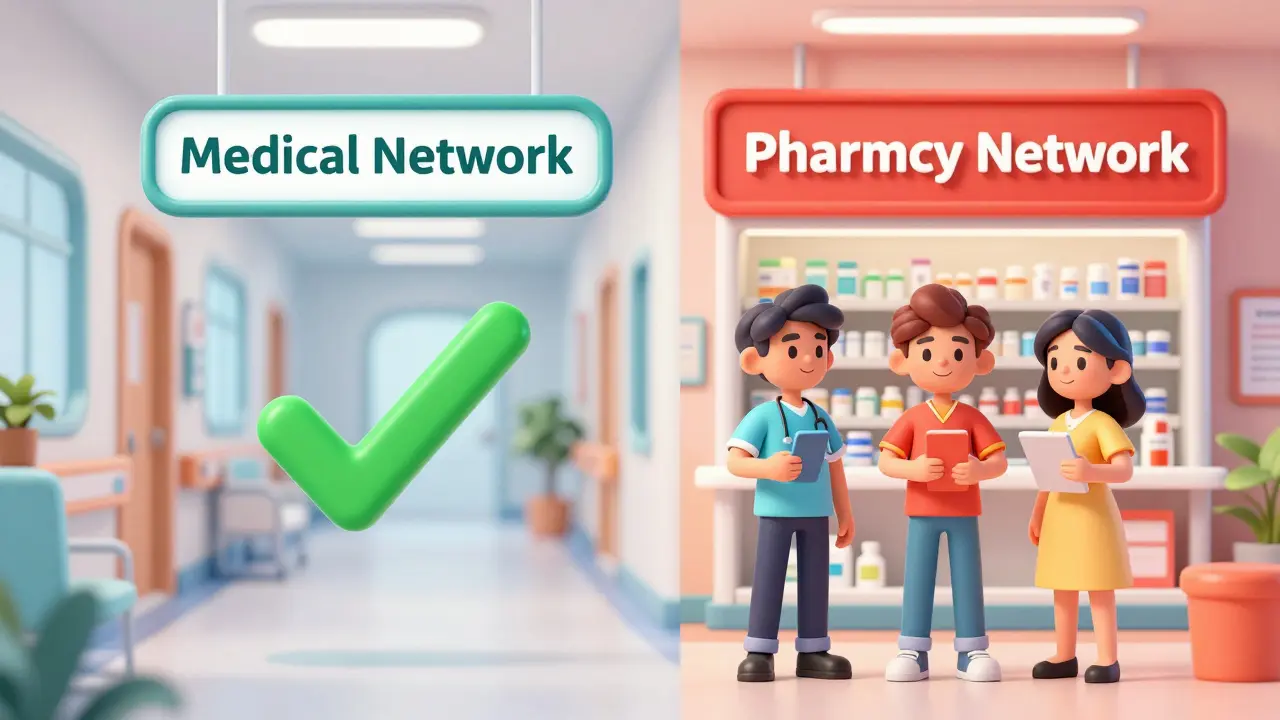
The reason for this gap is that your health insurance is essentially two different businesses. One side handles your doctor visits and hospital stays, while the other-your Pharmacy Benefit Manager (or PBM)-handles your drugs. Because PBMs operate under a completely different set of rules and contracts, you can be "in-network" for your primary care physician but "out-of-network" for the pharmacy across the street. This dual-network system is why many people experience sticker shock at the pharmacy counter.
Why Your Pharmacy Bill is Different from Your Hospital Bill
When you go to a hospital, the No Surprises Act prohibits "balance billing," which is when a provider charges you the difference between their full price and what your insurance agreed to pay. However, prescription drugs don't work through balance billing; they work through cost-sharing. When you use an out-of-network pharmacy, you aren't just paying a higher fee-you're often paying the full retail price without any of the negotiated discounts your insurance provider has secured.
Major Pharmacy Benefit Managers like CVS Caremark, Express Scripts, and OptumRx manage these networks. According to data from the Kaiser Family Foundation, about 92% of large employers use these separate PBMs. This means that even if you have a great health plan, the pharmacy network is a separate puzzle you have to solve. If you get this wrong, you aren't looking at a bill in the mail a month later; you're looking at a price on a screen at the point of sale that might be hundreds of dollars higher than your usual copay.
The High Cost of Specialty Medications
If you're taking a common generic drug, a network mistake is annoying. If you're taking a specialty medication for a chronic condition, it's a financial crisis. Many insurance plans use "limited distribution networks," meaning they require you to use one specific specialty pharmacy for high-cost drugs. If you try to fill a specialty script at a local retail pharmacy, your insurance might refuse to cover it entirely.
Experts, including those from the University of Southern California Schaeffer Center, have noted that patients often face costs 3 to 5 times higher when they are forced or accidentally directed to out-of-network specialty pharmacies. With specialty pharmacy spending projected to hit $375 billion globally by 2028, the stakes are getting higher. You can't assume that because a pharmacy is a "big name" chain, it's automatically in your network.
| Feature | Medical Services (Hospital/ER) | Pharmacy Services (Prescriptions) |
|---|---|---|
| Protected by No Surprises Act? | Yes (Emergency & some non-emergency) | No |
| Billing Method | Balance Billing (billed after service) | Cost-Sharing (paid at point of sale) |
| Network Manager | Health Insurance Provider | Pharmacy Benefit Manager (PBM) |
| Common Surprise | Out-of-network anesthesiologist bill | Full retail price instead of copay |
Proactive Steps to Avoid Pharmacy Bill Shock
Since the law doesn't protect you, you have to be your own advocate. You can't just ask a pharmacist, "Do you take my insurance?" because "taking" insurance isn't the same as being "in-network." A pharmacy might process your claim, but that doesn't mean they have a negotiated rate with your PBM.
Instead, follow these concrete steps to ensure you're getting the lowest price:
- Request the Pharmacy Network Directory: Do not rely on the general provider directory. Ask specifically for the pharmacy-only list. These are often separate documents.
- Use the Plan Finder Tool: If you're on a Medicare Part D plan, use the official Medicare Plan Finder. It helps you verify pharmacy networks separately from medical networks.
- Call Your PBM Directly: Before filling a new or expensive medication, call the number on the back of your insurance card and ask the representative to confirm the specific pharmacy address is in-network.
- Verify Specialty Requirements: If your drug is labeled as a "specialty medication," ask your doctor if it requires a specific pharmacy. Filling these at a standard retail pharmacy is the most common way people hit a network wall.

What to Do If You've Already Been Overcharged
If you've already paid an out-of-network price, you aren't completely out of luck, but it takes work to fix. Because this isn't covered by the No Surprises Act, you can't simply file a federal dispute. You'll need to pursue a "pharmacy billing dispute" through your insurance company.
Start by requesting a detailed printout of the claim from the pharmacy. This shows exactly what was billed and what the insurance paid. Then, contact your PBM and ask for a "retroactive network review." If you can prove that no in-network pharmacy was available in your area or that you were misinformed by a company representative, the PBM might agree to cover the medication at the in-network rate. While not guaranteed, the Patient Advocate Foundation has helped thousands of people navigate these disputes successfully.
The Future of Pharmacy Transparency
There is some hope on the horizon. The government is starting to realize that the gap between medical and pharmacy protections is too wide. For example, the Pharmacy Benefit Manager Transparency Act aims to force PBMs to provide real-time benefit checks. This would allow you and your doctor to see the exact cost and network status of a drug before the prescription is even sent.
Additionally, some states are taking matters into their own hands. California and New York have introduced legislation to extend surprise billing protections to pharmacies. Until those laws pass or the federal government steps in, the responsibility remains with the consumer to double-check every pharmacy visit.
Does the No Surprises Act cover my prescription drugs?
No. The No Surprises Act was designed for medical services like emergency room visits and certain hospital procedures. It explicitly excludes pharmacy benefits and prescription medications because they are managed by Pharmacy Benefit Managers (PBMs) rather than medical insurance networks.
What is the difference between "taking" insurance and being "in-network"?
A pharmacy may "take" your insurance in the sense that they will process the claim and accept payment from your provider. However, if they are not "in-network," they haven't signed a contract to provide the drug at a discounted rate. This means you will pay a much higher cost-sharing amount, often the full retail price.
Why are specialty pharmacies more confusing than regular ones?
Many insurance plans use restricted networks for specialty drugs. This means they only allow a handful of specific pharmacies to dispense these high-cost medications. If you use a pharmacy outside of this restricted list, your insurance may deny the claim entirely, even if that pharmacy is usually "in-network" for other drugs.
How can I find out if a pharmacy is in my network?
The most reliable way is to call your insurance company or PBM using the number on your member ID card. Ask them to verify the specific address of the pharmacy. You can also use official tools like the Medicare Plan Finder for Part D plans or the pharmacy-specific directory provided by your employer's health plan.
Can I get my money back if I accidentally used an out-of-network pharmacy?
It is difficult but possible. You can file a pharmacy billing dispute with your PBM. You'll need to provide the detailed claim from the pharmacy and potentially prove that there were no accessible in-network options. This is known as requesting a retroactive network review.





9 Comments
Doug DeMarco
Man, that's a rough spot to be in! Just remember you're not alone in this struggle 😊. I always tell people to double-check everything because the system is just a mess right now. Hang in there everyone! 👊
Peter Meyerssen
The systemic asymmetry here is simply a manifestation of late-stage capitalistic entropy. We are witnessing a paradigm shift where the PBMs act as the new high priests of pharmaceutical distribution, creating an artificial scarcity of affordability through complex network stratification. It is truly a banal form of exploitation 🙄. One must realize that the ontological nature of "insurance" has evolved into a mere simulation of protection while the actual fiscal burden is shifted onto the proletariat via these opaque cost-sharing mechanisms. The dialectic between the patient and the PBM is essentially a zero-sum game where the patient is always the loser. Truly pathetic how the cognitive dissonance of the average consumer allows this to persist. We are essentially paying for the privilege of being cheated by a corporate entity that operates in the shadows of federal regulation. It's an architectural failure of the health system. The fragmentation of medical and pharmacy networks is not a bug, it's a feature designed to maximize profit margins. A complete farce. 🤡
Ben hogan
Basically just another way for the elite to squeeze the peasants. Boring.
Danny Wilks
It is quite fascinating, if one maintains a certain emotional distance, how the American healthcare landscape mirrors a complex labyrinth where the walls are constantly shifting based on the whims of corporate contracts. I have observed that in many other developed nations, the pharmacy experience is far more integrated, which makes this fragmented American approach seem rather archaic when viewed through a global sociological lens.
Ryan Hogg
I can't even imagine the panic of seeing a $500 charge when you only have $20 in your account. It's just heart-wrenching. I've been through so much with my own health and every time I think I'm safe, some new bill comes and just drains the life out of me. I just can't do this anymore.
Suchita Jain
It is a matter of great concern that you all allow yourselves to be so blindsided by basic administration. One must maintain a disciplined record of all medical interactions to avoid such trivialities. It is a lack of personal spiritual and organizational discipline.
Camille Sebello
Check your mail more often!!! Who actually reads their plan docs?? Seriously!!!
Simon Stockdale
This is exactly why we need to stop letting these foreign-owned pharma companies dictate the prices in our own backyards and get the government to actually do somethin about these PBM scammers who think they can just rob us blind while we're sick and dyin in our own country and just laugh all the way to the bank in their fancy offices!
Thabo Leshoro
I feel your pain... it is so hard to navigate these complex formulary tiers... especially when the PBMs keep changing the preferred drug list... just stay strong... and keep calling those representatives... they eventually give in...