ICH Guideline Development Process Explorer
Explore how a new ICH guideline moves from concept to global standard. Click on each step to see detailed information about the process.
Expert Working Group Formation
What Happens:
A specialized group of technical experts is assembled to draft the initial proposal. This group includes representatives from regulatory authorities and industry stakeholders who collaborate to create a scientifically sound document based on current evidence and practical needs.
Key Activities:
- Literature review and data analysis
- Stakeholder identification
- Draft document creation
- Initial feasibility assessment
Real-World Example:
The development of ICH E6 (Good Clinical Practice) began with this step, bringing together experts from the US, EU, and Japan to address inconsistencies in clinical trial standards.
Imagine a world where a life-saving vaccine developed in Europe takes three years longer to reach patients in Asia simply because regulators require different safety tests. That scenario used to be common. Today, it is largely avoided thanks to the International Council for Harmonisation of Technical Requirements for Pharmaceuticals for Human Use, widely known as ICH. This organization acts as the backbone of modern global medicine, ensuring that safe, effective drugs are developed efficiently across borders.
For anyone involved in healthcare, from clinical researchers to regulatory affairs specialists, understanding these guidelines is not just academic-it is practical necessity. The ICH framework dictates how we test for toxicity, how we report clinical trials, and even how we handle real-world data after a drug hits the market. But what exactly makes these guidelines so powerful, and how do they actually protect you?
The Birth of a Global Standard
To understand why ICH matters today, you have to look back to 1990. Back then, pharmaceutical companies faced a nightmare. If they wanted to sell a new drug in the United States, the European Union, and Japan, they had to run separate sets of experiments for each region. The U.S. might want one type of carcinogenicity test, while Europe demanded another. This duplication wasted billions of dollars, delayed patient access, and subjected countless animals to unnecessary testing.
In response, regulatory authorities from these three major markets joined forces with industry representatives. They created ICH to develop unified scientific and technical guidelines. The goal was simple but ambitious: achieve greater harmonization so that medicines could be developed and registered in the most resource-efficient manner possible. By aligning requirements, they ensured that safety standards remained high while eliminating redundant hurdles.
A major shift occurred in October 2015 when ICH transformed from a collaborative forum into a non-profit legal entity under Swiss law. This change expanded its governance structure and global reach, allowing more countries to join as full members rather than just observers. It signaled that global harmonization was no longer just a suggestion-it was becoming the standard operating procedure for the entire pharmaceutical industry.
How the Five-Step Process Works
You might wonder how a guideline becomes binding across continents. ICH uses a rigorous five-step process designed to build consensus before any rule is enforced. This isn’t a top-down mandate; it is a collaborative effort involving technical experts, regulators, and industry stakeholders.
- Step 1: Expert Working Group Formation. A group of experts drafts the initial proposal based on scientific evidence and practical needs.
- Step 2: Consultation. The draft opens for public comment. Regulators and industry partners provide feedback, pointing out potential flaws or implementation challenges.
- Step 3: Finalization. The working group revises the document based on feedback. Once all members agree, the guideline is finalized.
- Step 4: Adoption. Regulatory members commit to implementing the guideline in their respective jurisdictions. This is the critical moment where policy meets practice.
- Step 5: Implementation. The guideline goes into effect. Companies must comply, and regulators begin enforcing the new standards.
This structured approach ensures that by the time a guideline like ICH E6 (Good Clinical Practice) is implemented, everyone-from the lab technician to the senior regulator-understands its intent. It prevents the chaos of conflicting rules and creates a predictable environment for drug development.

The Four Pillars: Quality, Safety, Efficacy, and Multidisciplinary
ICH guidelines are organized into four core categories, often referred to by their letter codes. Understanding these categories helps you navigate the vast library of over 60 finalized guidelines.
| Category Code | Focus Area | Key Example |
|---|---|---|
| Q | Quality | Manufacturing controls and stability testing |
| S | Safety | Preclinical toxicology and genotoxicity studies |
| E | Efficacy | Clinical trial design and reporting |
| M | Multidisciplinary | Bioequivalence and medical terminology |
The Safety (S) guidelines are particularly crucial for medication safety. For instance, ICH S1 addresses carcinogenicity testing, helping scientists determine if a drug candidate could cause cancer. Adopted in November 2000, it was one of the earliest harmonized standards. These guidelines specify which tests are necessary and which can be skipped, reducing animal use without compromising human safety.
The Efficacy (E) guidelines govern how we prove a drug works. ICH E6, or Good Clinical Practice (GCP), is perhaps the most famous. It establishes international ethical and scientific quality standards for clinical trials involving human subjects. When you see "conducted in accordance with ICH-GCP" on a study report, it means the trial met rigorous standards for data integrity and patient protection.
Real-World Impact: Beyond the Lab
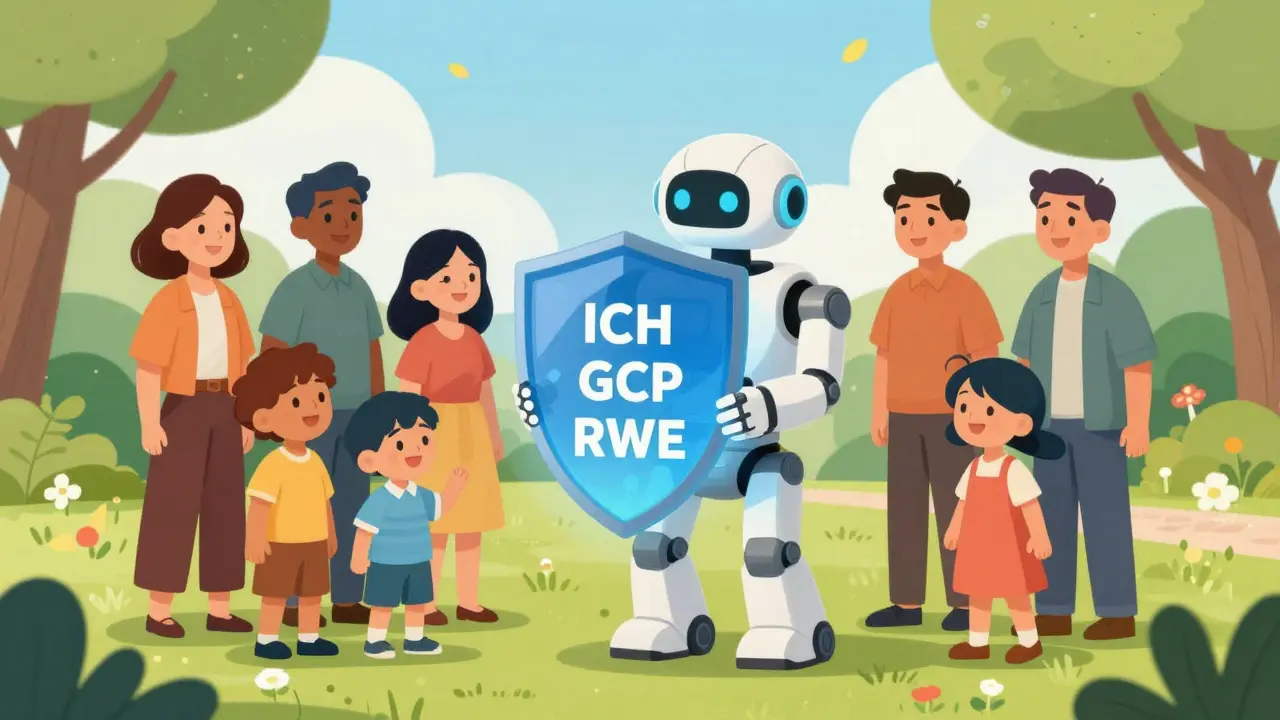
Harmonization does not stop once a drug is approved. Recent developments show ICH expanding into post-marketing surveillance and real-world evidence (RWE). In June 2024, the ICH Assembly adopted a reflection paper on RWE, co-sponsored by the FDA, EMA, and Health Canada. This initiative aims to harmonize terminology and establish general principles for planning and reporting studies using real-world data.
Why does this matter? Traditionally, drug safety was monitored through controlled clinical trials. However, rare side effects often only appear when millions of people take a medication in diverse settings. By creating standardized ways to collect and analyze this real-world data, ICH enables regulators to detect safety signals faster and more accurately. It bridges the gap between theoretical efficacy and practical safety.
Another recent milestone is ICH M13A, focused on bioequivalence for immediate-release solid oral dosage forms. Implemented by the UK’s Medicines and Healthcare products Regulatory Agency (MHRA) in June 2024, this guideline simplifies the approval process for generic drugs. It ensures that generics perform identically to brand-name drugs in the body, making essential medicines more affordable and accessible without sacrificing quality.
Global Adoption and Emerging Challenges
The power of ICH lies in its widespread adoption. The U.S. Food and Drug Administration (FDA) implements all ICH guidelines as official guidance documents. Similarly, the European Medicines Agency (EMA) incorporates them into its scientific guidance framework. The UK’s MHRA transitioned to full membership in May 2022, further solidifying ICH’s role beyond the original tripartite foundation.
However, challenges remain. While major markets like the U.S., EU, and Japan have high compliance rates, implementation in emerging economies can lag. Some guidelines take years to progress through the five steps, potentially delaying benefits for new therapeutic areas. Additionally, rapidly evolving technologies like gene therapies and AI-driven drug development pose questions that current frameworks may not fully address.
Despite these hurdles, the economic and ethical incentives for continued participation are strong. As the FDA notes, international harmonization reduces the time to get a product to market and prevents unnecessary duplication of clinical trials. This efficiency translates directly to faster access to life-saving treatments for patients worldwide.
Practical Tips for Navigating ICH Guidelines
If you are new to regulatory affairs, the volume of ICH documentation can feel overwhelming. Here are some practical steps to stay compliant and informed:
- Start with the Basics. Familiarize yourself with ICH E6 (GCP) and ICH Q7 (Good Manufacturing Practices). These form the foundation of most pharmaceutical operations.
- Monitor Step 4 Updates. Check the official ICH website regularly for newly adopted guidelines. Pay attention to the implementation timelines for your specific region.
- Leverage Q&A Documents. Regulatory agencies often publish Questions and Answers documents to clarify complex points. For example, the FDA has published detailed clarifications for ICH E3 (Clinical Study Reports).
- Engage with Industry Groups. Organizations like the International Federation of Pharmaceutical Manufacturers and Associations (IFPMA) provide valuable insights into industry trends and interpretation of guidelines.
Remember, ICH guidelines are living documents. They evolve as science advances. Staying updated is not just about compliance-it is about contributing to a safer, more efficient global healthcare system.
What is the primary purpose of ICH guidelines?
The primary purpose is to harmonize technical requirements for pharmaceuticals across major regulatory jurisdictions. This ensures that safe, effective, and high-quality medicines are developed and registered efficiently, reducing duplication of efforts and accelerating patient access.
Are ICH guidelines legally binding?
ICH guidelines themselves are not laws. However, they become legally binding when adopted by individual regulatory authorities. For example, the FDA and EMA implement them as official regulations or guidance documents, making compliance mandatory for companies operating in those regions.
Which ICH guideline covers clinical trial ethics?
ICH E6, also known as Good Clinical Practice (GCP), is the key guideline. It defines international ethical and scientific quality standards for designing, conducting, recording, and reporting trials that involve human subjects.
How does ICH help reduce animal testing?
By harmonizing preclinical safety guidelines (such as ICH S1-S11), ICH eliminates the need for duplicate animal studies in different countries. Regulators accept data generated under these unified standards, significantly reducing the total number of animals used in research without compromising safety assessments.
What is the latest major addition to ICH guidelines?
As of mid-2024, significant updates include ICH M13A on bioequivalence for solid oral dosage forms and a reflection paper on real-world evidence (RWE). These reflect ICH's expansion into post-marketing surveillance and simplified generic drug approvals.