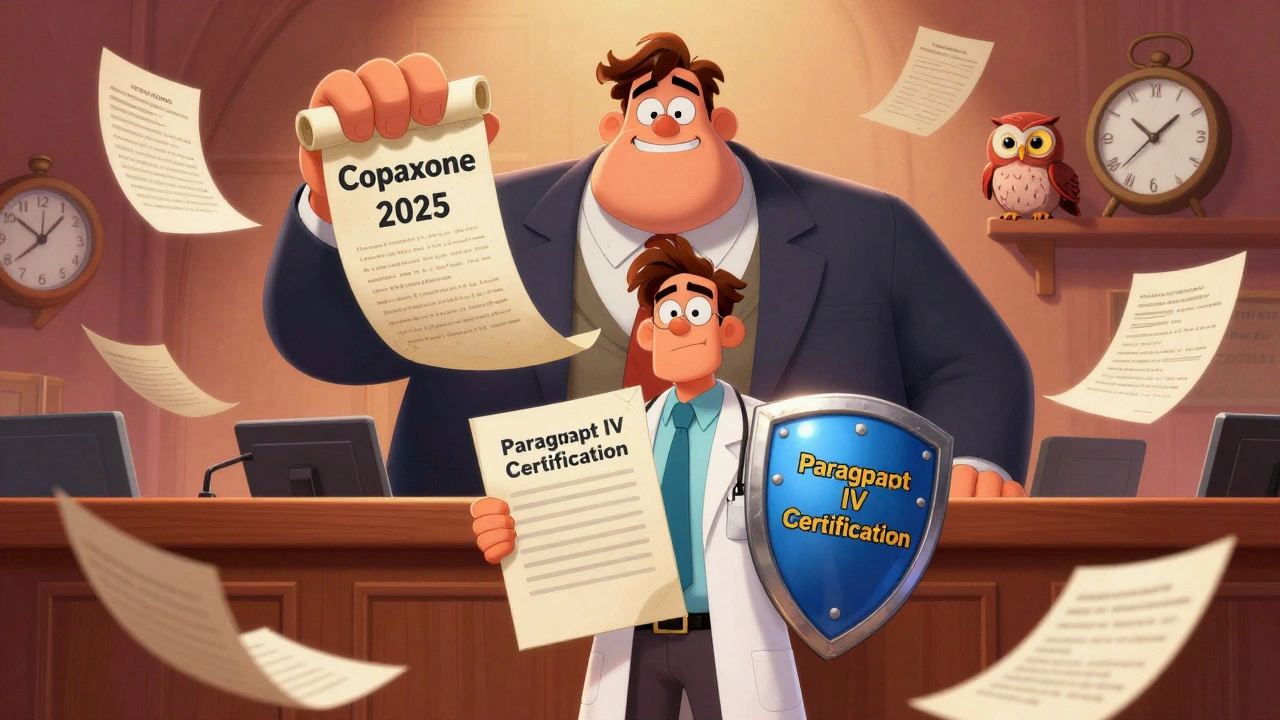
When a brand-name drug’s patent is about to expire, a race begins-not for speed, but for legal strategy. Generic drug makers don’t wait for the patent to fade away. They file a Paragraph IV certification with the FDA, directly challenging the validity of those patents. This isn’t a loophole. It’s a legal tool built into U.S. drug law since 1984, designed to force competition and slash prices. And it works. Today, 90% of prescriptions in the U.S. are filled with generics, even though they make up just 23% of total drug spending.
What Is a Paragraph IV Challenge?
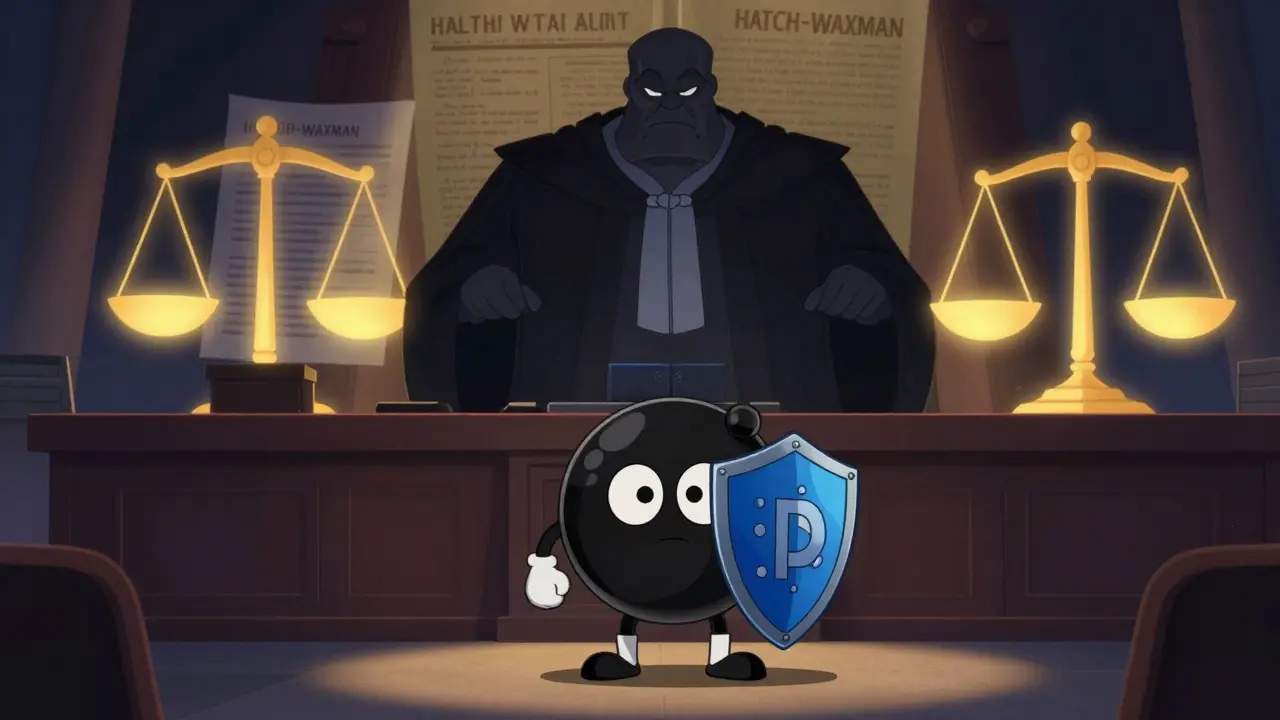
A Paragraph IV challenge is a formal notice filed by a generic drug company when it submits an Abbreviated New Drug Application (ANDA) to the FDA. The company certifies that one or more patents listed for the brand drug in the FDA’s Orange Book are either invalid, unenforceable, or won’t be infringed by the generic version. This isn’t a guess. It’s a legal declaration backed by evidence-often prior art, flawed claims, or lack of novelty.This act is treated as an artificial act of patent infringement under U.S. law. That means the brand company can sue. But here’s the twist: the generic company doesn’t need to wait for permission. It just needs to file the paperwork and notify the patent holder within 20 days. The brand then has exactly 45 days to respond with a lawsuit. If they do, the FDA can’t approve the generic for up to 30 months-unless the court rules the patent is invalid sooner.
Why Do Generic Makers Risk It?
The reward? A 180-day window of exclusive market access as the first generic to win the challenge. That’s not just a head start-it’s a financial jackpot. During that time, the first filer typically captures 70-80% of the entire generic market. Teva made $1.2 billion during its exclusivity period for generic Copaxone in 2017. Mylan took 75% of the generic EpiPen market in 2016. That kind of profit doesn’t come from selling cheap pills. It comes from being the only one allowed to sell them.But the cost is steep. The average Paragraph IV lawsuit now runs $15.7 million per case, up from $5 million in 2000. Smaller generic companies often can’t afford it. That’s why the top 10 generic manufacturers now file 68% of all Paragraph IV challenges-up from 52% in 2015. The barrier to entry isn’t just science. It’s money.
How Do They Win?
Winning isn’t about having the cheapest pill. It’s about finding weak patents. Generic makers spend years studying the Orange Book, looking for patents that don’t hold up under scrutiny. A patent on a pill’s color? Probably not valid. A patent on a dosing schedule that’s been used for decades? Likely obvious. A patent filed just before the original one expired? That’s a red flag.They also dig into prior art-old studies, published research, even expired patents that prove the drug or its method wasn’t new. In one case, a generic company showed that a brand’s patent on a drug delivery system was already described in a 1980s academic paper. The court invalidated it in 18 months.
And they must prove bioequivalence. The FDA requires that the generic drug performs the same way in the body as the brand. That means testing 24-36 healthy volunteers in crossover studies, measuring blood levels of the drug over time. The generic’s absorption rate (AUC) and peak concentration (Cmax) must fall within 80-125% of the brand’s. No wiggle room. No shortcuts.
The 30-Month Stay: A Double-Edged Sword
The 30-month regulatory stay sounds like a delay tactic for brand companies. And sometimes, it is. But it’s also a safety valve. It gives courts time to decide without forcing the FDA to approve a drug that might later be blocked by a patent ruling. The problem? Many cases take longer than 30 months. In 2023, the average litigation lasted 32 months-longer than the law allows. That means the generic sits on the shelf, waiting, while the brand keeps selling at high prices.Some companies try to stretch the timeline. They file multiple patents on the same drug-sometimes over 40. That’s called a “patent thicket.” Copaxone had 40+ patents. It’s not about protecting innovation. It’s about blocking competition. The FDA has cracked down since 2020, reducing the average number of patents per drug by 23%. But thickets still exist.
Settlements and Pay-for-Delay
Most Paragraph IV cases-72%-never go to trial. They settle. And for years, those settlements looked suspicious. Brand companies would pay the generic maker to delay launch. That’s called “pay-for-delay.” The FTC called it anti-competitive. In 2013, the Supreme Court ruled in Actavis that these deals could violate antitrust law.Since then, settlements have changed. Now, they usually include a date for generic entry-no later than 75 days before the patent expires. No cash payments. No delays. The FTC found that pay-for-delay deals dropped from 78% of settlements in 2010-2014 to just 15% in 2015-2020. The system’s cleaner, but not perfect. Some deals still hide behind royalty agreements or licensing terms.
Who Benefits?
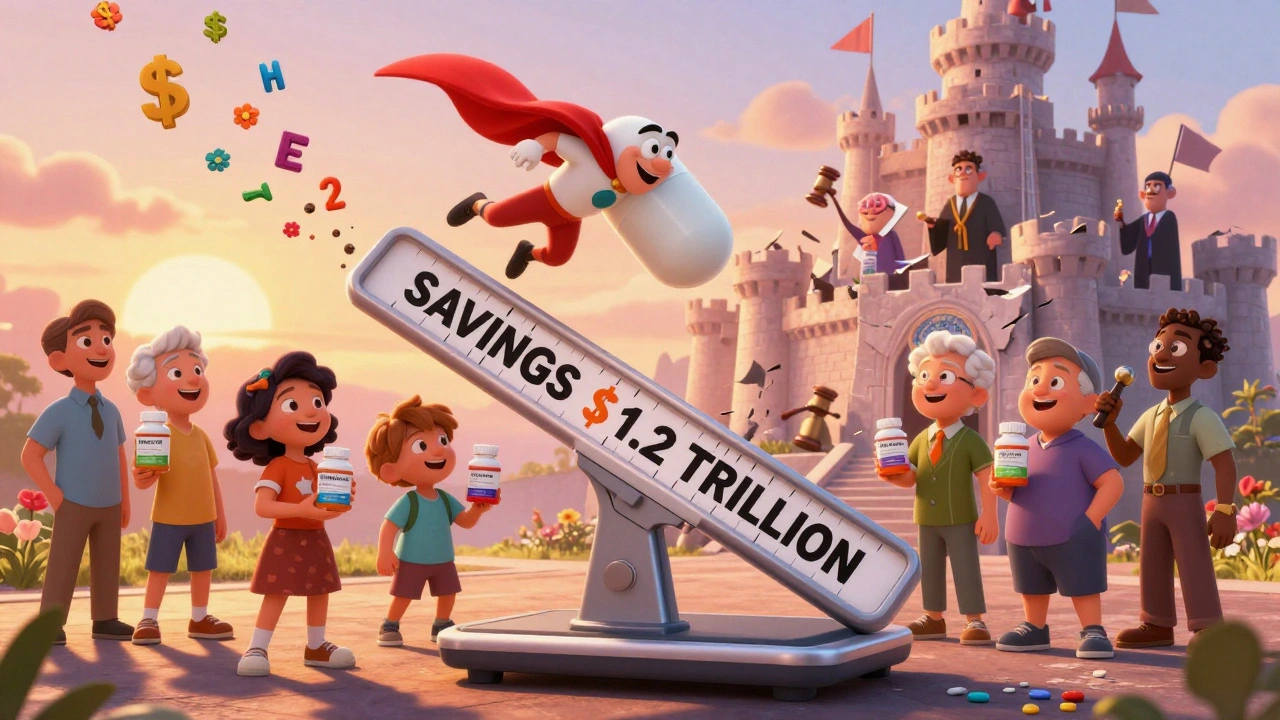
Consumers. The healthcare system. The economy. Since 1990, Paragraph IV challenges have saved U.S. patients more than $1.2 trillion. In 2022 alone, each successful challenge saved $13.7 billion per drug. That’s billions in lower out-of-pocket costs, fewer insurance claims, and more affordable prescriptions.Doctors benefit too. They can prescribe generics without worrying about cost barriers. Patients stick to their regimens. Chronic conditions like diabetes, hypertension, and high cholesterol become manageable. The ripple effect is massive.
What’s Changing Now?
The Inflation Reduction Act of 2022 gave Medicare power to negotiate prices for the most expensive drugs. That’s a game-changer. If a brand drug’s price is capped by Medicare, the financial incentive to delay generics shrinks. Analysts predict a 15-20% rise in Paragraph IV challenges for top Medicare drugs by 2025.Also, the FDA is getting tougher on “evergreening.” Drugs approved after 2020 have fewer patents. The agency now requires that each listed patent actually covers the drug’s active ingredient, formulation, or approved use-not minor changes like a new tablet shape or a different flavor.
And new targets are emerging. Generic makers are now challenging abuse-deterrent formulations and 505(b)(2) drugs-those that tweak existing drugs slightly. These used to be off-limits. Now, they’re fair game. Evaluate Pharma predicts a 30% jump in these challenges by 2027.
The Future of Generic Competition
Paragraph IV challenges are not going away. In fact, 92% of generic manufacturers say the system is essential to their business. But it’s under pressure. Litigation costs are rising. Patent thickets are still common. And the 30-month stay often becomes a 32-month delay.The real question isn’t whether the system works. It does. The real question is whether it’s fair. Should a company be able to extend monopoly pricing for years by filing 20 patents on the same pill? Should a generic maker risk $15 million on a lawsuit just to get a 180-day window?
For now, the balance still holds. Generic makers keep pushing. Courts keep ruling. The FDA keeps updating rules. And patients keep getting cheaper drugs. That’s the point. The system isn’t perfect. But it’s the only one we have that actually works.
What is a Paragraph IV certification?
A Paragraph IV certification is a legal statement filed by a generic drug company with the FDA, declaring that a brand drug’s patent is invalid, unenforceable, or won’t be infringed by the generic version. This triggers the Hatch-Waxman Act’s patent challenge process and allows the generic to seek approval before the patent expires.
How does a Paragraph IV challenge affect FDA approval?
When a Paragraph IV challenge is filed, the FDA cannot approve the generic drug for up to 30 months if the brand company sues within 45 days of notification. The approval is blocked until the court rules on the patent or the 30-month period ends-whichever comes first. If the patent is invalidated early, approval happens immediately.
Why do generic companies risk a lawsuit?
The first generic company to successfully challenge a patent gets 180 days of exclusive market access. During that time, they capture 70-80% of the generic market, often earning hundreds of millions in revenue. This exclusivity period makes the high cost of litigation worthwhile for large generic manufacturers.
What’s the difference between a Paragraph IV challenge and an IPR?
A Paragraph IV challenge is filed in federal district court as part of the FDA approval process and triggers a 30-month stay on drug approval. An Inter Partes Review (IPR) is handled by the Patent Trial and Appeal Board (PTAB) and doesn’t delay FDA approval. IPRs are faster (18 months) but don’t guarantee market access-only patent invalidation.
Do Paragraph IV challenges lower drug prices?
Yes. Since 1990, Paragraph IV challenges have saved U.S. consumers over $1.2 trillion. Each successful challenge typically reduces the price of a drug by 80-90% within months of generic entry. In 2022, these challenges saved $13.7 billion per drug on average.
Are Paragraph IV challenges only for small-molecule drugs?
Yes. Paragraph IV challenges apply only to traditional small-molecule drugs approved under the New Drug Application (NDA) pathway. Biosimilars and biologics use a different process under the Biologics Price Competition and Innovation Act (BPCIA), which allows patent challenges but without the 180-day exclusivity.

15 Comments
Shayne Smith
So generics are basically the ultimate hack of the pharma system. Wild that we let this happen.
pallavi khushwani
I love how this system forces innovation to actually mean something. If your patent is just a color change or a new tablet shape, you don’t get to block the world from affordable medicine. It’s not a loophole-it’s justice.
Gwyneth Agnes
180 days of monopoly for generics? That’s just as bad as the brand companies
Kay Jolie
Let’s be real-the entire Hatch-Waxman Act is a beautifully engineered economic grenade. You give generics a shot at 180-day exclusivity, and suddenly the patent thicket collapses like a house of cards. The only people who hate this? The ones who profit from stagnation.
Priya Ranjan
India should be ashamed. Our generic manufacturers are the reason the West can afford insulin. We build medicines for the world while our own people die waiting for pills. This isn’t innovation-it’s exploitation dressed as charity.
Ashish Vazirani
Wait-so American companies are suing Indian generic makers for challenging patents that were written by lawyers who didn’t even understand the science? And we’re the ones being called ‘copycats’? This is colonialism with a FDA stamp on it. 180 days? They should get 180 months. And the $15M lawsuit cost? That’s just a parking ticket for Big Pharma.
Myles White
It’s fascinating how the 30-month stay was meant to be a buffer but has become a de facto extension of patent life. The FDA’s 2020 crackdown on evergreening was a step forward, but the fact that some drugs still have 40+ patents suggests we’re still playing whack-a-mole with legal loopholes. And let’s not forget that the cost of litigation has skyrocketed because Big Pharma now hires teams of patent attorneys who specialize in dragging out cases just to exhaust the generics’ funding. The system was designed to promote competition, but now it’s a financial endurance test where only the biggest players can survive. Smaller companies? They either get bought out or give up. And that’s not competition-that’s consolidation with a side of legal theater.
Nava Jothy
Pay-for-delay is still happening, just with fancy names now. Royalty agreements? Licensing deals? Please. It’s the same old bribe, just dressed in a suit. And don’t tell me the FTC’s numbers are clean-they’re based on what’s visible. The real deals? Hidden in offshore shell companies. I’ve seen the spreadsheets. The money doesn’t disappear. It just changes addresses.
Billy Schimmel
So the system works… but only if you’re rich enough to afford the lawsuit. That’s not capitalism. That’s a rigged game where the house always wins unless you bring a bank with you.
Mansi Bansal
One must observe, with a degree of clinical detachment, that the structural imbalance inherent in the Paragraph IV framework incentivizes predatory litigation strategies under the veneer of public health advocacy. The 180-day exclusivity window, while ostensibly a market-based reward, functions as a monopolistic rent-seeking mechanism that perpetuates inequity under the guise of competition. Furthermore, the bioequivalence thresholds-80-125%-are statistically indefensible as a proxy for therapeutic equivalence, particularly for narrow-therapeutic-index drugs. The FDA’s regulatory framework, though well-intentioned, remains dangerously naïve in its assumption that pharmacokinetic similarity equates to clinical safety. This is not innovation. It is regulatory arbitrage dressed in the clothing of consumer welfare.
Nigel ntini
What’s incredible is how this system quietly saves lives every single day. People don’t realize that the $5 insulin they’re buying? That’s because someone spent years in a courtroom, not a lab. The real heroes aren’t the CEOs-they’re the patent lawyers and bioequivalence testers who work for pennies while Big Pharma rakes in billions. We need more of this. Not less.
brenda olvera
Generics are the quiet revolution. No one throws parades for them. No one makes movies about them. But every time someone chooses a $4 pill over a $400 one, that’s a victory. And it’s because of this system. Don’t let anyone tell you it’s broken. It’s working exactly as designed-for the people.
Geraldine Trainer-Cooper
Patents are supposed to protect innovation not delay death
olive ashley
Ever notice how every time a new generic hits, the brand company suddenly releases a ‘new and improved’ version with a slightly different shape and a 30% price hike? Coincidence? Or is the whole thing a pyramid scheme where the real product is the patent paperwork?
Kenny Pakade
Why do we even let foreigners make our medicine? This isn’t competition-it’s national security risk. If China or India controls the supply chain, they control our health. And now they’re using legal tricks to undercut us? We need tariffs. On pills.