
Imagine sitting in a doctor's office and trying to remember the exact dose of that one pill you take on Tuesdays, or why your specialist told you to stop taking a certain medication three months ago. It's a stressful scramble that happens to millions of people, and it's where dangerous mistakes often start. A Medication Action Plan is a structured document designed to bridge the communication gap between you and your healthcare providers. Rather than relying on memory, this tool turns your medication routine into a clear, written contract that ensures everyone-from your GP to your pharmacist-is on the same page.
Quick Summary for Your Next Visit
- Bring everything: Your current plan, a full list of meds, and the actual pill bottles.
- Update in real-time: Cross out old meds and add new ones with exact dates during the appointment.
- Be specific: Replace "take as directed" with concrete instructions like "Take 500mg with breakfast."
- Share the wealth: Give copies to family members and every specialist you visit to prevent duplicate therapies.
What Exactly is a Medication Action Plan?
At its core, a Medication Action Plan (MAP) isn't just a list of drugs; it's a strategic tool used in Medication Therapy Management (MTM) programs. In the US, the Centers for Medicare & Medicaid Services (CMS) standardized this process to help patients resolve medication problems and hit specific health goals. It's a living document that evolves as your health changes.
Why does a formal template matter more than a handwritten note? Because standardization saves lives. Research shows that when patients use a standardized template, nearly 88% can find critical medication information on the first try. Even more striking, the Agency for Healthcare Research and Quality (AHRQ) found that these plans can cut adverse drug events by up to 23%. When you use a template, you aren't just listing pills; you're implementing a safety system.
Breaking Down the Template: What to Look For
Not all templates are the same, but the most effective ones-like those used by CareSource or the CDC-contain a few non-negotiable sections. If your template is missing these, you might want to add them in manually.
First, there's the "What we talked about" section. This is where you and your provider document the clinical discussion. Instead of leaving the office and forgetting why a dose was changed, you have it in writing. Then, look for the "What I need to do" boxes. This is the heart of the plan. Avoid vague phrases. A plan that says "Take metformin 500mg with breakfast" leads to 34% higher adherence than one that simply says "Take as directed."
You also need a tracking area, often labeled "What I did and when I did it." This helps your provider spot patterns. If you've missed three doses of a blood pressure med in two weeks, your doctor needs to know that *before* they decide to increase your dosage. Finally, always have a "Questions I want to ask" space. Writing these down before you enter the room ensures you don't forget that nagging concern about a side effect once the white coat is standing in front of you.
| Section Name | Purpose | Example of High-Quality Entry |
|---|---|---|
| Clinical Discussion | Records the "Why" behind changes | "Increased Lisinopril due to BP reading of 150/95" |
| Action Steps | Concrete instructions for the patient | "Take 1 tablet of Atorvastatin at 8 PM daily" |
| Adherence Tracker | Monitors actual usage | Checkmarks for Mon-Sun or date/time logs |
| Symptom Criteria | Triggers for as-needed (PRN) meds | "If rash appears and itches, apply ointment every 6 hours" |
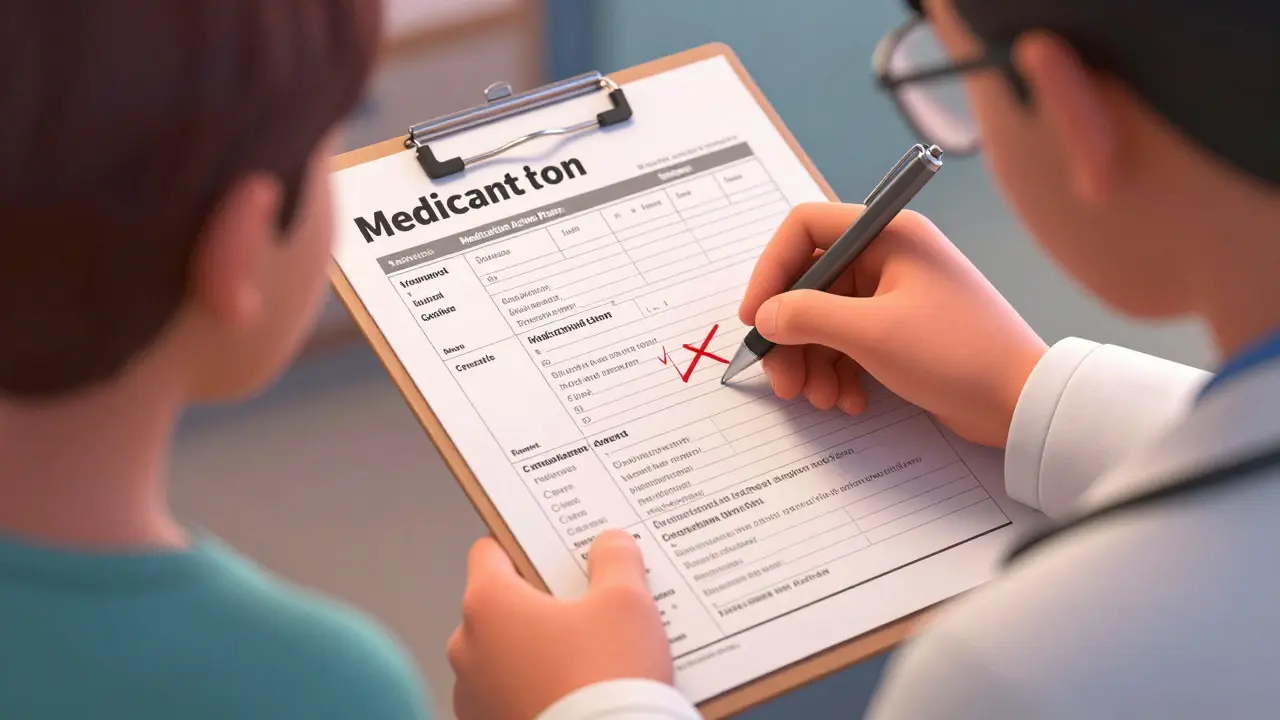
How to Use the Plan During Your Visit
Having the paper in your hand is only half the battle. To make the visit productive, you need a specific protocol. Start by handing the MAP to your provider the moment you sit down. Ideally, the first 5 to 7 minutes of the encounter should be dedicated to reviewing this document. If you're seeing a pharmacist, expect them to spend a few minutes specifically analyzing your adherence patterns in the tracking section.
One of the biggest mistakes people make is treating the MAP as a static form. It should be a "living document." As you discuss changes, your provider should update the list in real-time. This means crossing out discontinued medications and adding new ones with exact start and stop dates. The Institute for Safe Medication Practices (ISMP) warns that failing to document the exact date a med was stopped is a primary cause of reconciliation errors in outpatient care.
Don't forget the "brown bag" method. Bring your actual medication containers along with the MAP. Comparing the physical bottle to the written plan improves accuracy by over 37% compared to just relying on memory. This is especially critical for high-risk medications, such as those that increase fall risks in older adults, which usually require a dedicated 8-12 minute assessment during the visit.
Real-World Wins and Common Pitfalls
The difference between a well-used MAP and a forgotten piece of paper can be life-changing. Consider the case of Mary Thompson, a patient who started bringing her MAP to every specialist. During a routine check-up, her cardiologist noticed she was taking two different blood pressure medications that shouldn't be combined-a mistake that could have led to a serious hospitalization if not caught.
However, it's not always seamless. A common struggle is health literacy. Not everyone finds medical jargon easy to navigate. If you struggle with the terms, ask your pharmacist to spend 15-20 minutes teaching you how to use the plan during your first setup. This initial investment of time makes a massive difference; patients who receive this training are more than twice as likely to keep their plans updated correctly between visits.
Another pitfall is the "lost paper" syndrome. Many elderly patients find full-sized templates cumbersome. A great pro tip from practicing pharmacists is to create a laminated, wallet-sized version of the most critical information. It doesn't replace the full MAP, but it ensures that if you're in an emergency room, the most vital data is instantly accessible.

Post-Visit: Turning the Plan into Action
The work doesn't end when you leave the clinic. The most important step happens in the parking lot: distributing the information. You should immediately share the updated MAP with your other doctors, your primary care provider, and your family or caregivers. Sharing the plan across multiple providers has been shown to reduce duplicate therapies by nearly 23%.
Set up a simple system at home to maintain the plan. Use a checkmark system for missed doses so you have an honest record for your next visit. If you prefer digital tools, that's fine, but be aware that for many people-especially those over 65-paper remains the most reliable and preferred format for these specific health records.
What should I do if my doctor says they don't have time to review my plan?
Politely remind them that the plan is designed to prevent medication errors and save time in the long run. Mention that it contains a pre-written list of questions and your adherence history, which actually makes the diagnostic process faster. If they still resist, ask if your pharmacist can review it first and send a summary to the doctor's office.
Can I use a digital app instead of a paper template?
Yes, as long as the app allows you to export a clear, printable summary that your doctor can sign. Many providers still prefer paper because they can physically cross out meds and write notes during the visit. If using an app, ensure it includes the specific "What I need to do" and "Symptom Criteria" sections found in standardized templates.
How often should the Medication Action Plan be fully updated?
It should be treated as a living document and updated at every single healthcare encounter where medications are discussed. However, a comprehensive review-similar to a Comprehensive Medication Review (CMR)-should happen at least once a year to ensure all goals of therapy are still aligned with your current health status.
What do I do if I notice a discrepancy between the MAP and my pill bottles?
Do not change your dose until you speak with a provider. Mark the discrepancy clearly on the MAP (e.g., circle it and write "Bottle says 20mg, Plan says 10mg") and make it the first item you discuss during your visit. This is exactly why bringing the bottles to the appointment is so critical.
Who is authorized to sign a Medication Action Plan?
According to CMS regulations, the plan must be signed by the authorized prescriber (such as your doctor or nurse practitioner) and the patient or their legal guardian. This signature confirms that both parties agree on the goals and the specific actions required to meet them.
Next Steps for Different Scenarios
If you are a caregiver: Your priority is the distribution of the plan. Ensure you have a copy in your car or phone at all times and maintain a master folder with the most recent version from every specialist the patient sees.
If you have multiple chronic conditions: Focus heavily on the "Symptom Criteria" section. Make sure your provider defines exactly what symptoms should trigger an as-needed medication so you aren't guessing during a flare-up.
If you are starting a new medication: Request a 15-minute education session with your pharmacist to integrate the new drug into your MAP, specifically noting potential side effects and the exact date you start the therapy.








12 Comments
william wang
The brown bag method is honestly a game changer for anyone dealing with multiple specialists. I've seen so many people get confused by generic packaging or old labels, so having the actual bottle right there removes all the guesswork. It's a simple step that prevents a huge amount of stress during the appointment.
Rock Stone
Let's get this organized people! Just start small and you'll feel so much more in control of your health journey.
Ben Ferguson
Oh, the absolute tragedy of the fragmented healthcare system is truly a spectacle to behold, isn't it? I recall a time when I had to navigate three different clinics in one week, and the sheer chaos of trying to explain my regimen to a doctor who had never seen my primary care notes was practically a theatrical performance in itself, which is exactly why these standardized templates are not just helpful but absolutely essential for the modern patient who finds themselves caught in the crossfire of mismatched electronic records and indifferent administrative staff who simply cannot grasp the gravity of a medication error!
Anna BB
It's so interesting how a piece of paper can shift the power dynamic in a clinic... it really makes you think about how we advocate for ourselves!!!! I love the idea of a living document... so organic!!
Michael Lewis
Stop letting doctors rush you through your appointment. If they say they don't have time to look at your plan, you need to stand your ground because your safety is more important than their schedule.
Maggie Graziano
pharma just wants us tracked
Nell O'Leary
Totally agree on the MTM aspect! 💊 Using a standardized template definitely reduces the risk of polypharmacy issues and helps with therapeutic reconciliation during transitions of care. So helpful! 😊
Nathan Berlin
imagining you need a piece of paper to remember pills lol 🤡 western medicine is such a joke 🇮🇳
Colleen Tankard
The wallet-sized version is such a cute and practical idea! 🌸✨
Sophia Rice
I tried doing this last month but I keep loseing my papers haha. Maybe the lamination thing would help me stay more organized!
Bonnie Piersall
Listen up! You've got to get your ducks in a row before you step foot in that office. It's a total whirlwind in there and if you don't have your list, you're just winging it. Get that template sorted, get it signed, and don't let those white coats glaze over the details. It's your body, your rules, and your health on the line. Stop playing Russian roulette with your prescriptions and start acting like the CEO of your own wellness. It's not rocket science, it's just basic organization. If you can manage a grocery list, you can manage a MAP. Just do it. Now. No more excuses. Grab a folder, print the form, and start crossing out the junk you don't need. Your future self will thank you for not having a meltdown in the waiting room because you forgot the name of that one weird blue pill. Get it together!
Theresa Griffin MEP
Consistency is mandatory. Adherence saves lives.