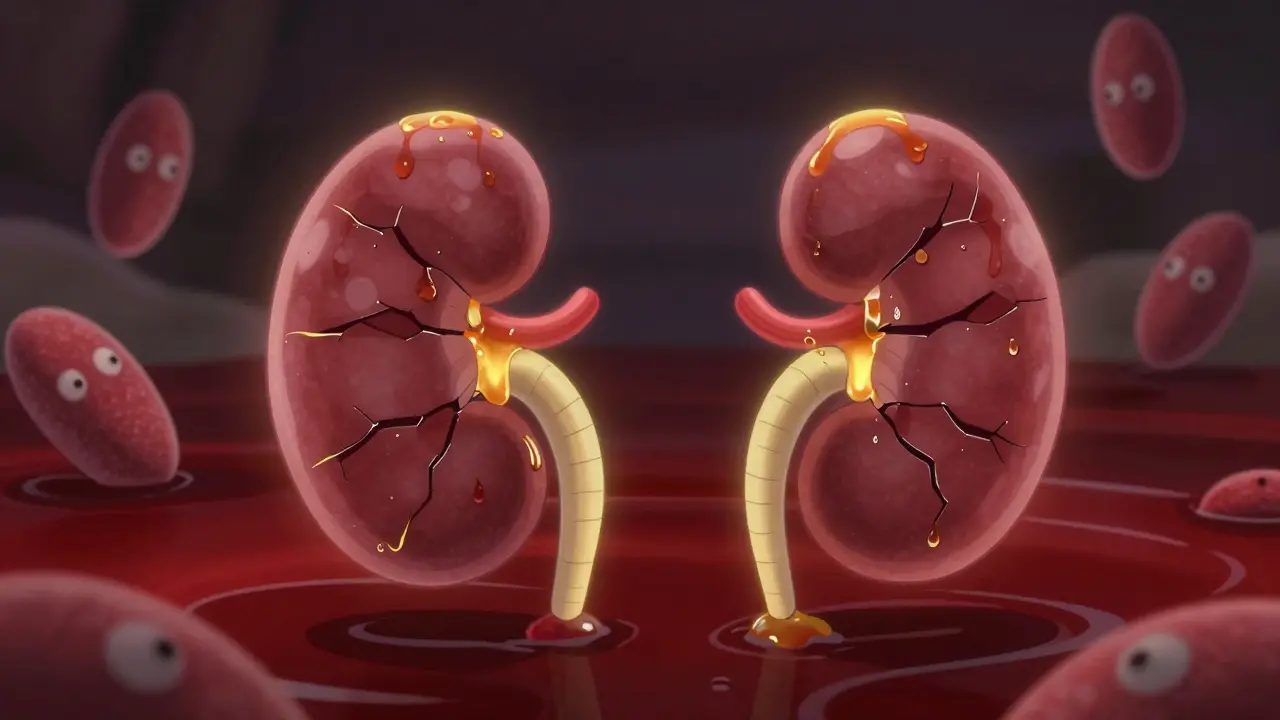
When your kidneys fail, your body loses its ability to clean your blood. Toxins build up, fluids pile up, and your whole system starts to shut down. This isn’t a sudden event-it’s usually the end of a long, silent process. The three biggest reasons this happens? Diabetes, hypertension, and glomerulonephritis. Together, they cause nearly 80% of all kidney failure cases in the U.S. And the scary part? Many people don’t know they’re on this path until it’s too late.
Diabetes: The Silent Killer of Kidneys
Diabetes doesn’t just affect your blood sugar. It slowly destroys your kidneys. In fact, it’s the number one cause of kidney failure worldwide. About 44% of new cases of end-stage renal disease (ESRD) come from diabetes, according to the U.S. Renal Data System. That’s nearly half of all people starting dialysis.
Here’s how it happens: High blood sugar over years forces your kidneys to work harder. Your glomeruli-the tiny filters in your kidneys-start to stretch and leak. This isn’t normal. Healthy filters keep protein in your blood. When they get damaged, protein spills into your urine. That’s the first warning sign: albuminuria. A urine test can catch this before you feel any symptoms.
By the time someone feels tired, swollen, or nauseous, the damage is often advanced. Studies show that 30% of people with type 1 diabetes and 40% with type 2 diabetes will develop kidney disease. The structural damage is clear under the microscope: thickened basement membranes, swollen glomeruli, and scarred tissue. And it’s not just about sugar. High glucose also starves kidney cells of energy. Mitochondria-the power plants inside kidney cells-produce 30-50% less ATP within weeks of uncontrolled diabetes. That means your kidneys literally run out of fuel.
The good news? Early action works. Getting your HbA1c below 7% in the first five years of diagnosis cuts kidney disease risk by over 50%. And newer drugs like SGLT2 inhibitors (empagliflozin, dapagliflozin) don’t just lower blood sugar-they protect the kidneys directly. The EMPA-KIDNEY trial showed a 32% drop in kidney failure risk. For many, this means avoiding dialysis altogether.
Hypertension: The Pressure That Breaks Filters
High blood pressure is the second leading cause of kidney failure. It’s responsible for 28% of ESRD cases. And here’s the twist: many people with kidney damage from high blood pressure don’t even know they have it. Hypertension doesn’t hurt. It doesn’t make you feel sick. It just quietly crushes your kidney’s blood vessels.
When your blood pressure stays above 140/90 mmHg for years, the small arteries leading to your kidneys thicken and harden. This is called arteriolar hyalinization. Less blood gets through. The glomeruli, starved of oxygen and nutrients, start to die. Studies show that 60-70% of hypertensive kidney disease cases have scarring in more than a quarter of their filters. This is called global glomerulosclerosis.
And it gets worse when diabetes and high blood pressure team up. The Framingham Heart Study found that 75% of diabetic patients develop hypertension. Together, they accelerate kidney damage by almost 80% compared to diabetes alone. While diabetes alone causes a decline of about 1.8 mL/min/1.73m² in kidney function per year, the combo pushes it to 3.2 mL/min/1.73m². That’s like losing a full year of kidney health every 18 months.
Controlling blood pressure is your best defense. The KDIGO guidelines recommend a target below 130/80 mmHg for people with kidney disease. But for those with protein in their urine, even lower-below 120/80-is better. ACE inhibitors and ARBs are the go-to drugs. They don’t just lower pressure-they actually reduce protein leakage and slow scarring. And the earlier you start, the more you save.
Glomerulonephritis: When Your Immune System Attacks Your Kidneys
Unlike diabetes and hypertension, glomerulonephritis isn’t about wear and tear. It’s an attack. Your immune system, confused or overactive, turns on the glomeruli. This triggers inflammation. Blood and protein leak into urine. Swelling appears. And if it’s not caught, the filters scar and die.
This isn’t one disease. It’s a group. The most common type? IgA nephropathy. It affects 2.5 to 4.5 people per 100,000 every year, depending on where you live. Asian populations see higher rates. It often starts with a sore throat or cold, followed by dark, cola-colored urine. Many patients see seven different doctors over 18 months before getting diagnosed. One Reddit user wrote, “I thought I had the flu. Turns out, my kidneys were failing.”
Another major form is lupus nephritis. About half of people with lupus develop it. If it’s Class IV (the worst type), there’s nearly a 30% chance of kidney failure within 10 years. The damage shows up as immune deposits stuck in the glomeruli-visible only with special staining under a microscope.
What makes this tricky? Progression varies wildly. Some people with IgA nephropathy never progress. Others lose kidney function in 10 years. The Oxford MEST-C score helps predict this. A score of 0-1 means 50% kidney survival at 20 years. A score of 4-5? Only 20%.
Treatment is aggressive. Steroids, immunosuppressants, and newer drugs like rituximab can cut ESRD risk by nearly half. But there’s debate. Some experts warn that strong immune suppression in older patients increases infection risks without clear kidney benefit. Others say early, targeted therapy can prevent over three years of dialysis per person. It’s a balance-and it needs expert care.
How Fast Do These Conditions Progress?
Not all kidney failure happens at the same speed.
Diabetic kidney disease moves fastest. If you have macroalbuminuria (over 300 mg of protein in your urine), you have a 44% chance of reaching kidney failure in five years. Microalbuminuria? Still 8%. Normal? Just 1%.
Hypertensive kidney disease is slower. It takes an average of 12.3 years from diagnosis to ESRD. But if you’re diabetic and hypertensive? That drops to 8.7 years.
Glomerulonephritis? Wildly unpredictable. IgA nephropathy can take 20 years to cause failure-or just 5. It depends on the type, how much protein leaks, and whether you get the right treatment.
What Can You Do to Protect Your Kidneys?
You can’t undo damage, but you can stop it from getting worse. Here’s what works:
- Test your urine for albumin yearly if you have diabetes or high blood pressure. A simple dipstick or urine albumin-to-creatinine ratio (UACR) test catches early damage.
- Keep your HbA1c under 7%. If you’re diabetic, ask about SGLT2 inhibitors or finerenone-both are proven to protect kidneys.
- Control blood pressure. Aim for under 130/80. If you have protein in your urine, aim for 120/80. ACE inhibitors or ARBs are first-line.
- For glomerulonephritis, see a nephrologist early. Biopsy may be needed to confirm the type and guide treatment.
- Don’t ignore symptoms. Foamy urine, swelling in legs, unexplained fatigue, or high blood pressure that won’t budge? Get checked.
Medication adherence is a big hurdle. Only 58% of people stick with their ACE inhibitors after a year. Diet matters too. Most patients struggle to eat just 0.8 grams of protein per kilogram of body weight. Too much protein? It stresses damaged kidneys. Too little? You risk muscle loss. It’s a tightrope.
The Bigger Picture
More than 850 million people worldwide have some form of kidney disease. The cost in the U.S. alone? $124 billion a year. Diabetic ESRD patients cost Medicare $96,000 per year-more than hypertension-related cases. And the gap is growing. In low-income countries, only 10% of people with kidney failure get dialysis. In high-income nations, it’s 95%.
The future? Better drugs. Finerenone, approved in 2023, cuts kidney failure risk by 18% in diabetics. Sparsentan, coming in 2024, may reduce proteinuria by nearly 50% in glomerulonephritis. New biomarkers like urinary TNF receptor-1 can predict kidney failure with 89% accuracy-long before traditional tests show anything.
But the real win? Prevention. The Lancet Commission on kidney health says 30-50% of future kidney failures could be avoided with early detection and simple interventions. That’s not science fiction. It’s what we already know works.



8 Comments
Tom Sanders
I read this whole thing and honestly? I’m just glad I don’t have diabetes. My dad went through dialysis for three years before he passed. Nobody told him it could’ve been slowed down. Just said 'take your pills.' Like that’s enough.
Philip Mattawashish
You people act like this is some new revelation. Kidney failure? It’s just what happens when you let corporations sell you sugar and salt until your organs turn to mush. The system doesn’t want you healthy-it wants you on meds for life. SGLT2 inhibitors? More profit for Big Pharma. They’ll sell you a miracle drug while your kidneys rot. Wake up.
Erica Santos
Wow. So we’re now treating kidney disease like a moral failure? Like if you just ‘tried harder’ you wouldn’t have protein in your urine? I’ve got a friend with type 1 who’s been on insulin since age 7, eats clean, exercises, and still hit stage 4. Guess she just didn’t care enough. Thanks for the enlightenment.
Dan Mayer
i read this and i think the real problem is that no one tests their urine. like seriously. my bro got diagnosed with kidney issues because he forgot to pay his water bill and went to the bathroom at a gas station and saw foam. then he went to the er. that’s not a joke. it happened.
Jazminn Jones
The clinical data presented here is both statistically robust and clinically actionable. However, one must critically interrogate the underlying epistemological assumptions: namely, that biomedical reductionism-focusing exclusively on HbA1c thresholds and glomerular filtration rates-obscures the socio-structural determinants of renal pathology. The neoliberal healthcare apparatus commodifies prevention while systematically disinvesting in primary care infrastructure. Thus, while the pharmacological interventions cited are empirically valid, their accessibility remains a function of socioeconomic privilege, not clinical need.
Nicholas Gama
They’re lying about the 80%. The real number is 92%. The CDC hides it because if people knew how bad it is, they’d riot. And don’t get me started on the SGLT2 drugs-those are just Trojan horses for the globalist agenda to implant tracking chips under your skin via the pill coating.
Mary Beth Brook
If you're not running a full metabolic panel and a 24-hour urine protein test annually, you're playing Russian roulette with your kidneys. America's complacency is a national security threat. We outspend every other country on healthcare and still let this happen? Pathetic. We need mandatory screening. Like, now.
Neeti Rustagi
This is such an important post. I work in public health in India, and we see so many patients who only come in when they’re swollen and breathless. The cost of a UACR test is less than $1 here, yet 70% never get it. Education is the real medicine. Thank you for writing this with clarity. Let’s get this into schools, clinics, temples. Prevention is possible.